

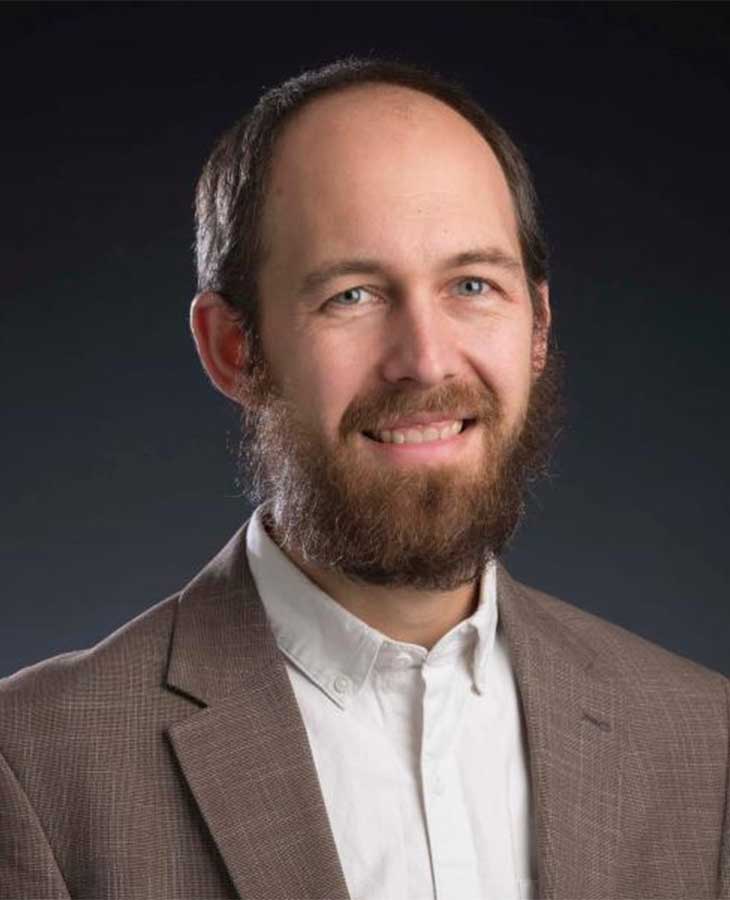
OSU biology professor expands science education with free Soundlab web app
Friday, July 31, 2026
Media Contact: Jet Turner | Associate Director of Marketing and Communications | 405-744-9559 | jet.b.turner@okstate.edu
Twigs snap underfoot as the sun just disappears behind the horizon. Dr. Michael Reichert leads his team of students around McPherson Pond, everyone watching and listening for the croak of a gray treefrog.
Water sloshes as a couple of students trudge into the pond, their overall-like waders keeping them dry as they search for the source of all the calls surrounding them.
Finally, they spot one. The headlamps and flashlights click off. A directional microphone is pointed at the frog and its croaks are recorded. For about 15 minutes they stand in complete silence and darkness listening, recording and playing calls back to hear how the frog responds.
Once the recordings are finished, the frog is captured and taken back to the lab for measurements. Days later, it’s released back into McPherson Pond.
Reichert, an associate professor with the Oklahoma State University Department of Biology, studies animal communication and cognition, looking at both the mechanisms and functions of these traits. While not everyone can participate in the depth of research happening in Dr. Reichert’s lab, spectrogram technology very similar to what he and his students use is now free and available to the public thanks to a National Science Foundation (NSF) CAREER grant.
SoundLab, co-developed with Galactic Polymath, is a free web-based tool, allowing anyone to record any sound and see it visually, analyze its frequency, collect data and even graph multiple samples.
“It’s really interactive, not dry like a textbook,” Reichert said. “Students will naturally want to experiment with it once they see what the tool does. It just connects much more with scientific concepts, so it allows you to see things like what the frequency of a sound is, which is basic physics and biology.”
Two video lessons were developed by Reichert — with doctoral candidate Rachel Jacks and undergraduate student Shelby Hardy helping create a third video, turning the project into a learning opportunity for them as well.
This project encompassed an essential part of Jacks' research. Each chapter of her dissertation requires her to analyze spectrograms of frog mating calls, and in the field she’s constantly creating mental spectrograms to help her notice the subtleties of the calls she hears.
Jacks mostly helped with workshopping and recording the scripts for the video lessons, learning how difficult it can be to produce research content that can reach multiple audiences while being engaging and informative.
But for Jacks, the hard work was worth it.
“Free access to research and learning tools is so important because science is for everyone,” Jacks said. “It already has a reputation for being difficult to understand, and sometimes even boring, so we need to do everything we can to make it easy to access.”
The lessons are written and prepared for high school biology students and are designed to meet state education standards.
These lessons include: The Science of Croaks: Tradeoffs in the Love Language of Frogs, SoundLab: The Free Web App That Lets You See Sound and Spectrogram Explained: Seeing the Sounds of a Swamp.
“It’s important to understand science and to learn about the natural world and support education,” Reichert said. “That’s beneficial for everything. It’s critical to have a good understanding of sciences, and so anything that we can do to help support students to do that is really important.”
SoundLab is available for free at soundlab.sciencemusic.org.