

OSU professor earns National Science Foundation award for conservation research
Wednesday, November 4, 2026
Media Contact: Jet Turner | Associate Director of Marketing and Communications | 405-744-9559 | jet.b.turner@okstate.edu
Key Facts
Oklahoma State University biology professor Dr. Bo Zhang received a $249,856 National Science Foundation award as part of a $550,000 collaborative conservation research project.
The three-year project investigates how habitat fragmentation affects wildlife populations and how species traits influence their ability to survive in isolated habitats.
Zhang’s research combines laboratory experiments, mathematical modeling and long-term field data to predict how wildlife populations respond to habitat fragmentation.
OSU researchers are collaborating with scientists at the University of Central Florida and Ohio State University and three state wildlife agencies to improve conservation planning.
The NSF-funded project supports graduate and undergraduate research and will develop a research-based course open to OSU biology majors.
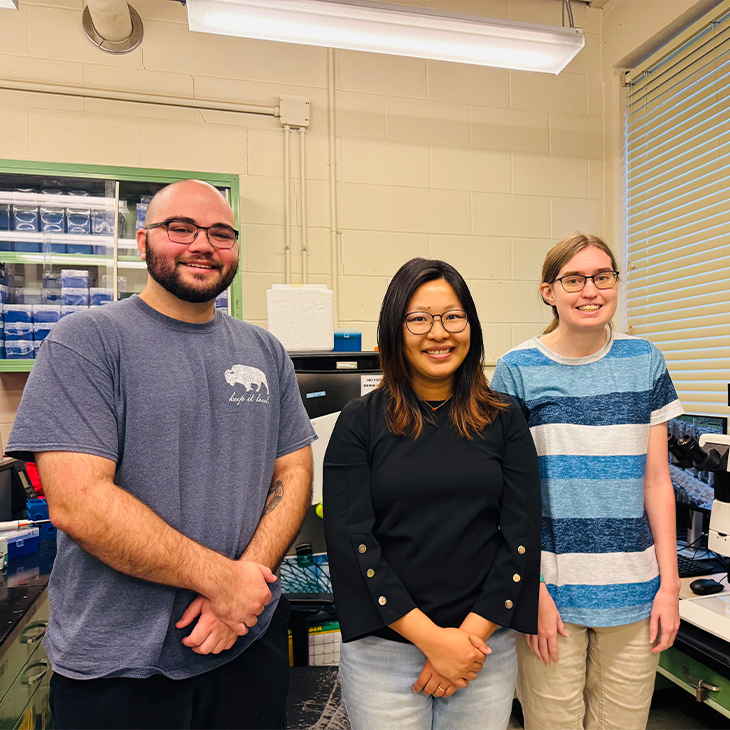
Dr. Bo Zhang, an assistant professor of biology at Oklahoma State University, has received a National Science Foundation award to study how habitat fragmentation affects wildlife populations with different traits and how that information could help conservationists protect wildlife.
The $249,856 award to OSU is part of a $550,000 joint project, “Quantifying Fragmentation Impacts on Ecological Dynamics: A Trait-Based Framework.” Running from August 2026 through July 2029, the project pairs laboratory experiments and models with long-term field data to predict how animals cope with fragmented habitats. Zhang’s research could help determine which land to protect so that animals don’t get cut off from food and mates. That could mean smarter wildlife corridors and better use of limited conservation funds.
Habitat fragmentation occurs when roads, farms, development and other human activities break large habitats into smaller, isolated pieces. This can leave animals with less space to find food, reproduce and move from place to place. Zhang’s research focuses on predicting how species with different traits, such as dispersal or reproductive success, respond to fragmented landscapes.
Studying habitat fragmentation in the wild can be difficult and expensive, especially when researchers need to track its effects over months or years. To study these effects, Zhang’s lab uses small roundworms named Caenorhabditis elegans in controlled laboratory environments. Researchers change where the worms’ food, E. coli bacteria, is placed to create different fragmentation habitat setups using 3D-printed blocks. Zhang’s lab can control the conditions and test different patterns of habitat loss and separation.
“Our laboratory system created a unique and fun system to fulfill our research need,” Zhang said.
Working with mathematicians Zhisheng Shuai of the University of Central Florida and King-Yeung Lam of Ohio State University, Zhang’s team will develop mathematical models to predict how different habitat layouts affect animal survival. Zhang’s laboratory system enables researchers to use empirical results to improve models predicting how wildlife populations may be affected. Ultimately, researchers will also compare the models’ predictions with long-term field data from freshwater communities of small animals, such as insects and snails.
The findings could help conservationists design wildlife corridors and restore damaged ecosystems. Zhang’s team will also work with three state wildlife agencies to evaluate existing conservation areas and identify priorities for future conservation efforts.
“Ultimately, our project will provide a theoretical framework that can be implemented to solve wildlife management challenges,” Zhang said.
The award will support one to two graduate students, who will help create experimental environments, collect population data and conduct statistical analyses. Zhang said approximately 10 undergraduate students have also been recruited through the biology department to help conduct experiments. Two of the undergraduates are listed as co-authors on research publications.
The project will also create opportunities for undergraduates to participate in research through a course that combines laboratory experiments with mathematical modeling. The course will be open to all biology majors and is designed to reach many students. Zhang’s team plans to share the course materials with other institutions through presentations at the Association for Biology Laboratory Education.
FAQs
-
What conservation research is being conducted at Oklahoma State University?
OSU biology professor Dr. Bo Zhang leads NSF-funded research examining how habitat fragmentation affects wildlife populations. His team combines laboratory experiments, mathematical modeling and field data to understand how different species respond to habitat loss and isolation.
-
How is Oklahoma State University using research to improve wildlife conservation?
Dr. Bo Zhang’s research at OSU aims to help conservationists predict which wildlife populations are most vulnerable to habitat fragmentation. The findings could inform wildlife corridor design, habitat restoration and decisions about where to prioritize limited conservation resources.
-
What National Science Foundation-funded ecology research is underway at OSU?
The National Science Foundation awarded Oklahoma State University $249,856 as part of a $550,000 collaborative project titled “Quantifying Fragmentation Impacts on Ecological Dynamics: A Trait-Based Framework.” Running from August 2026 through July 2029, the project investigates how animal traits and habitat fragmentation influence wildlife survival.
-
Can undergraduate biology students participate in research at Oklahoma State University?
Yes. Approximately 10 undergraduate students have been recruited to help conduct experiments in Dr. Bo Zhang’s biology lab, and two undergraduate researchers are co-authors on research publications. The NSF-funded project will also develop a course combining laboratory experiments and mathematical modeling that is open to all OSU biology majors.
-
How does OSU study habitat fragmentation in laboratory environments?
Dr. Bo Zhang’s lab uses small roundworms called Caenorhabditis elegans and 3D-printed blocks to simulate fragmented habitats under controlled conditions. Researchers vary the placement of the worms’ food to study how different habitat configurations affect populations and use the results to improve mathematical models.
Story By: Colby Lewis | colby.t.lewis@okstate.edu