

OSU researcher receives National Institutes of Health award to study bacteria-killing viruses
Friday, October 23, 2026
Media Contact: Jet Turner | Associate Director of Marketing and Communications | 405-744-9559 | jet.b.turner@okstate.edu
Key Facts
Oklahoma State University microbiologist Dr. Paul Kirchberger received a five-year, $1.25 million National Institutes of Health award to study bacteria-killing viruses.
The NIH R35 MIRA supports research into how small, single-stranded DNA bacteriophages evolve and how their genomes are organized.
Kirchberger’s research could help scientists design bacteriophages that target specific bacteria, including antibiotic-resistant pathogens.
OSU researchers combine computational biology, classical microbiology and synthetic biology to study viruses that are difficult to grow in laboratories.
Undergraduate and graduate students participate in bacteriophage research in Kirchberger’s OSU microbiology lab.
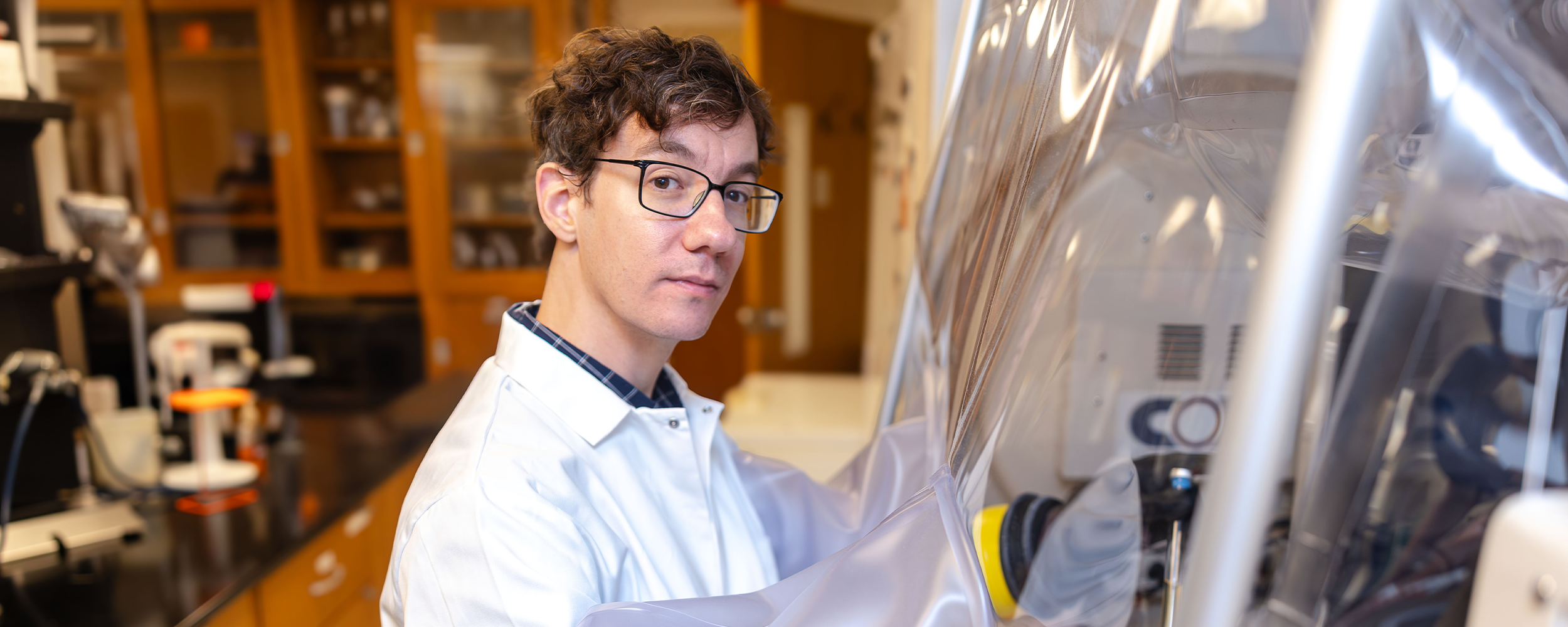
Dr. Paul Kirchberger, an assistant professor in Oklahoma State University’s Department of Microbiology and Molecular Genetics, has received an R35 MIRA from the National Institutes of Health to study how a group of microscopic, bacteria-killing viruses evolve and how they are built.
The five-year award, sponsored by the NIH’s National Institute of General Medical Sciences on Aug. 24, provides $1.25 million in federal funding to Kirchberger’s project, “Rules of Genome Evolution and Design in Small, Single-Stranded DNA Phages.”
The research focuses on viruses of bacteria, or bacteriophages, which infect and kill bacteria but are harmless to people. Kirchberger’s lab studies a specific group called single-stranded DNA microviruses, which he said are very abundant in the human microbiome and elsewhere. Yet scientists have been mostly unable to grow them in a lab.
"We know they're out there, but we can't study them in the lab," Kirchberger said.
The lab will start with a basic question: How do you grow them? Kirchberger wants to learn what these small viruses do differently from their larger competitors.
"For a virus, having a tiny genome requires completely different strategies to adapt to new challenges," Kirchberger said. "They have to do a lot with very little.
"But that simple genomic blueprint is then very attractive to us from a design standpoint. If we can figure out the 'rules' behind that, that means we can perhaps make our own phages to specifically target and kill bacteria of interest, antibiotic-resistant pathogens for example."
The five-year award will allow Kirchberger's lab to follow new leads as researchers learn more, which is important when so little is known about these viruses.
"We need to be able to go where the results lead us," Kirchberger said.
If researchers spot an interesting phage genome in existing data, they can try to grow the virus in their lab, exploratory work that Kirchberger said can be difficult to fund through other grants.
The work combines computational work, classical microbiology and synthetic biology. Kirchberger spends a lot of his time studying genome sequences on a computer, but the lab is working to turn those findings into experiments. Researchers can use computer data to synthesize small phage genomes, then introduce them into host bacteria to produce viruses they can study.
Graduate students handle plenty of the work in the lab, and Kirchberger hopes to hire more of them. Undergraduate students also learn in the lab, working alongside graduate students or leading smaller projects of their own.
FAQ
-
What NIH-funded microbiology research is being conducted at Oklahoma State University?
OSU assistant professor Paul Kirchberger received a five-year, $1.25 million award from the National Institutes of Health to study how small, bacteria-killing viruses evolve and are built. His research combines computational biology, classical microbiology and synthetic biology.
-
Who is studying bacteriophages at Oklahoma State University?
Dr. Paul Kirchberger, an assistant professor in OSU’s Department of Microbiology and Molecular Genetics, studies single-stranded DNA microviruses. His lab investigates how these viruses evolve, how their genomes function and how researchers can grow them in laboratory settings.
-
Could OSU’s bacteriophage research help fight antibiotic-resistant bacteria?
Kirchberger’s research could help scientists understand how to design bacteriophages that target and kill specific bacteria, including antibiotic-resistant pathogens. The research focuses on understanding the genomic principles that make these viruses function.
-
What is an NIH R35 MIRA award?
The National Institutes of Health awarded Kirchberger an R35 MIRA through its National Institute of General Medical Sciences. The five-year, $1.25 million award supports his research into the evolution and design of small, single-stranded DNA bacteriophages.
-
Can undergraduate and graduate students conduct microbiology research at Oklahoma State University?
Yes. Undergraduate and graduate students participate in bacteriophage research in Kirchberger’s lab at OSU. Graduate students conduct much of the laboratory research, while undergraduates work alongside them or lead smaller projects of their own.
Story By: Colby Lewis | colby.t.lewis@okstate.edu