

Tested to lead: OSU Army ROTC cadets excel at Advanced Camp
Tuesday, September 29, 2026
Media Contact: Jet Turner | Associate Director of Marketing and Communications | 405-744-9559 | jet.b.turner@okstate.edu
Nerves were the only thing keeping Lucy Stuteville awake.
After a long layover in Dallas, her flight finally touched down at the Louisville Muhammad Ali International Airport at 2 a.m. She retrieved her bag from the carousel and found her way to the van that would transport her and seven other Army ROTC cadets to Fort Knox.
For about an hour, the van bounced down the road. Not even the night sky and her heavy eyelids stopped Stuteville from taking in the fort’s massive white granite walls as they appeared on the horizon.
Stuteville entered the Fort Knox barracks around 4:30 a.m., checked in at the reception desk, gathered her bedding and key, as she made her way to her room. She only had about 30 minutes to rest before her 5:30 a.m. formation.
It wasn’t the way Stuteville wanted to start her U.S. Army Cadet Command Advanced Camp.
“Everything after that day was alright,” Stuteville said. “After that day, you get used to waking up and the routine.”
A few days earlier, Emma Saxe arrived at Fort Knox with redemption clouding her thoughts. A month before Stuteville’s arrival, John Lewis rode the same hot, cramped bus from the airport. Weeks before him, Hector Fino watched the same white walls rise above the Kentucky landscape.
Cadet Advanced Camp is a required 31-day capstone training and evaluation course for Army ROTC cadets. Each summer, Army leaders evaluate nearly 6,000 cadets on their leadership, physical fitness and military skills. Those evaluations help determine branch assignments, active-duty selection and Distinguished Military Graduate honors.
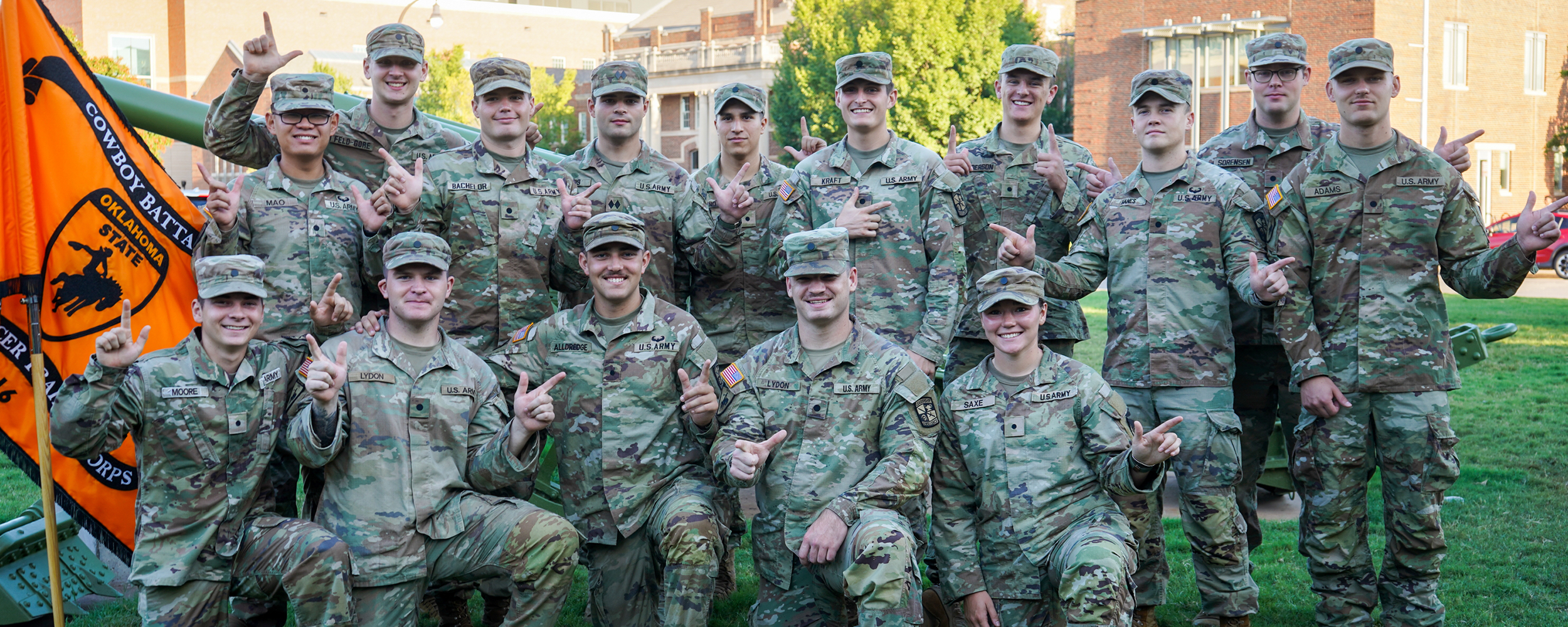
In total, Oklahoma State University sent 18 Army ROTC cadets to this summer’s Advanced Camp.
The day after each of them arrived was full of general paperwork, height and weight screenings, medical checks and more.
The next day, the tests began.
The Barracks Phase
Saxe took a deep breath. Sweat dripped down her brow. Pressure swelled in her chest.
She approached the deadlift bar to begin her Army Fitness Test (AFT), squatted down and wrapped her hands around the weight. She was trying to hide her shaking from the cadets and officers watching.
She closed her eyes, took one more deep breath and lifted the bar off the ground.
Last year, Saxe left Fort Knox early after failing the Army’s required height and weight assessment. Caught off guard, her confidence shaken, she packed her bags and returned home to Pittsfield, Illinois.
She returned to OSU in fall 2025 as a senior with only one final chance to complete Advanced Camp.
It took a while for Saxe to gain her confidence back, but OSU’s ROTC instructors, as well as her fellow cadets, believed in her. She spent this unexpected extra year of training honing her skills and rebuilding her resolve for this very moment.
“There were times where it was hard to decide to come back,” Saxe said. “But really trusting in my training back at my program, they believed in me, so I was able to believe in myself.”
That deadlift bar came off the ground three times, the required amount to pass this section of the test.
At the time of Saxe’s test, a score of 465/500 or higher would exempt a cadet from the height and weight screening standards. She had a goal to achieve, and all the work Saxe had completed over the last year, with the help of her instructors and peers, had prepared her for this moment.
The AFT continued with hand-release pushups, sprint-drag-carry, planks and a two-mile run.
At the end of the AFT, Saxe had a score of 475/500.
“I think I would’ve been nervous no matter if I had that pressure on me or not because there had been a lot of talk about the graders being very strict on form,” Saxe said. “But I was very happy with the results.”
After completing the AFT, cadets moved through land navigation and marksmanship before reaching warrior skills, a series of evaluations covering basic soldier tasks such as weapons handling, medical response, radio communications and calling for fire.
For Fino, these tests showed how OSU’s training compared with what he encountered at Fort Knox.
“The prior training and time that people are able to put into the program really helps,” Fino said. “It requires a lot of time. And you have to really buy into it to get the good out of it.”
The cadets’ preparation was tested again during the ruck assessment, where cadets had two hours to carry a 35-pound pack six miles.
Stuteville had heard about Agony Hill before she ever saw it.
The infamous hill is one of several steep climbs at Fort Knox that have challenged soldiers since World War II. Soon, Stuteville would have to climb it herself.
“This is just gonna suck,” Stuteville thought as she began her ruck.
The Kentucky humidity weighed on Stuteville as she put one foot in front of the other. But her training quickly kicked in. At OSU, cadets are expected to complete their rucks in an hour and a half, so the two-hour trek suddenly seemed manageable.
In fact, Stuteville ran the first four miles.
“One mile at a time, I just wanted to get it over with,” Stuteville said.
Stuteville had already passed mile five when she saw it. She wasn’t sure at the time if it was Agony Hill, but she knew she was getting over it regardless.
She continued her trek up the notorious hill. Step after step, she climbed, her shirt drenched. Finally, she crested the hill and saw the sign directing her toward mile six. She made it.
Stuteville finished the ruck in 1 hour, 27 minutes – 33 minutes under the two-hour standard and right around the pace she trained for at OSU.
“Oh, we’re done,” Stuteville said. “That wasn’t as bad as what people were saying it was.
“I think the preparation just got me through it all. Literally just not stopping and just pushing through.”
Cadets finished their barracks tests with an obstacle course and a hand grenade assault course. Then, they packed their gear and left the relative comfort of the barracks behind, ruck-marching into the field.
Now, they have to lead.
The Field Training Phase
Lewis led his squad through the Kentucky woods to the objective rally point (ORP), the final location where his squad would meet and organize before completing its raid.
During the field training phase, cadets spend almost two weeks living in the field conducting leadership looks or “lanes,” missions during which individual cadets rotate through leadership positions and are evaluated.
“The lanes are like our most weighted event,” Lewis said. “It’s kind of like the culmination of everything you’ve learned.”
Today was Lewis’s second mission as weapons squad leader.
The vegetation was seemingly endless as the squad stepped closer to the ORP. A cadet got Lewis’ attention.
“Hey, I think there are two guys right there,” one of the cadets said to Lewis, pointing into the brush.
That’s when the enemy opened fire.
“Get online!” Lewis yelled to his squad.
The squad quickly established the enemy's distance, direction and description so they could effectively space themselves and return fire. Lewis dropped behind his squad members and radioed the platoon leader, telling him they needed him forward to assess the situation.
Once the platoon leader arrived, Lewis crawled back to meet him and explain what was happening.
With little time to respond, Lewis proposed a plan: His squad would flank the enemy while another squad provided supporting fire.
The platoon leader approved Lewis’s plan, and he returned to the squad.
“It was complete chaos,” Lewis said. “But I ended up taking control of the situation.”
Field training is split into three phases: Wolverine, Panther and Grizzly. Wolverine serves as a refresher and training phase where cadets shadow more experienced leaders. Panther and Grizzly put cadets through evaluated missions, including ambushes, raids, movements to contact and attacks.
Fino faced another challenge in the field: learning to lead cadets he barely knew. Advanced Camp brought together ROTC cadets from universities across the country, requiring leaders to quickly understand how different people communicated and worked.
“You got to be really quick understanding how this person deals with how you talk to them or how they receive information,” Fino said.
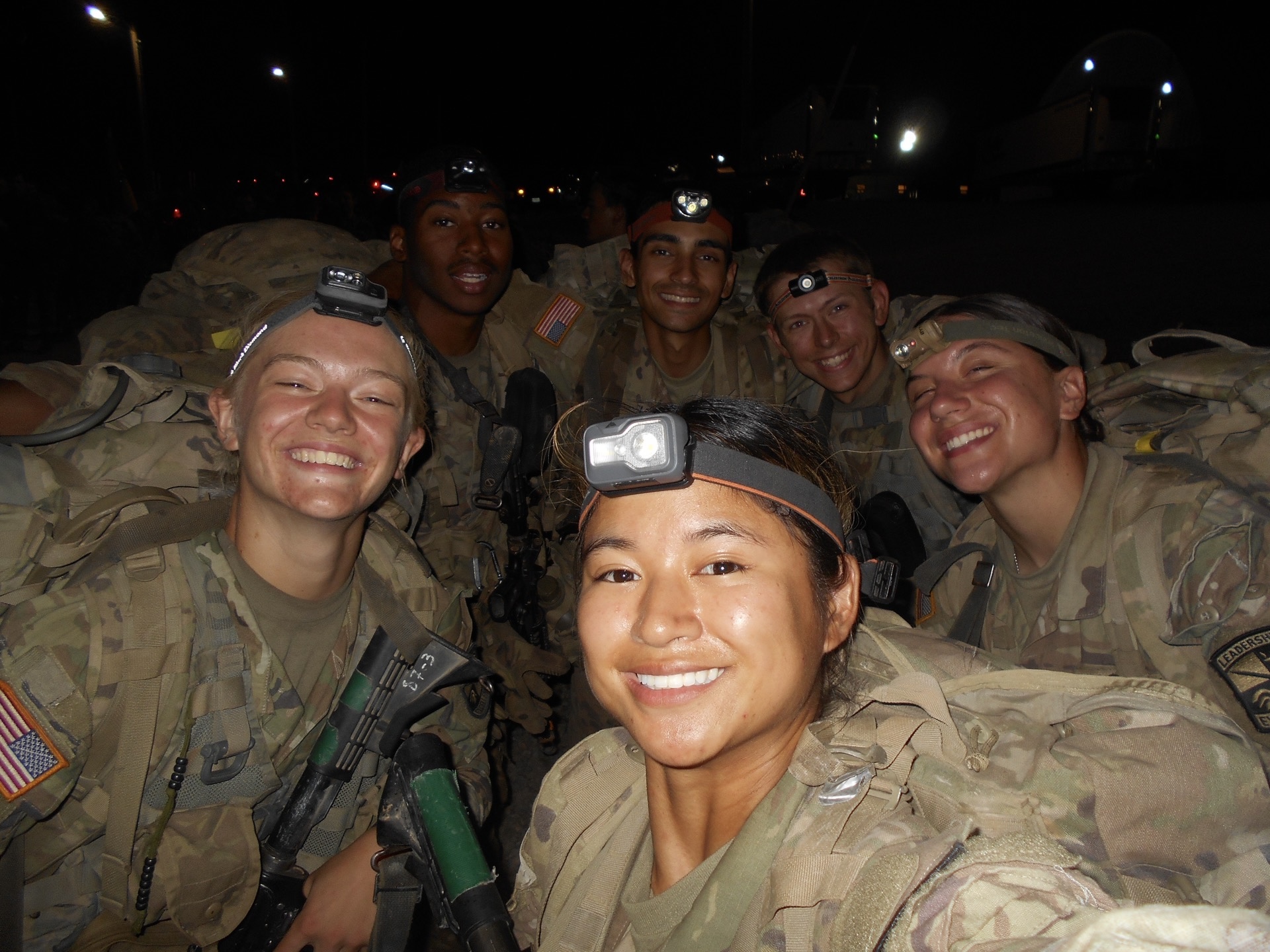
For Stuteville, the field presented another test of endurance.
On the first day of Panther, Stuteville served as an alpha team leader during an attack mission. Her squad was at the ORP, about 50 meters from the objective, when she was called forward. She stood up and rolled her ankle.
Her first reaction was laughter. A grader came to check on her and sent Stuteville to the medic, where she received painkillers. Stuteville quickly returned to the mission and finished it despite her ankle swelling and throbbing throughout.
Eventually, Stuteville had to be transported from the field to have an X-ray of her ankle. Nothing was broken, but her ankle was sprained. In her mind, she had two options: tough it out or go home.
“If you’re going to be a big baby about it, you’re going to have to go again next year if you tell them you can’t do it,” Stuteville told herself. “So just deal with the pain.”
After a mandatory 24-hour rest, Stuteville returned to the field.
As Stuteville returned to training, the missions only grew more difficult. By Grizzly, cadets were expected to handle increasingly complex situations with little warning.
For Saxe, Grizzly offered another opportunity to prove just how far she had come.
Saxe was assigned as the Assault 2 squad leader for her Grizzly raid mission.
Everything in the mission was going smoothly until she encountered the enemy much earlier than expected. Saxe’s squad wasn’t even at the objective when shots were fired.
“We quickly had to make a plan to return fire and complete the mission at the objective,” Saxe said. “While we were executing that hasty plan, I was in the process of bounding my squad across the objective so we could complete the mission.”
However, it became apparent that the other squads had substantially more simulated casualties than Saxe’s, enough to consider the situation a mass casualty. Saxe immediately changed course.
She got her squad back to the ORP in a secure position so they could begin mass-casualty operations.
“The mission went on, and let’s just say it was very chaotic,” Saxe said. “But we ended up completing the mission. I was glad that my squad never took a casualty.”
Saxe stayed calm, and her squad followed her lead.
“I stayed calm during the chaos of the mission, so in turn my squad also stayed calm and took my direction well,” Saxe said.
After talking with her grader, Saxe received an excellent rating for her leadership evaluation.
Once Grizzly was complete, cadets packed their gear and completed the final challenge: a 12-mile overnight ruck back to the barracks.
Around 11 p.m., the cadets shouldered their packs and began the long trek out of the field. Four hours later, they arrived back at the barracks, exhausted but with the most demanding portions of Advanced Camp behind them.
For OSU’s 18 cadets, the weeks of testing, training and leadership evaluations produced some of the program’s strongest results.
OSU’s Army ROTC ranked No. 20 nationally among 292 participating schools and No. 3 in the Big 12. OSU also ranked No. 1 in national leadership performance.
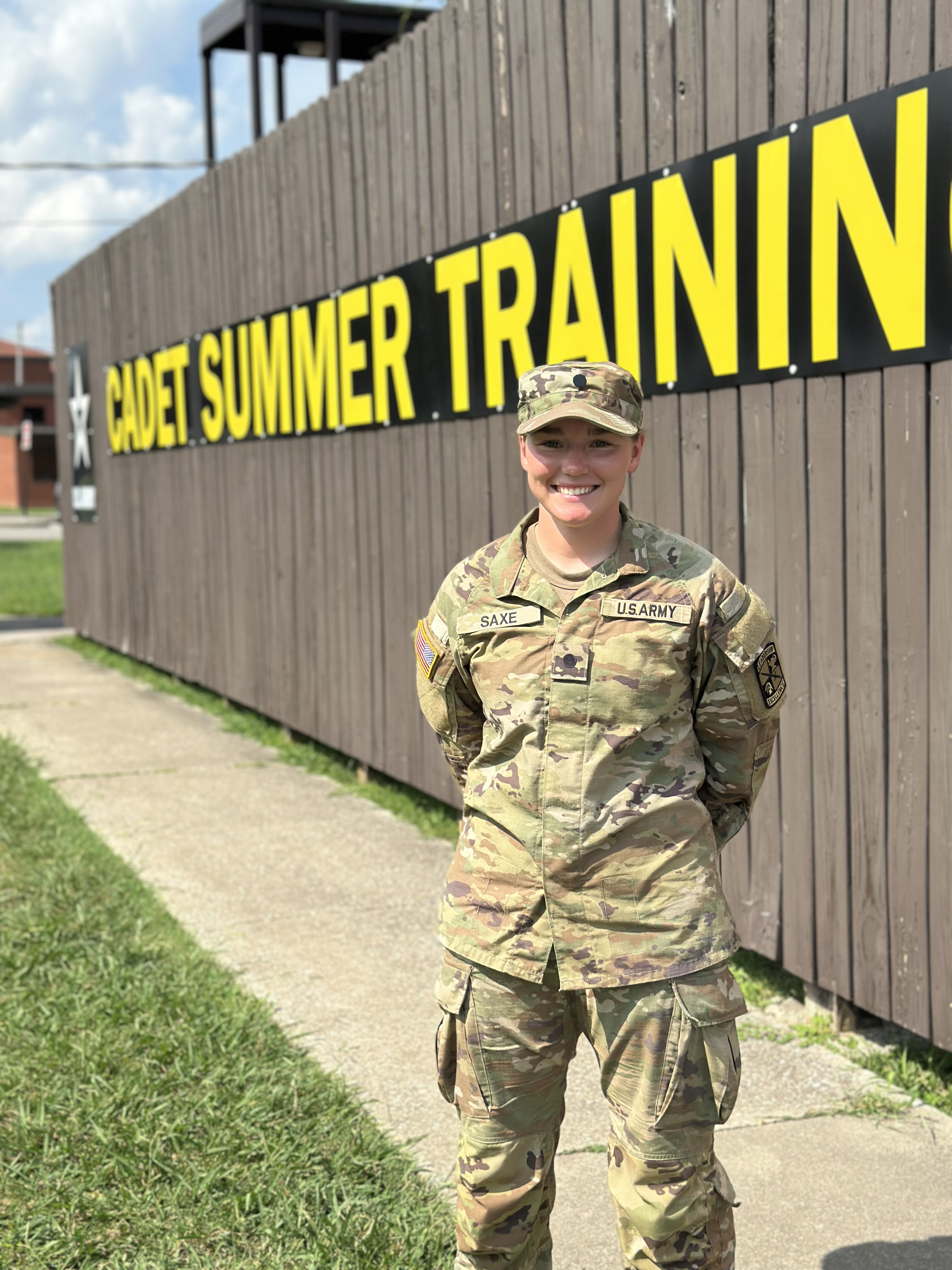
For Saxe, the accomplishment was more personal.
One year after leaving Fort Knox early, she graduated from Advanced Camp on Aug. 8.
“This experience showed me that I can be resilient and still accomplish this goal, even when being told ‘Not right now,’” Saxe said. “I have gained so much confidence in my ability to lead soldiers and feel so much pride for accomplishing something that seemed so far out of reach at times.
“All of the things I learned about myself, I truly believe, will make me a better leader and officer in the U.S. Army. I am excited for this new adventure and ready to represent a new generation of leaders in today’s Army.”