

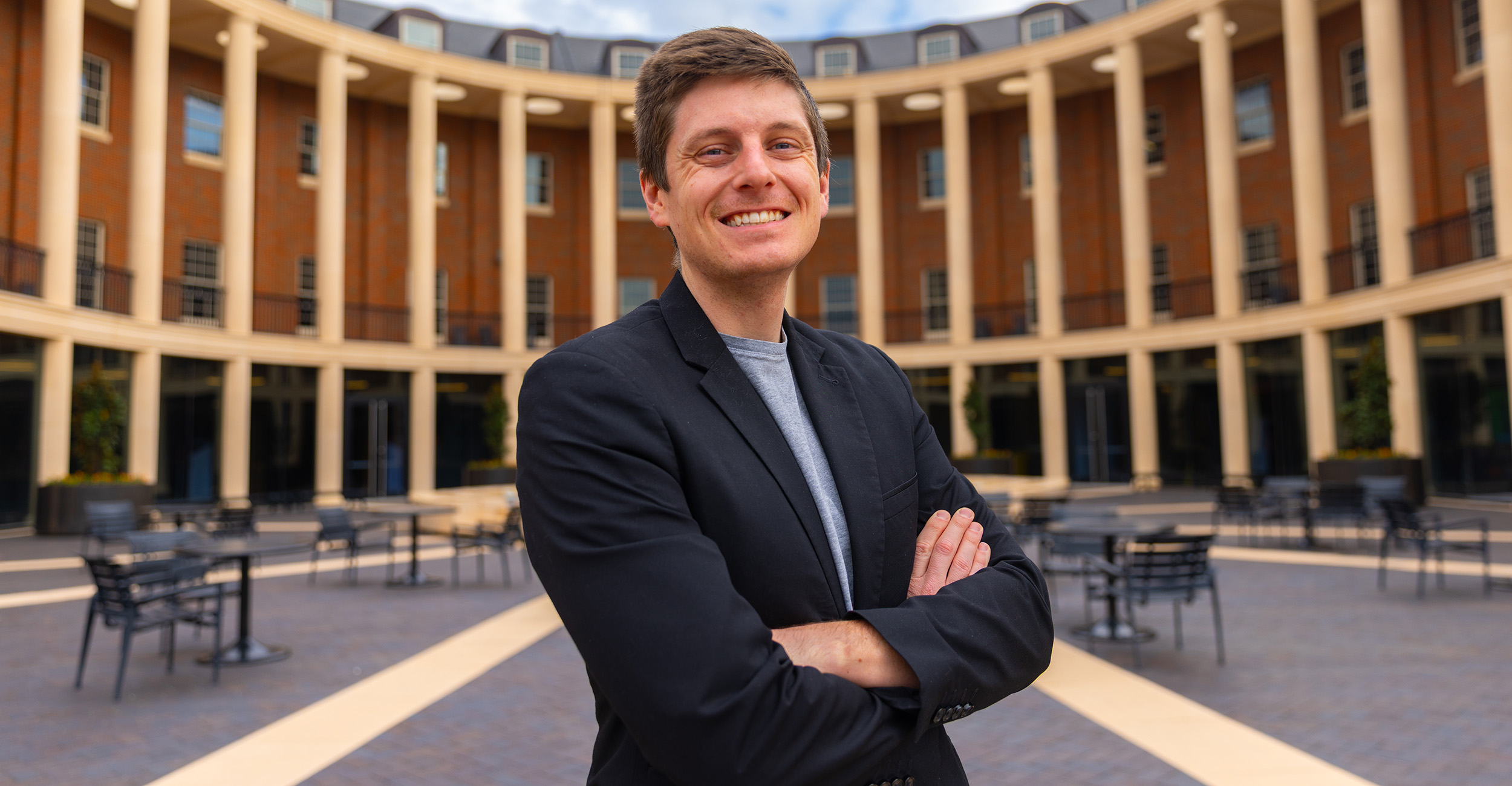
The gift of EGIVE: How a Spears Business assistant professor is improving machine learning
Tuesday, November 24, 2026
Media Contact: Hallie Hart | Communications Coordinator | 405-744-1050 | hallie.hart@okstate.edu
Key Facts
- Dr. Matt Baucum is the lead author of “EGIVE (Efficient Global Interaction and Variable Explainability): A Fast and Comprehensive Method for Global Interpretability Analysis of Black-Box Models,” published in Decision Support Systems.
- Baucum and his team created the EGIVE dashboard to explain the patterns behind machine learning models’ predictions. EGIVE is available to data scientists as a Python package.
- The researchers verified EGIVE using datasets on substance use disorder treatment completion and Parkinson’s disease forecasting. The SUD dataset includes more than 6 million de-identified records.
An auditor reviews a company’s financial records. A health inspector visits a restaurant.
A supervisor meets with an employee for a performance review.
These standard business practices hold people accountable at work, but it isn’t so straightforward when you’re working with machine learning models.
How do you audit an algorithm?
Dr. Matt Baucum, an assistant professor in Oklahoma State University’s Department of Management Science and Information Systems, set out to solve this problem nearly five years ago.
The Cowboy Code at OSU says, “We finish what we start,” and that’s exactly what Baucum did.
After years of meticulous work, he and his co-authors not only published their findings in Decision Support Systems, but also created an open-source Python package for data scientists to use. Python is one of the most common computer programming languages, making their work accessible across domains.
“We really designed it with data scientists and researchers in mind so they essentially could help build better models,” Baucum said. “You train a model, and you oftentimes don’t have any indication if it’s using the information you think it is in the way you want it to.”
To address this challenge, lead author Baucum worked with Dr. Meysam Rabiee from the University of Colorado Denver, Dr. Babak Aslani from the Memorial Sloan Kettering Cancer Center in New York and Dr. Kaushik Dutta from the University of South Florida.
Their paper, “EGIVE (Efficient Global Interaction and Variable Explainability): A Fast and Comprehensive Method for Global Interpretability Analysis of Black-Box Models,” helps data scientists see the “why” behind a machine learning model’s calculations.

Why is EGIVE important?
Data scientists develop sophisticated decision support systems for professionals in medicine, finance and other domains involving risk.
Their data-informed models generate precise, individualized predictions as numerical scores. For example, a model might calculate a patient’s likelihood of developing a disease, helping the patient and doctor work together to create an optimal care plan.
These tools reduce human error and contribute to groundbreaking advancements, but a number is only as useful as the context surrounding it.
Imagine you’re in a class where your teacher is handing out graded exams. Your score appears in red ink at the top of the page, but the percentage won’t make sense unless the teacher marks which questions you missed.
Similarly, data scientists can’t improve a machine learning model unless they see how its variables interact.
EGIVE, a dashboard interface that runs a collection of algorithms, makes machine learning predictions interpretable and explainable. The dashboard uses explainable artificial intelligence, or XAI, to create plots that clearly illustrate relationships among variables.
In medicine, those variables may include vital signs, lab test results, family history of disease and other risk factors. Baucum and the research team contribute to the growing literature on XAI by focusing on a big-picture view rather than solely explaining individual predictions.
“We started addressing it from the pattern discovery side,” Baucum said. “If you look across predictions, what interesting or novel patterns crop up?”
How does EGIVE solve problems?
An accurate model isn’t always a fair model.
In machine learning, a data-informed computer model is trained to make predictions based on patterns.
This means an algorithm might make perfect calculations, but the results are untrustworthy if they’re based on flimsy correlations, biased data or unreliable metrics.
"We really designed it with data scientists and researchers in mind so they essentially could help build better models."
In high-stakes fields such as medicine, a flawed algorithm can have dire consequences. On the other hand, a well-constructed model can root out human bias and save lives, but this requires a thorough review process before industry deployment.
EGIVE reveals patterns that help either confirm a machine learning model’s validity or catch systematic flaws. Baucum’s vision is for data scientists to check their models using EGIVE, see how the variables interact and update the models as needed.
“The use case we saw is preventing models from making erroneous decisions, rather than just trusting them at face value,” Baucum said.
When Baucum and his team began their research, other methods already existed for explaining algorithmic predictions. The problem? Those systems were slow and fragmented.
Baucum knew most data scientists can’t spend hours waiting on programs to run, so the team got to work.
“A lot of it was just trying to make good ideas that had been around for a long time more usable,” Baucum said. “Part of that was just figuring out ways to make the algorithms faster, and then all the dashboard packaging and the visualization was built on top of that.”
What are EGIVE’s real-world uses?
Baucum said EGIVE takes only a couple of minutes to run and is effective.
The researchers verified their work with two real-world datasets. A dataset on substance use disorder treatment completion includes more than 6 million de-identified records, and the other dataset addresses Parkinson’s disease forecasting.
Baucum, who joined OSU’s Spears School of Business in 2025, has knowledge of both topics.
His 2023 publication in Management Science examines medication regimens for patients with Parkinson’s disease, a nervous system disorder that affects millions of people globally. In 2025, Baucum’s publication on overdose death reduction and access to treatment centers won the Pierskalla Best Paper Award from the INFORMS Health Applications Society.
With his EGIVE paper, Baucum continues his department’s long tradition of publications in Decision Support Systems. From 2014-23, Spears Business MSIS faculty produced the second-most articles in the top-tier global journal.
As Baucum concludes one project, the rapid evolution of machine learning and AI prompts further research questions.
When he began working on EGIVE, large language models like ChatGPT were not publicly available. Today, could an updated version of EGIVE not only explain an algorithm’s numerical predictions, but also identify patterns between users’ prompts and an LLM’s text-based responses?
It would be a new challenge, but Baucum sees an ethical obligation for researchers to foster accountability around machine learning and AI.
“I got interested in it, ultimately, because I felt like there was a greater need for tools that shone a light on what machine learning models were doing,” Baucum said. “That’s just as important now as ever. Now, the models themselves have gotten so much more complex, it’s a question of how that research can keep up.”
Frequently Asked Questions
-
What is EGIVE?
EGIVE, or Efficient Global Interaction and Variable Explainability, is a novel method for explaining a machine learning model’s predictions. Dr. Matt Baucum led the research team that developed EGIVE, a dashboard interface that runs a collection of algorithms and is accessible to data scientists as a Python package.
-
Are machine learning and AI the same?
Machine learning is a type of artificial intelligence. AI is the broad term for computer technology that mimics human intelligence, while machine learning refers to computer models trained to recognize patterns in data and draw conclusions accordingly. Some machine learning models generate text, while others make numerical predictions.
-
Is machine learning new?
No. While large language models like ChatGPT are new, data scientists have conducted machine learning research for decades. In the Spears School of Business, preeminent machine learning scholars include Dr. Ramesh Sharda, Dr. Dursun Delen and MSIS department head Dr. Rick Wilson. Visit the Experts directory to learn about all OSU faculty research interests and publications.
-
Are OSU researchers creating predictive machine learning models?
Yes. Researchers across the OSU System are collaborating to create predictive models with real-world applications. In the Center for Health Systems Innovation, Regents Professor Dr. Dursun Delen and his research team developed a risk index to prevent and detect diabetic retinopathy, the leading cause of adult-onset blindness in the United States. This is just one example of OSU’s cross-campus research on predictive medicine.
-
I am a student. Can I do research in OSU's Spears School of Business?
Yes. Visit the website to learn about the Spears Business research ecosystem and opportunities to work with faculty researchers.