


Answering the Call: OSU student dispatchers help when it matters most
Wednesday, May 6, 2026
Media Contact: Mak Vandruff | Communications Specialist | 405-744-7112 | makenzie.vandruff@okstate.edu
When people hear loud sirens and see flashing lights, they know someone is in trouble, and that help is on the way. But before the first responders arrive and a helping hand is extended, a call must be made.
Oklahoma State University dispatchers are the unsung heroes of emergency response on campus. For many of these dispatchers, the job revolves around effective communication, composure and adaptability. They serve as the direct link between the public and first responders, so the dispatcher becomes the first voice someone hears during a crisis.
OSU students Audrey Cox, Emma Breckenridge and Chloe Weis are among these dispatchers, and each has a unique perspective on their contributions to campus safety.
“We’re communicators for the public to the officers,” said Breckenridge, who is a junior majoring in psychology with a double minor in biology and criminal justice. “We’re able to hear and understand what the public’s concern is and get that streamlined to the officers so that they can get to them and solve the problem as fast as possible.”
Weis, a sophomore horticulture business major, said she has learned skills that will help her in her future career as an air traffic controller.
“I’ve definitely learned how to better communicate with people and figure out ways to get a point across when trying to help someone in a stressful situation,” Weis said. “I figure out the key things to do to help them grasp what I’m trying to communicate with them, and so I’m able to apply that in the real world when I’m talking to people and figuring out how to better communicate.”
Dispatchers have a valuable role in keeping OSU safe. Cox, a sophomore public safety major with a minor in emergency management, is familiar with emergency communications after doing EMT clinicals in high school. She said that being in a position to keep people safe has had a big impact on her.
“Dispatchers know everything that’s going on on campus,” Cox said. “They’re making sure everybody’s safe. It’s a huge role that nobody ever really thinks about. Yes, people think about dispatchers, but not the amount of work they’re doing to make sure everyone’s safe.”
Sometimes, moments stick even after the shift ends. After one specific call, Breckenridge said it had a big influence on her.
“She called, and she was freaking out,” Breckenridge said. “She was crying, she was yelling. She didn’t know what to do. It was something about hearing her calm down because of what I was saying and getting her through it. That was super impactful for me because it felt like I was actually doing the job.”
For Cox, her moment came when a call arrived from a business where she used to work.
“I knew where it was coming from, and I knew someone needed help,” Cox said. “Now I was in the position to send someone who could help them.”
Of course, dispatching brings its struggles along with its wins. Cox, Breckenridge and Weis are all students, so they have to balance their coursework with this job. Breckenridge also works overnight shifts, and she said the schedule can be demanding and that it requires mental resilience.
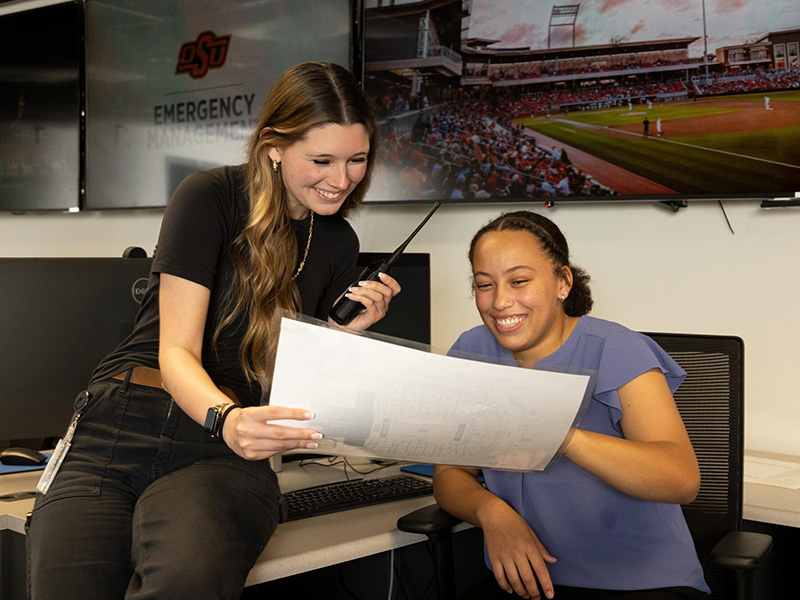
“Dispatching brings a certain amount of stress to you that you need to learn how to manage,” Breckenridge said. “As much as I recommend the job, there are parts of it that some people wouldn't be able to handle. Balancing classes on top of work can get really hard to manage. And mental health is so important. That’s the No. 1 thing that you have to take care of as a dispatcher is your own mental health, because if you're not helping yourself, you can't help other people.”
Despite the stresses of this job, all three dispatchers said that the experience has been worthwhile. They each mentioned being proud to help others, even if they don’t receive recognition.
“I like being in the background,” Weis said. “Being able to silently help the community, I think it’s great.”
Cox agreed that, despite being unseen, this job is extremely meaningful.
“It's super rewarding knowing that I'm sitting down here in this basement and nobody knows, but I’m able to help somebody,” Cox said.
While they may still be earning their degrees, these students have been entrusted with one of the most important and stressful jobs on campus. They calm distressed callers, coordinate with first responders and monitor the situation. The responsibility placed on them is significant.
OSU Chief of Police Michael Beckner said he knew these three would be great employees.
“Each had their own traits that immediately stood out,” Beckner said. “From being very focused to having that personality that could make a caller in distress feel heard and helped.”
That determination is something Public Communications Supervisor Travis Eastman looks for in his applicants.
“One of the most important things I look for in any applicant is a desire to do the job and a drive to succeed,” Eastman said. “I've found that the type of student who would take on the challenge of being a full-time student and a full-time employee has very high drive and time management skills.”
Finding a balance between homework and emergencies, or between lectures and late-night calls, is something many people would struggle with. However, Eastman said these students rise to the challenge.
“These students have been great to work with,” Eastman said. “They've been fast to learn and manage their time well. In the interview process, they each displayed an understanding of how important this job would be and how hard they would need to work. Watching them take on the challenge has been inspirational.”