


HPNRI researcher earns statewide recognition
Monday, November 16, 2026
Media Contact: Jeremy Gross | HPNRI Coordinator | 405-744-1886 | jeremy.gross@okstate.edu
Key Takeaways
- Dr. Harshvardhan Singh, an implementation scientist at Oklahoma State University’s Human Performance and Nutrition Research Institute, received OAHPERD’s 2026 University/College Health Professional of the Year Award.
- Singh brings more than 15 years of research experience in rehabilitation, biomechanics, neuromotor sciences, and cardiovascular and musculoskeletal diseases.
- Singh mentors OSU students through research and innovation projects, helping develop practical solutions that improve health outcomes and accessibility.
- Singh collaborated with OSU engineering and education faculty and students to develop RearGear, an air-powered resistance system designed to make strength training more accessible.
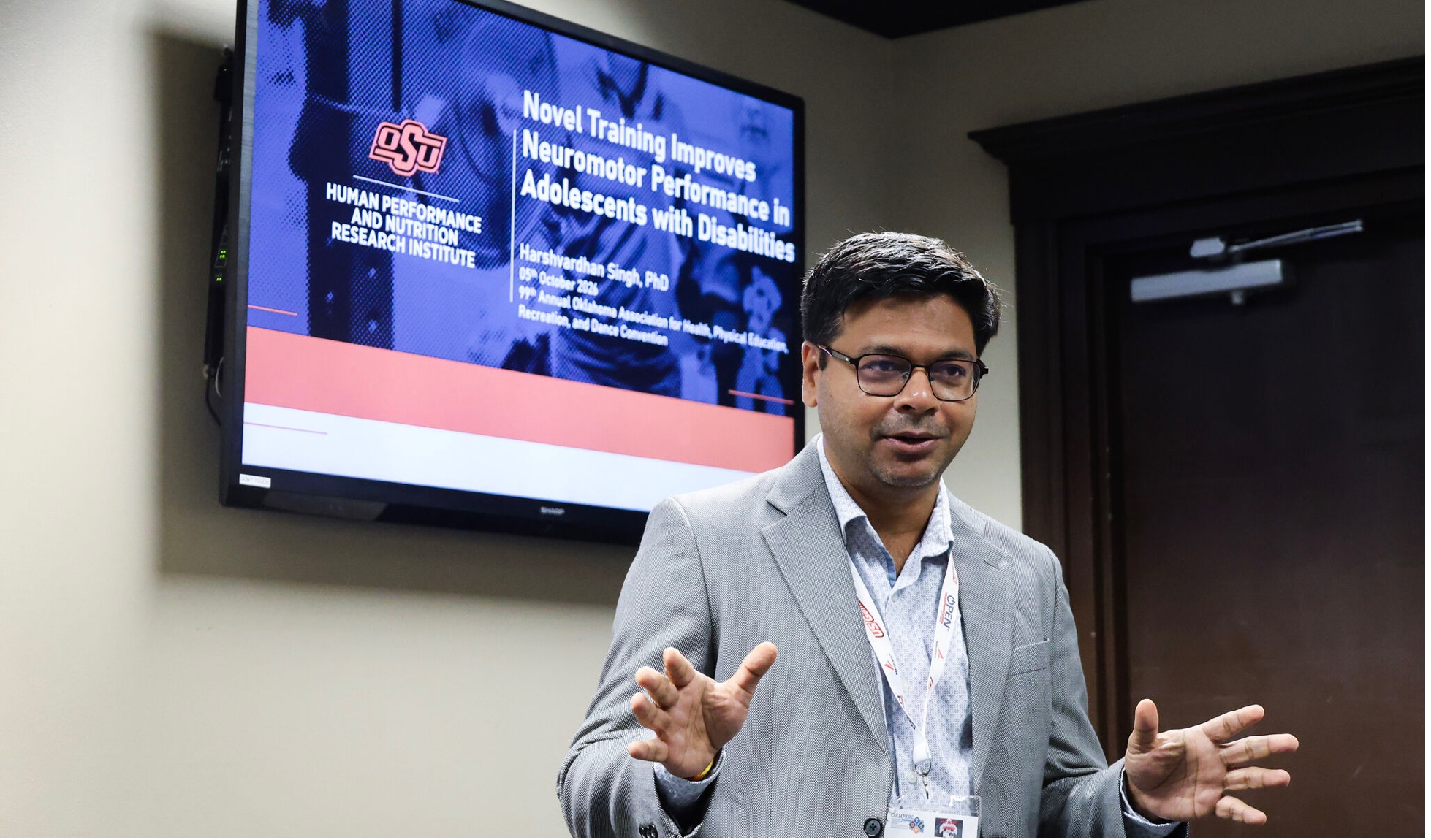
Recognizing his commitment to advancing impactful, transdisciplinary research supporting health outcomes and underserved populations, the Oklahoma Association for Health, Physical Education, Recreation and Dance named Dr. Harshvardhan Singh the recipient of its 2026 University/College Health Professional of the Year Award.
Singh, an implementation scientist with the Oklahoma State University Human Performance and Nutrition Research Institute, received this honor during OAHPERD's annual convention held at the University of Central Oklahoma.
Singh’s research career spans more than 15 years, with expertise in rehabilitation, neuromotor sciences, biomechanics, and cardiovascular and musculoskeletal diseases.
At HPNRI, his contributions extend beyond research and innovation. He plays an important role in student mentorship and workforce development, providing students with opportunities to apply their knowledge, develop professional skills and understand the broader impact of research.
Under Singh’s mentorship, Tom Booth, an exchange student from the University of Bath, developed valuable experience in human performance research. One of Booth’s most significant takeaways was recognizing that research is ultimately a tool to improve people’s lives, rather than simply a means of producing data and outcomes.
“He displayed this constantly in the work we did. Every project was designed to improve the health and wellbeing of a wide array of individuals,” Booth said. “For Harsh, it's not about a name on a paper or an award, it's about creating real-world tools to target real-life problems.”
In the field of research, the work can sometimes overshadow who the work is intended to serve.
“Throughout my career, I have been motivated by a simple idea: to think with a researcher's rigor while never losing sight of the people and communities our work is meant to serve,” Singh said. “This recognition belongs as much to the students, collaborators, mentors, and community partners who have shared that journey as it does to me.”
One example of Dr. Singh’s innovation with people at the forefront is his RearGear invention, a project reflecting his commitment to bring together research, engineering and human performance.
Developed in collaboration with faculty and students from the College of Engineering, Architecture, and Technology and the College of Education and Human Sciences; RearGear is a pneumatic system replacing free weights with air-driven resistance, using pistons and a cable system to simulate the feel of weighted plates.
One version of this design incorporated a chair to better simulate sit-to-stand training. This is an invention designed in hopes to make the activity of weightlifting more accessible for all individuals.
“For Harsh, it's not about a name on a paper or an award, it's about creating real-world tools to target real-life problems.”
A key student contributor to prior RearGear iterations was Alec Murray, former OSU mechanical engineering student.
“Working with Dr. Harsh on RearGear was majorly impactful to my academic and professional career,” Murray said. “His passion for engineering in healthcare was contagious, and he consistently encouraged us to innovate and come up with ideas, while remaining focused on improving patient outcomes.
“In any design challenge, it can be far too easy to target specifications and efficiency without considering the user experience. One thing I learned from Dr. Harsh is to consider the end user in every design aspect. Considerations towards accessibility, comfort, and usability of a device are almost never written requirements but can make substantial impacts on the outcome of a project.”
In April 2026, Murray joined Bethany Children’s Health Center as a rehabilitation engineer, carrying forward the knowledge and experience he gained while serving as a project lead on RearGear.
Singh's recognition by OAHPERD highlights the value of his impact across research, innovation, and student development. It also underscores the importance of celebrating professionals whose dedication helps advance health and physical literacy across Oklahoma.
Frequently Asked Questions
-
Who received the 2026 University/College Health Professional of the Year Award?
Dr. Harshvardhan Singh, an implementation scientist with Oklahoma State University’s Human Performance and Nutrition Research Institute, received the 2026 University/College Health Professional of the Year Award from the Oklahoma Association for Physical Education, Dance, and Recreation.
-
What does Dr. Harshvardhan Singh research at Oklahoma State University?
Dr. Harshvardhan Singh has more than 15 years of research experience in rehabilitation, neuromotor sciences, biomechanics, and cardiovascular and musculoskeletal diseases. His work at OSU focuses on advancing health outcomes through research, innovation and practical solutions for individuals and communities.
-
What is RearGear at Oklahoma State University?
RearGear is an OSU-developed pneumatic strength training system that uses air-driven resistance, pistons and cables to simulate the feel of traditional free weights. Developed by faculty and students from the College of Engineering, Architecture, and Technology and the College of Education and Human Sciences, RearGear is designed to make strength training more accessible.
-
How does RearGear improve accessibility in strength training?
OSU's RearGear system replaces traditional free weights with air-driven resistance, offering an alternative approach to strength training. One version incorporates a chair to simulate sit-to-stand exercises and support more accessible exercise options.
-
How does Dr. Harshvardhan Singh support student development at OSU?
Dr. Harshvardhan Singh supports OSU student development through research mentorship and hands-on innovation projects. His mentorship has helped students such as Tom Booth and Alec Murray gain practical human performance research experience and develop skills for careers focused on improving health outcomes.