


New Hamm Institute study identifies nuclear fuel processing as energy security challenge
Monday, June 22, 2026
Media Contact: Dara McBee | Hamm Institute for American Energy | 580-350-7248 | dara.mcbee@hamminstitute.org
The Hamm Institute for American Energy has released a new report through the Trilateral Energy Security Committee examining vulnerabilities in uranium processing and opportunities for the United States, Japan and South Korea to strengthen allied nuclear fuel-cycle capacity.
The report, "Uranium Processing Supply Chain Security: A Framework for Trilateral Investment Coordination," finds that the most consequential weaknesses in the nuclear fuel cycle are not limited to uranium mining. The greater challenge lies in the midstream stages that convert and enrich uranium for reactor use.
Those stages remain highly concentrated. Russia controls roughly 40-43 percent of global uranium enrichment capacity. Russia and China are also currently the only commercial-scale producers of high-assay low-enriched uranium, or HALEU, a higher-enriched form of uranium needed for many advanced reactor designs.
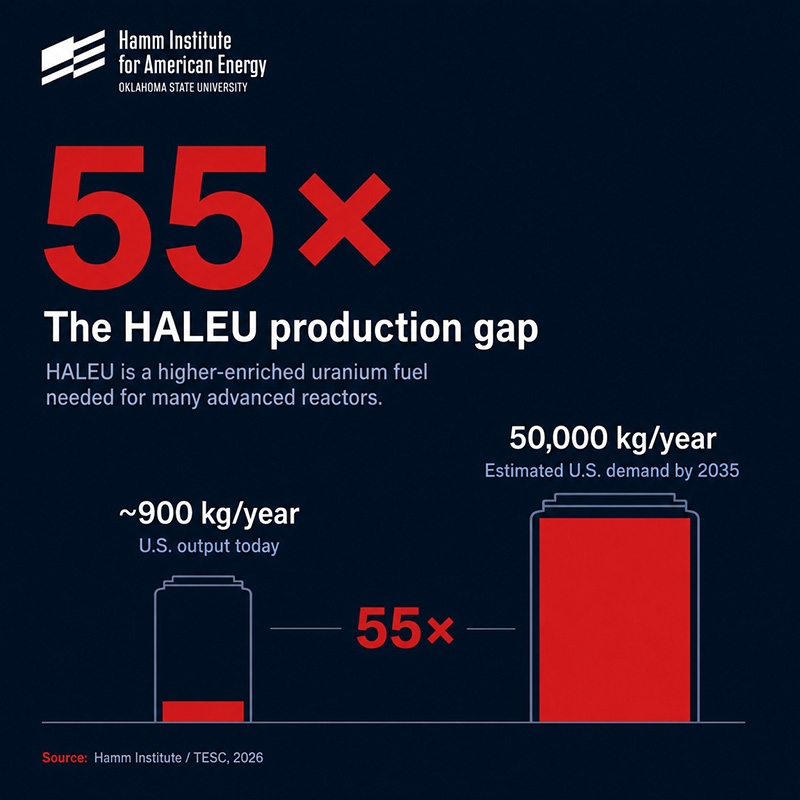
The HALEU gap illustrates the scale of the challenge. Centrus Energy has demonstrated an annualized HALEU production rate of roughly 900 kilograms per year at its Piketon, Ohio, facility. U.S. HALEU requirements could reach approximately 50 metric tons annually by 2035 to support small modular and advanced reactor deployment.
The study identifies conversion, enrichment and HALEU production as the clearest opportunities for coordinated action among the U.S., Japan and South Korea. These midstream capabilities face high geopolitical exposure but can be expanded across allied economies through coordinated investment, demand commitments and policy alignment.
The report recommends a trilateral strategy focused on expanding allied conversion and enrichment capacity, developing collective HALEU production capability, and securing upstream uranium supply through long-term offtake agreements and strategic investment in allied producer countries.
Fuel fabrication remains an area of relative industrial strength for the three countries. The more immediate task is ensuring reliable access to the converted and enriched uranium needed to support existing and future reactor fleets.
Read the full report here.
About the TESC:
The Trilateral Energy Security Committee brings together the Hamm Institute, the Institute of Energy Economics, Japan and the Korea Energy Economics Institute to advance practical energy-security cooperation among the United States, Japan and South Korea.