


OAIRE invited to demo sea mammal project during annual meeting
Wednesday, June 10, 2026
Media Contact: Jeff Hopper | Communications and Media Relations Manager | 405-744-5827 | news@okstate.edu
The Oklahoma Aerospace Institute for Research and Education recently conducted a demonstration during the Alliance of Marine Mammal Parks & Aquariums Annual Meeting at Dolphin Quest Hawaii in Waikoloa.
The OAIRE team was invited to provide a live demonstration of its Passive Health Assessment in Sea Mammals (PHASM) program for AMMPA, an international association of marine parks, aquariums, zoos and research facilities.
“This was a great opportunity to demonstrate our collaborative research efforts with a wide range of stakeholders dedicated to the health and preservation of marine mammals,” said Dr. Jamey Jacob, executive director of OAIRE. “It also provided an opportunity to discuss the future of research in this area and how we may be able to help future partners pursue their research efforts.”
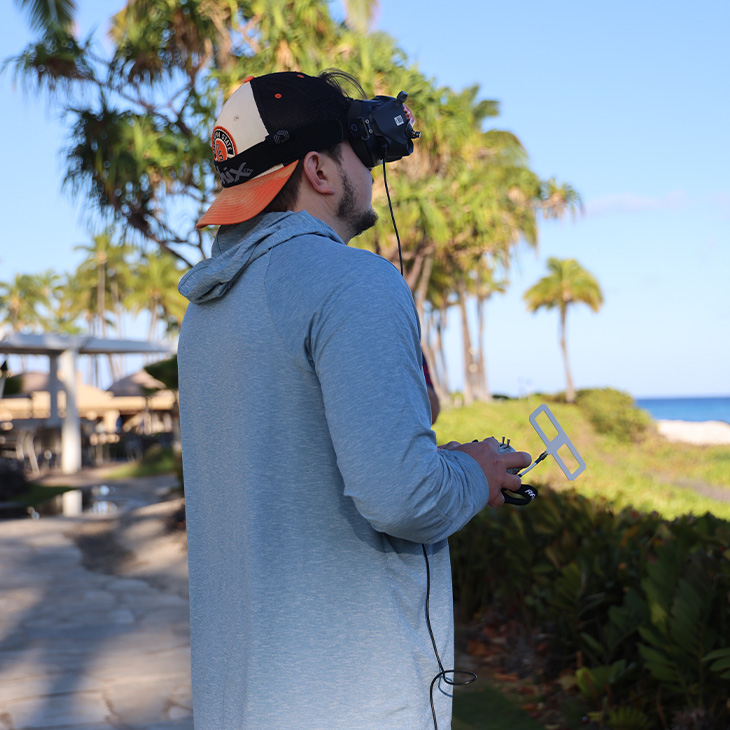
The PHASM project, started in 2019, uses a specially designed, fixed-wing aircraft to collect chuff samples from free-swimming aquatic mammals in order to assess the health of an individual or group of animals.
The demonstration allowed members of AMMPA to witness firsthand the non-invasive process of OAIRE researchers piloting the aircraft along a designated flight path, passing over a dolphin, flying through a chuff plume and collecting a sample.
“This has been a long process with many design iterations,” Jacob said. “Our researchers have done a great job of refining their design to the aircraft we use today.”
In homage to that iterative process and the collaborative research work, the OAIRE team donated the original aircraft to Dolphin Quest Hawaii to display as a symbol of their ongoing research and conservation efforts.
“Our partnerships with biologists from Stephen F. Austin University and members of Dolphin Quest have been crucial to our success,” Jacob said. “We were honored to donate the first aircraft to their Hawaiian education discovery center to represent the research we’ve already accomplished and the milestones we hope to reach.”
Since its inception, the PHASM project has had its first successful sample collection with captive dolphins in 2024 and has progressed to ongoing testing of sample collection off the coast of Texas with pods of wild dolphins in 2025 and later this summer.
The team is also beginning new projects with entities such as the Georgia Aquarium to increase the breadth of aquatic mammal research and the impact the PHASM team can have on research and conservation efforts.