

OAIRE takes part in real-world, emergency response exercise
Monday, April 20, 2026
Media Contact: Jeff Hopper | Communications and Media Relations Manager | 405-744-5827 | jeff.hopper@okstate.edu
While the Oklahoma Aerospace Institute for Research and Education’s status as a leader in unmanned systems is unquestioned, its recent participation in an emergency response exercise may stray from the obvious.
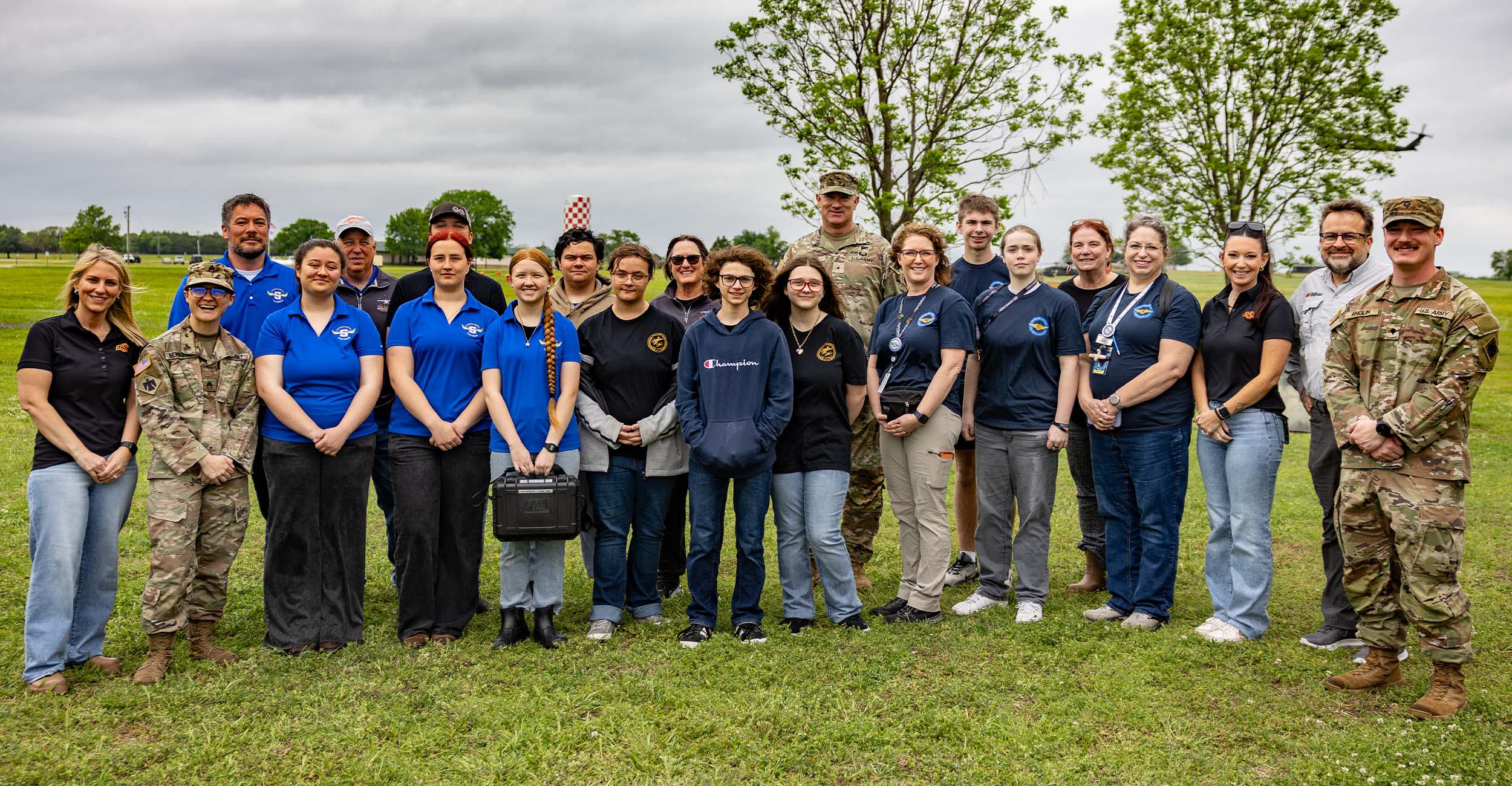
As part of the Oklahoma National Guard’s Exercise Lightning Strike at the Camp Gruber Training Site near Braggs, Oklahoma, approximately 15 students from across the state, along with their teachers and administrators, were given the opportunity to conduct simulated search-and-rescue missions using drones.
“I was proud to see how our team participated in the Guard’s Lightning Strike exercise this week. Our mission is to support the integration of UAS into emergency operations and doing this alongside a strong group of state partners and technical experts was refreshing,” said Dr. Jamey Jacob, OAIRE’s executive director. “It was encouraging to see such a coordinated effort around advancing this capability and OSU helping lead the way.”
Teams from Stillwater, Wilson and Pryor were asked to fly two search and rescue missions to find a lost and injured hiker inside a structure and a motorist who had been involved in an accident and sought shelter in a wooded area near the scene.
Teams received “updates” from their subjects throughout each mission to help pinpoint each location. The students then had to rely on teamwork, communication and UAS piloting skills to find each target and relay a code back to the command post to complete the mission.
“The hardest part of the competition was communication,” said Melanie Woods, a member of the winning team from Stillwater High School. “We had to rely on our visual observers to tell us how much room we had and to keep our drone in range of our pilot.”
Fellow SHS teammate Dakota Welsh identified teamwork as a key to the team’s success.
“We’ve been in class all semester together and become really good friends,” Welsh said. “We’ve learned how to communicate well with each other.”
The third member of the team, Laura Bennett, credited practice as the main contributor to their ability to log the fastest time.
“We’ve been practicing in similar situations,” Bennett said. “We’ve even been able to practice in wooded areas like this one, which helped.”
Participating in the friendly competition gave students and teachers an opportunity to showcase their skills ahead of this fall’s second annual Search and Rescue State Championship. However, observing the other training scenarios demonstrated the integration of drones into real-world careers and educational opportunities the students could pursue.
For one administrator, the event was a first glimpse into the school’s aviation team and their drone skills, but also an opportunity for his students to see the opportunities their passion could offer them.
“This was an amazing event,” said Greg Munholland, principal at Wilson High School. “I’ve never been to one of these competitions, and I was really impressed. Competitions like this develop skillsets that are very important and will make the students successful in life. I’m really proud of them.”
Exercise Lightning Strike consisted of several real-world scenarios, including natural disaster response to a devastating tornado, civil disturbance and wildland firefighting. The exercise provided the opportunity to build a support network across federal, state, tribal and academic partnerships to develop and implement response mechanisms.
However, representatives from industry and other academic institutions across the country who attended the event wanted to learn more about the search-and-rescue exercises that OAIRE has developed to engage students from across the state.
“We have several other states here to learn what we are doing in Oklahoma,” said Natalie Noles, OAIRE’s business operations manager. “Several universities have asked us to come out and replicate what we are doing for the high school teams with their institutions.”
The Oklahoma National Guard’s goal for the three-day event was to validate and synchronize emergency response operations with partner agencies and to integrate uncrewed systems into those responses.
“It is in our DNA as a research land-grant university to support our state and federal institutions in adopting emerging technology,” said Jacob. “We’ve been doing drone research for over 30 years now and thus often think of it as routine, but it’s one thing to test a robotic aircraft at our flight test field and quite another to integrate it into manned aircraft operations in a real-world disaster scenario. This is where you learn what works and what doesn’t. You have to do it here before you do it for real.”
For Shane Riley, a retired colonel and co-owner of RXR worldwide, a company dedicated to training, support, innovation and program management in the drone, defense and commercial world, the event also served as an opportunity to showcase Oklahoma’s expertise in those respective fields.
“The Oklahoma National Guard has had a lot of success with partnerships, leaning on all the capability that resides in Oklahoma in the aerospace and defense world,” Riley said. “Oklahoma has always had a strong aerospace and defense capacity, and with the continued development in those areas, we now have national and international partners looking to Oklahoma as an expert.”
Riley also highlighted how impactful it was to have students not just observe, but participate in the exercises.
“It’s amazing to get young people into this environment, expose them to what we think the future of commercial and defense activity looks like, and give them an opportunity to play and interact in this space and see the professional careers that exist,” Riley said. “They get to see the opportunity and pique their interest and understanding of what is going to be a foundational part of the world around them in the future.”