

Shooting for space
Friday, May 1, 2026
Media Contact: Jeff Hopper | Communications and Media Relations Manager | 405-744-5827 | news@okstate.edu
OSU student team attempting to launch a rocket to the edge of space
“Man must rise above the Earth — to the top of the atmosphere and beyond — for only thus will he fully understand the world in which he lives.” - Socrates
“3…2…1…”
As the countdown echoed in the background, the team of Oklahoma State University students braced for what was their biggest test to date — then ignition.
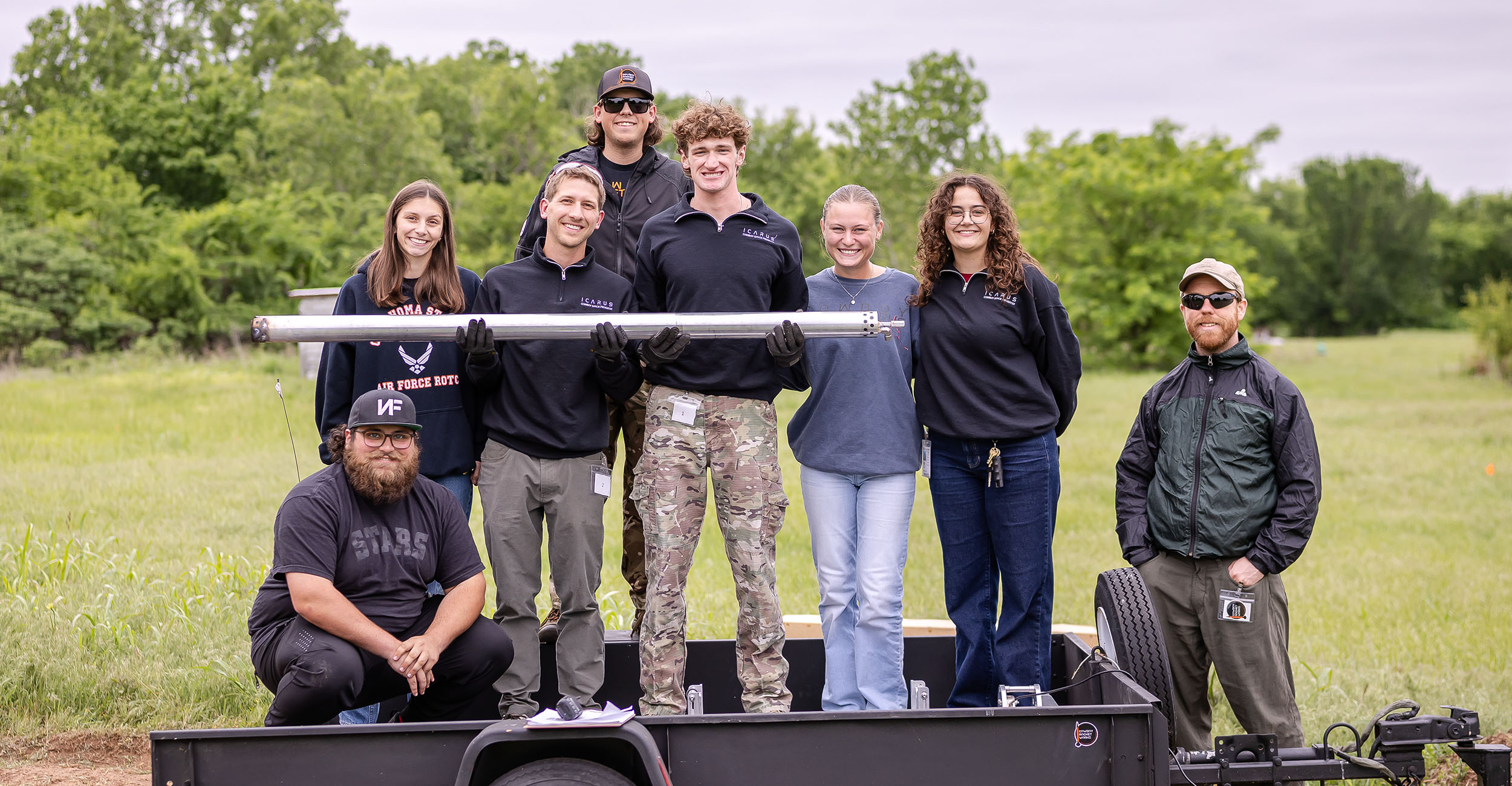
The Cowboy Rocketworks team watched as the vehicle lurched from the launch rail on its most recent test flight in March in a field in rural Kansas. As the rocket sped higher and higher, it ultimately reached an altitude of nearly 34,000 feet and clocked a speed of Mach 2.5, the fastest and highest rocket ever launched by an OSU team.
The test proved to be a great success, but the ultimate goal is much larger — space.
“It’s amazing that the students are able to do this and really push that limit,” said Dr. Jamey Jacob, executive director of the Oklahoma Aerospace Institute for Research and Education (OAIRE) and team sponsor. “That’s the first small step. Now we have to take that and scale it an order of magnitude to get to space – a giant leap.”
The first stage
Growing up in the Fort Worth, Texas, area, Gavin Stearman knew in high school that he wanted to be a part of sending a rocket into space.
“I had a great mentor in high school who was really interested in rocketry,” Stearman said. “I went through an aerospace engineering program in school for two years and realized this is something I want to do moving forward. It really lit a fire in me to be involved in rocketry from then on.”
During that same time, OSU’s rocket team was coming off of a run of consecutive victories at the Argonia Cup competition, which challenges teams of collegiate students to design, construct and execute a rocketry project utilizing innovative engineering and technology concepts.
“The choice of where to go for college was pretty easy,” Stearman said. “OSU was the obvious choice because of the success of their rocketry program and team.”
From the moment he arrived on campus, the soon-to-be mechanical and aerospace engineering graduate knew he wanted to continue to pursue the goal of sending a student-designed and -built rocket 100 kilometers, or approximately 330,000 feet, up to the Karman Line or edge of space — a goal referred to by those chasing it as a space shot.
Stearman met with faculty members — including Jacob and Dr. Rouser — soon after arriving on campus to discuss pursuing a space shot. Stearman was met with a challenge — the faculty members weren’t sure the current infrastructure and student knowledge base existed on campus to pursue a space shot.
“I was a little discouraged after that conversation,” Stearman said. “However, after some time thinking it over, I decided, ‘Why don’t I try to help develop the foundation for a space shot?’”
He joined the rocketry team and has, over the last five years, continued to develop the team and its capabilities, including fabricating their own airframes and mixing and casting their own motors.
However, it wasn’t until 2024 that the idea of an OSU space shot really began to take off. Up to that point, the capstone project for rocketry students was an Argonia Cup entry, alongside the Cowboy Rocketworks club entry. That year, the two teams would have likely won a title if they had combined efforts.
Another conversation ensued between Stearman and Jacob. The result was the idea to make the capstone project a space shot, as part of OSU’s moonshot initiatives under the newly formed OAIRE. In the fall of 2024, the first space shot capstone team was formed and supported with funding from OAIRE, with the goal of reaching a half-scale space shot — reaching 50 kilometers or approximately 165,000 feet.
The team faced several challenges and setbacks, but for Stearman, each one served as a learning opportunity and provided invaluable data to build a foundation for the next team to start from, taking on additional challenges along the way, such as casting their own rocket motors.
The second stage
Last fall, Stearman took over as the team lead and turned the focus toward developing one of the two stages that will take the team’s rocket to space, the sustainer.
The sustainer is the second stage of the rocket that will take over after the booster stage pushes through the densest and most challenging part of the atmosphere. The sustainer will provide an even, consistent burn over a set time period and will push the rocket to the Karman Line.
With the support of partners, like OAIRE, the Zink Center for Competitive Innovation and the College of Engineering, Architecture and Technology, the team has had successful tests of the sustainer stage and will continue to make adjustments over the summer, leading up to a half-scale space shot attempt in September in the deserts of Nevada.
With a successful half-scale test, the team would then move on to developing its own booster stage over the next year, culminating in a full space shot test in the fall of 2027.
“It’s really impressive what the team has been able to accomplish,” said Dr. Paul Elliott, a research assistant professor in mechanical and aerospace engineering and the team’s faculty mentor. “I was part of teams like this when I was in undergrad, and it’s been really exciting to have that ‘full circle’ moment, from being the lowest member of the team as an undergrad to now helping mentor a team and see all the pieces come together.
“The goals of the team are very auspicious. There are only a few collegiate teams to have achieved a space shot, and for this team to do so would be tremendous. As a point of perspective, the goal of my undergrad teams was one kilometer. Now, they’re shooting for 100 kilometers."
The space shot team is one of several initiatives across OSU and the state to put a larger emphasis on the space side of aerospace.
“As a state, we’re kind of a big ‘A’ and little ‘s’ in aerospace,” Jacob said. “OSU is a microcosm of that, but we’re developing moonshot initiatives, like this space shot team, to prioritize space–focused projects and goals. This will help the university and the state develop a more robust and well-rounded aerospace industry providing opportunities for startups and attracting rocket companies to the state, and of course further cement us as a leader in both space and aviation.”
True to the Cowboy Code, Stearman has elected to pursue his master’s degree in mechanical and aerospace engineering and see the space shot mission through to the end — finishing what he started years ago.