

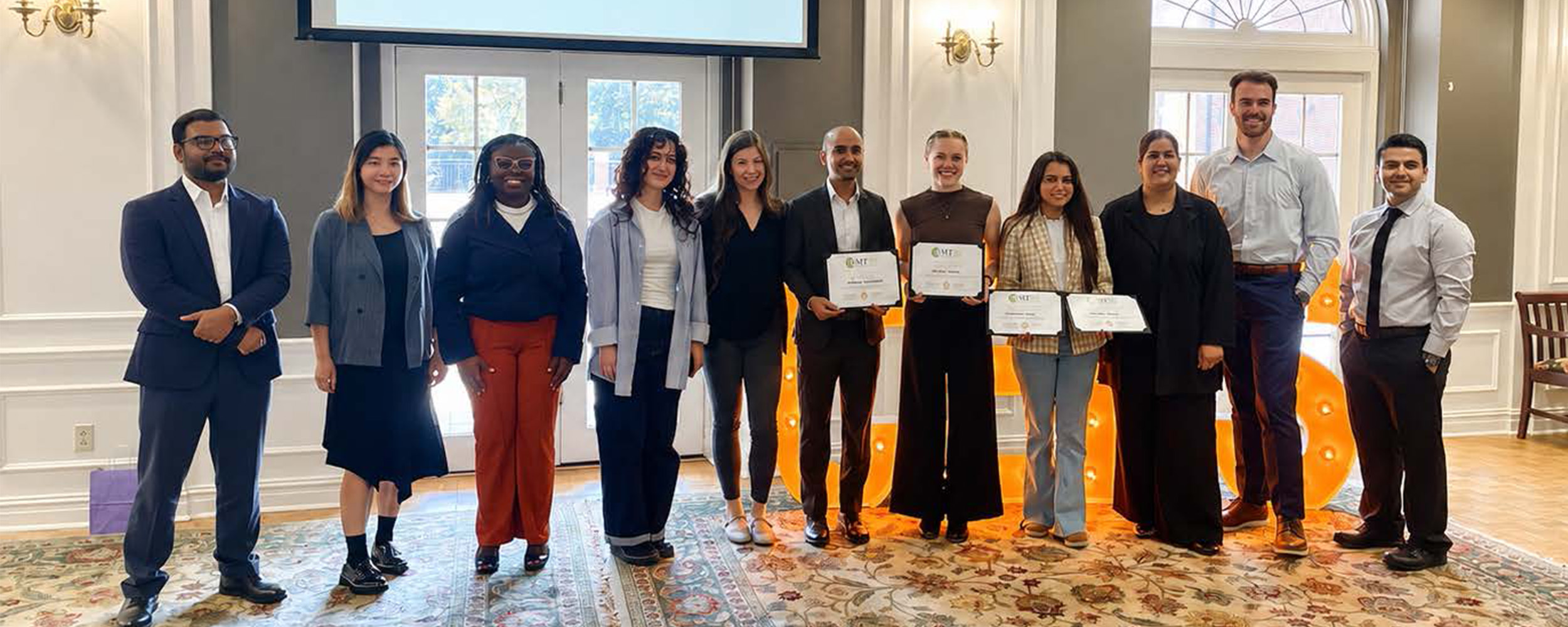
Three-Minute Thesis highlights student research in the College of Education and Human Sciences
Thursday, October 22, 2026
Media Contact: Kirsi McDowell | Communications Coordinator | 405-744-8320 | kirsi@okstate.edu
Key Facts
Nutritional sciences doctoral student Gopal Lamichhane won first place in the College of Education and Human Sciences Three-Minute Thesis competition on Oct. 10. for his presentation on curcumin and its potential effects on metabolic health
Isabella Hanks, a master’s student in marriage and family therapy, earned second place for research on couples’ relationship satisfaction during therapy.
Lamichhane and Hanks will represent the College of Education and Human Sciences at the universitywide Three-Minute Thesis competition at 3:30 p.m. Oct. 29.
The College of Education and Human Sciences showcased leading student researchers at its Three-Minute Thesis competition on Oct. 10.
Among the 11 competitors, three were recognized as top graduate student researchers in the college.
Gopal Lamichhane, a doctoral student in nutritional sciences, earned first place and a $300 prize for his presentation, “Can Curcumin Slow Metabolic Diseases in Aging?” Lamichhane’s research adviser is Dr. Yoo Kim.
Lamichhane studies curcumin, a bioactive compound found in turmeric, to examine its potential effects on metabolic health in older adults and animal models. He said the competition offered an opportunity to share research with people outside academia.
“Three-Minute Thesis is a really good platform where we can present our research to a general audience,” Lamichhane said.
Lamichhane said condensing months of research into a three-minute presentation required him to focus on the broader significance of his work rather than detailed scientific mechanisms.
“I was really happy when I saw that I won first place,” Lamichhane said. “I can really see I’m doing better as I progress into the next step.”
Isabella Hanks, a master’s student in marriage and family therapy, earned second place and a $200 prize for her presentation, “Relationship Satisfaction Trajectories in Couples Therapy: A Comparison of Parents and Non-Parents.” Working with her research adviser, Dr. Preston Morgan, Hanks examined whether parenting influences couples’ relationship satisfaction at the beginning of therapy and how satisfaction changes throughout the process.
“I felt like my research was important because relationships are something that so many people can relate to, and I wanted to share what I found in a way that was understandable and meaningful to people outside of my field,” Hanks said.
Hanks said this was her first time competing in the 3MT competition. She prepared by organizing her presentation around the research background, methodology and findings, focusing on the most important information to fit the three-minute limit.
“Winning second place was a huge honor,” Hanks said. “I was proud of my presentation, and it was validating to see that the message resonated with the judges.”
Lamichhane and Hanks will represent CEHS at the universitywide 3MT competition at 3:30 p.m. on Oct. 29.
Tamanna Kinha, a doctoral student in human development and family science, earned third place with a $100 cash prize and the $300 People’s Choice Award. Her presentation, “The Invisible Paradox: A Tale of Indian Immigrant Adolescents and Their Mental Health,” focused on the mental health of Indian immigrant adolescents. Kinha’s research adviser is Dr. Ron Cox.
Kinha said her interest in the topic grew from her background in India and her experience as a science educator for more than six years, in which she worked closely with adolescents. She wanted to better understand how cultural transitions may affect Indian immigrant adolescents as they adapt to life in the United States.
“The People’s Choice Award is actually a cherry on the cake,” Kinha said. “I realized that the topic that I presented and the research I’m doing is something which people can actually relate to.”
Kinha said she felt encouraged by the audience’s response and hoped her research would help people recognize the challenges facing Indian immigrant adolescents and work toward solutions.
The 3MT competition challenges graduate students to communicate their research to a broad audience in a concise presentation. Participants must work complex research into a three-minute presentation, making their work accessible to people outside of academia.
The competition was founded by the University of Queensland in 2008 and has evolved into a globally recognized challenge.
Frequently Asked Questions
Who won the OSU College of Education and Human Sciences Three-Minute Thesis competition?
Gopal Lamichhane won first place in the OSU College of Education and Human Sciences Three-Minute Thesis competition on Oct. 10. Isabella Hanks earned second place, and Tamanna Kinha earned third place and the People’s Choice Award.
When is the OSU universitywide Three-Minute Thesis competition?
The OSU university-wide Three-Minute Thesis competition is scheduled for 3:30 p.m. Oct. 29. Gopal Lamichhane and Isabella Hanks will represent the College of Education and Human Sciences.
What is the OSU Three-Minute Thesis competition?
The OSU Three-Minute Thesis competition challenges graduate students to explain complex research in a three-minute presentation for a general audience. The competition was founded by the University of Queensland in 2008 and has since become a globally recognized research communication challenge.
Story By: Annie Ross | annie.ross@okstate.edu