

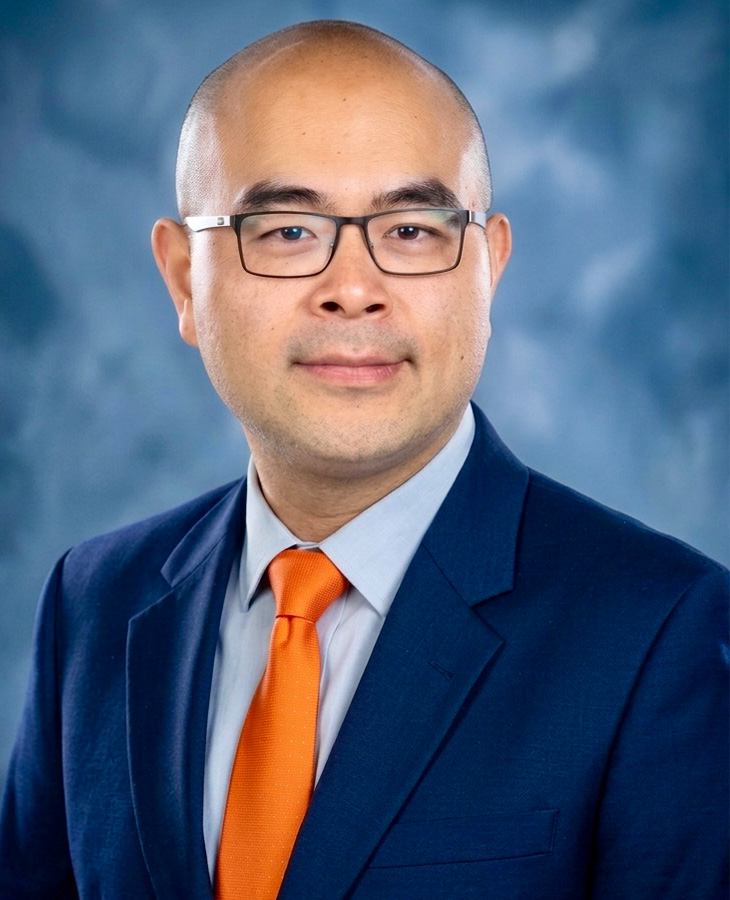
Bian named head of School of Industrial Engineering and Management
Monday, June 22, 2026
Media Contact: Desa James | Communications Coordinator | 405-744-2669 | desa.james@okstate.edu
Dr. Linkan Bian has been named professor and head of the School of Industrial Engineering and Management in the College of Engineering, Architecture and Technology at Oklahoma State University.
For Bian, the opportunity to lead IEM is about more than a position; it’s about possibility.
“This is a school with a deep history and a strong foundation — but also real opportunity to shape what comes next,” he said. “I was drawn to the chance to help define that next phase and create an environment where faculty and students can do meaningful, impactful work.”
Bian brings a national perspective and a proven record of leadership in advanced manufacturing, artificial intelligence and systems engineering. He currently serves as a program director and advanced manufacturing cluster lead at the National Science Foundation, where he helps guide research priorities and innovation initiatives across the country.
“With leadership experience at NSF and a strong academic record, Linkan will be an excellent head to lead IEM,” said Dr. Hanchen Huang, dean of CEAT. “I look forward to working with him in moving IEM forward.”
His academic journey spans the globe, from earning his bachelor’s degree in applied mathematics from Peking University in Beijing to his Ph.D. in industrial and systems engineering at Georgia Tech to building a distinguished career at Mississippi State University, where he held an endowed professorship and earned recognition for both research and teaching excellence.
But beyond the accolades, the 86 journal publications, $15 million in funded research and national honors, including being named a fellow of the Institute of Industrial and Systems Engineers, Bian’s work is grounded in something simple: solving real problems that matter.
“Industrial engineering is about understanding complex systems and making them work better,” he said. “When you improve systems, you improve outcomes — and that can impact industries, communities and lives.”
Building on legacy, leading with purpose
As IEM approaches its centennial, Bian sees the milestone as both a celebration and a turning point.
“A program that lasts nearly a century does so by adapting,” he said. “My goal is not just to preserve that legacy, but to extend it with purpose — ensuring that IEM is known not only for its history, but for its continued relevance and leadership.”
His vision centers on alignment — bringing together research excellence, meaningful industry partnerships and student success in ways that reinforce one another. He aims to strengthen the school’s role in fields that are rapidly transforming how industries operate: AI, smart manufacturing and human-centered systems.
“In this new era, industrial engineering is becoming even more essential,” Bian said. “We are the bridge between advanced technology and real-world implementation.”
An education that feels real
At the heart of Bian’s leadership philosophy is a deep commitment to students, not just as learners, but as future leaders.
He envisions an IEM experience where classroom knowledge meets real-world application through hands-on projects, internships and industry collaboration. Initiatives like the Cowboy Academy will continue to play a key role in connecting students directly with practitioners and real challenges.
“When students work on problems without predefined answers, they learn how to think — not just what to know,” Bian said. “That’s when confidence grows. That’s when transformation happens.”
His passion for teaching comes from witnessing that transformation firsthand.
“Over time, you see students move from uncertainty to clarity — from following solutions to creating their own,” Bian said. “That’s what makes this work meaningful.”
Strengthening connections beyond campus
Bian also sees tremendous opportunity to deepen partnerships with industry and alumni through expanding internships, applied research and collaborative projects that bring real-world relevance into every aspect of the program.
These connections, he believes, create a powerful cycle: industry informs research; research enhances education, and students graduate ready to make an immediate impact.
In the next 5 to 10 years, Bian envisions IEM as a school that stands out with clarity and confidence.
And as the school looks toward its next century, he offers a simple but powerful invitation:
“Now is the best time to be in industrial engineering,” Bian said. “I invite our students, faculty, alumni and partners to join me in shaping what comes next.”