


CEAT researchers unveil hidden mechanics behind oil-water emulsions
Tuesday, July 14, 2026
Media Contact: Tanner Holubar | Communications Specialist | 405-744-2065 | tanner.holubar@gmail.com
They may be invisible to the naked eye, but their effects are seen every day across the oil and gas industry. Millions of microscopic oil droplets are present in produced water after it is extracted from oil, making separation more difficult and expensive.
This process is caused by an emulsion, in which two liquids are mixed, with tiny droplets of each dispersed throughout the other.
An interdisciplinary research team in the College of Engineering, Architecture and Technology at Oklahoma State University is uncovering new knowledge of these droplets that will help in oil recovery and water treatment efforts.
A team consisting of Dr. Mark Krzmarzick, head of the School of Civil and Environmental Engineering, Dr. Clint Aichele, professor in the School of Chemical Engineering, and Alireza Zahedi and Saeed Azizi, graduate research assistants in CHE, co-authored a paper titled “Viscoelastic Properties of Produced Water Emulsions,” which was published in Energy & Fuels in June. The National Science Foundation supported their research.
The oil and gas industry produces more than 900 billion gallons of produced water annually. Before it can be reused, recycled or disposed of, the oil must be removed from the water, a process hampered by the microscopic droplets caused by emulsion.
“Our research looks at the behavior of the very thin film that forms between the oil droplets and the water around them, almost like the ‘skin’ of each droplet,” Zahedi said. “By understanding how stiff or flexible that skin is, we can figure out why some mixtures are easy to separate, and others are stubbornly stable.”
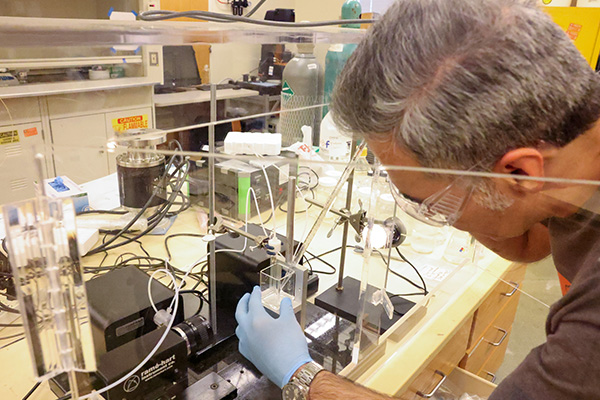
The team used a technique to gently stretch and compress individual droplets to measure their properties. They discovered that the salty, chemically complex water produced by oil wells behaves differently from ordinary water.
This is a challenge because oil breaks into millions of droplets that are stabilized by naturally occurring and added chemicals, which create surfactants, or substances that reduce the surface tension between two liquids.
Traditional approaches have focused on measuring the tension at the water-oil boundary, but this yields a single, non-definitive measurement.
"Our research went further by measuring the viscoelastic properties of that interface — essentially, how the droplet's 'skin’ responds when it’s stretched or compressed, storing or releasing energy,” Zahedi said. “We also specifically studied produced water rather than plain laboratory water, which turns out to matter enormously. The dissolved salts and ions in produced water change the behavior of surfactants in ways that couldn't be predicted from simpler systems.”
Developing more efficient methods for separating oil from water is critical, as the water can’t be discharged into the environment or reused without treatment. This is even more important as freshwater scarcity grows, resulting in increased efforts to treat produced water for agricultural or industrial reuse.
The team discovered several aspects that could improve treatment efforts. They found that the chemistry of produced water caused surfactants to become active at much lower concentrations than ordinary water, resulting in stable emulsions forming more easily.
They also found that the microscopic film surrounding oil droplets is more than twice as stiff as the film formed in ordinary water under the same conditions, although stiffness alone does not determine whether droplets remain separated.
“Having enough surfactant to completely coat the surface of every droplet is just as important as how strong the coating is,” Zahedi said. “Even a very stiff interfacial film won’t prevent droplets from merging if there simply isn’t enough surfactant to cover all of the droplet surfaces.”
This allows engineers to design more effective treatment strategies, as well as improve the use of demulsifiers, or chemicals added during oil production to break emulsions and speed up the separation process.
The team plans to investigate commercial demulsifiers currently used to better understand how surfactant molecules are distributed during emulsification.
The fundamental science behind this research could have an impact on other areas. Food processing, such as salad dressing and dairy products, involves emulsions. They are also found in pharmaceuticals, cosmetics and environmental remediation involving contaminated water.
This project utilized synthetic produced water and a model surfactant and oil to establish a clean baseline. The next step would involve using real produced water samples from active fields, which carry a much more complex mixture of organic compounds, natural surfactants and variable ion chemistry.
“This work lives at the crossroads of environmental responsibility and energy production,” Zahedi said. “Produced water treatment is not just an engineering problem. It’s increasingly a water security issue, especially in regions where reuse is being actively explored.
“Research that helps us understand and control these systems at a fundamental level has real consequences for communities, ecosystems and the long-term sustainability of energy operations. We're grateful for the support of the National Science Foundation, which made this work possible, and for the collaboration with our colleagues in Civil and Environmental Engineering here at Oklahoma State.”