

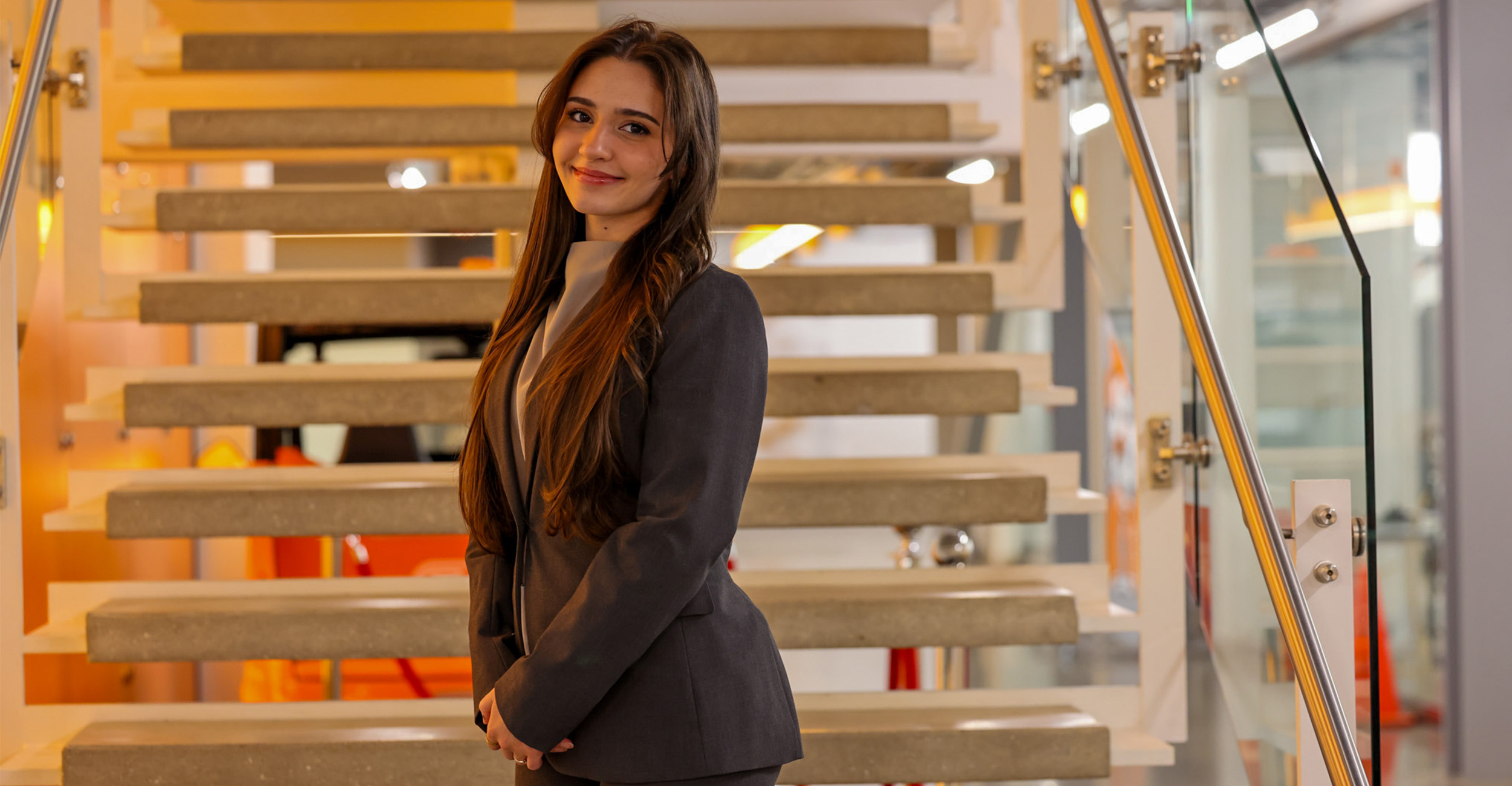
Chemical Engineering student Ceyda Kara earns 2026 Barry Goldwater Scholarship
Wednesday, April 22, 2026
Media Contact: Tanner Holubar | Communications Specialist | 405-744-2065 | tanner.holubar@okstate.edu
At Oklahoma State University’s College of Engineering, Architecture and Technology, sophomore Ceyda Kara is charting a path that blends engineering, medicine and neuroscience.
Kara, a pre-med student in the School of Chemical Engineering with a minor in neuroscience, has been named a 2026 Barry Goldwater Scholarship recipient. This scholarship supports students pursuing research careers in science, engineering and mathematics, and is an indication of future leaders in these fields. OSU nominates only four students each year for this prestigious honor.
Kara said she knew, while applying, that it was rare for a sophomore to be selected and that the M.D.-Ph.D. track made it even more competitive.
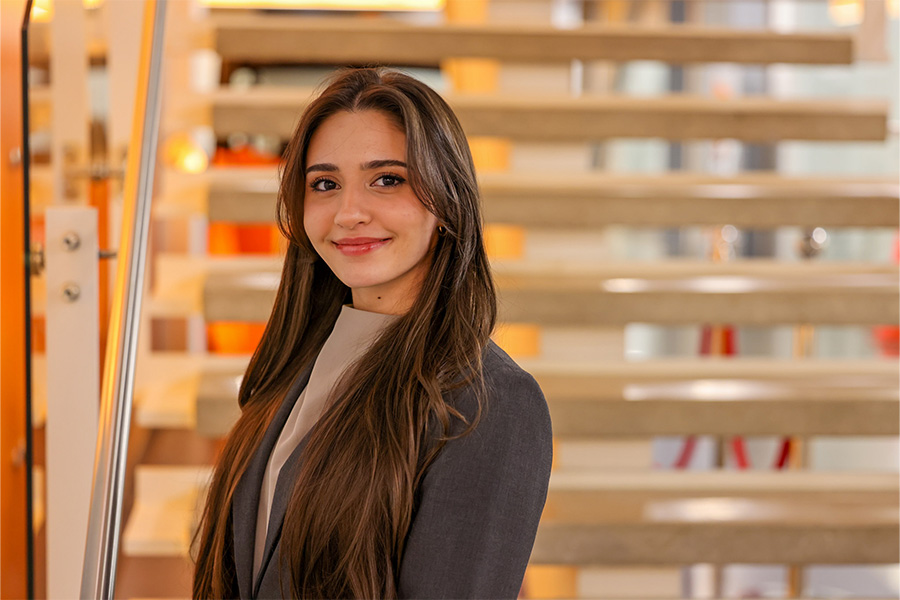
“The night before the announcement emails went out, I couldn't sleep at all,” Kara said. “When I finally opened the email and saw, ‘Congratulations,’ I completely lost it. I was overwhelmed with joy and disbelief. The odds felt stacked against me, which makes this recognition mean that much more.”
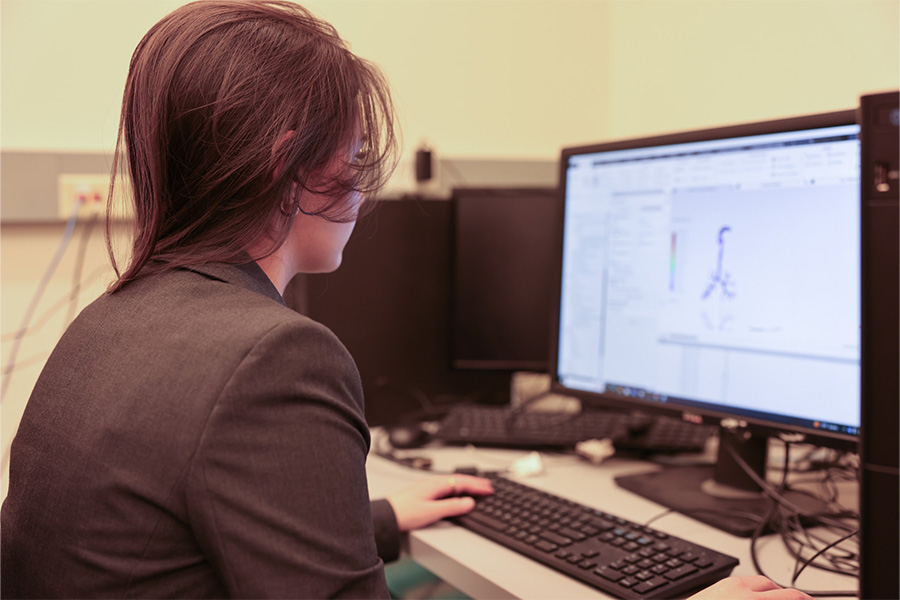
Working on Dr. Yu Feng’s research team in the Computational Biofluidics and Biomechanics Laboratory, Kara builds computational models of organs such as the lungs and liver and uses computational fluid dynamics to simulate airflow, particle motion and blood flow.
This enables the study of drug delivery and the development of personalized care for patients with diseases such as COPD and cancer. Kara has also conducted neuroscience research at the Oklahoma Medical Research Foundation, where she studied drug addiction using mice.
Kara said her top priority is to invest in her research with the funding provided by this scholarship.
“Whether that's attending conferences to present my work and connect with other researchers or upgrading my tech setup so I can work more efficiently,” Kara said. “I also won't lie, I have a soft spot for good stationery, so some of it might go toward that too. But at its core, this funding gives me more freedom to pursue intensive research without as many financial constraints.”
Kara’s inspiration to become an engineer lies in her fascination with the fact that every car, every time someone uses a phone, and every road and bridge people travel are designed by engineers. With so many engineering paths to choose from, Kara is following her passion to become a neural engineer.
“I hope to design technology such as brain-computer interfaces, for example,” Kara said. “These brain chips are being implanted into paralyzed patients and allowing them to communicate using only a computer and their brain signals.”
There have been many mentors and supporters who have helped Kara get to this point, from professors to her peers in CEAT. She is also thankful to OSU, CEAT and CHE for the support she said has been transformative.
“First and foremost, my research mentor Dr. Yu Feng — none of this would have happened without his guidance, belief in me, and the incredible opportunities he's given me in his lab,” Kara said. “Dr. Hang Yi, a postdoc in the Feng Lab, has also been a constant source of support whenever I hit a wall in my research. At OMRF, Dr. Michael Beckstead played a huge role in solidifying my passion for neuroscience, and Laci Liter, a Ph.D. student there, inspired me with her love for the work.
“Dr. Harris Blankenship gave me some of the best advice throughout my Goldwater application, and I'm so grateful for his support. On the administrative side, Jessica Sullins and Latasha Tasci were incredible throughout the entire application process — and taking us to Taos was genuinely one of the most inspiring experiences of my life. That trip gave me so much clarity and energy while writing my essays. And of course, my friends Noor, Janat, Lizzie, and Victoria, who were always there to listen, encourage, and cheer me on. And my parents, who sat with me through every draft, every idea, thank you from the bottom of my heart.”
Kara aims to pursue a master’s degree in biomedical engineering at Cambridge University, then apply to an M.D.-Ph.D. program, to work at the intersection of neuroscience and medicine as a neural engineer.
To her fellow CEAT students, Kara said it is important to find the “why” behind engineering passions.
“Engineering is hard. When you're staring down your 50th heat transfer problem, passion is what gets you through, not willpower alone,” Kara said. “When you take the big picture into account and remember that you are training to be the person who builds the world's next tallest building or sends humans to Mars, it will carry you through CEAT and far beyond it. OSU gives you incredible tools and opportunities; let that vision of your future self be the reason you use every single one of them.”