

CIBS fosters collaboration benefiting OSU, HVAC industry
Thursday, September 3, 2026
Media Contact: Tanner Holubar | Communications Specialist | 405-744-2065 | tanner.holubar@okstate.edu
The Center for Integrated Building Systems in the College of Engineering, Architecture and Technology fosters distinct collaboration between academia and the heating, ventilation and air-conditioning industry.
CIBS is designed to advance pre-proprietary research in support of industry and national lab members. OSU faculty and students also collaborate with industry on proprietary research to tackle some of the most pressing issues facing the HVAC industry.
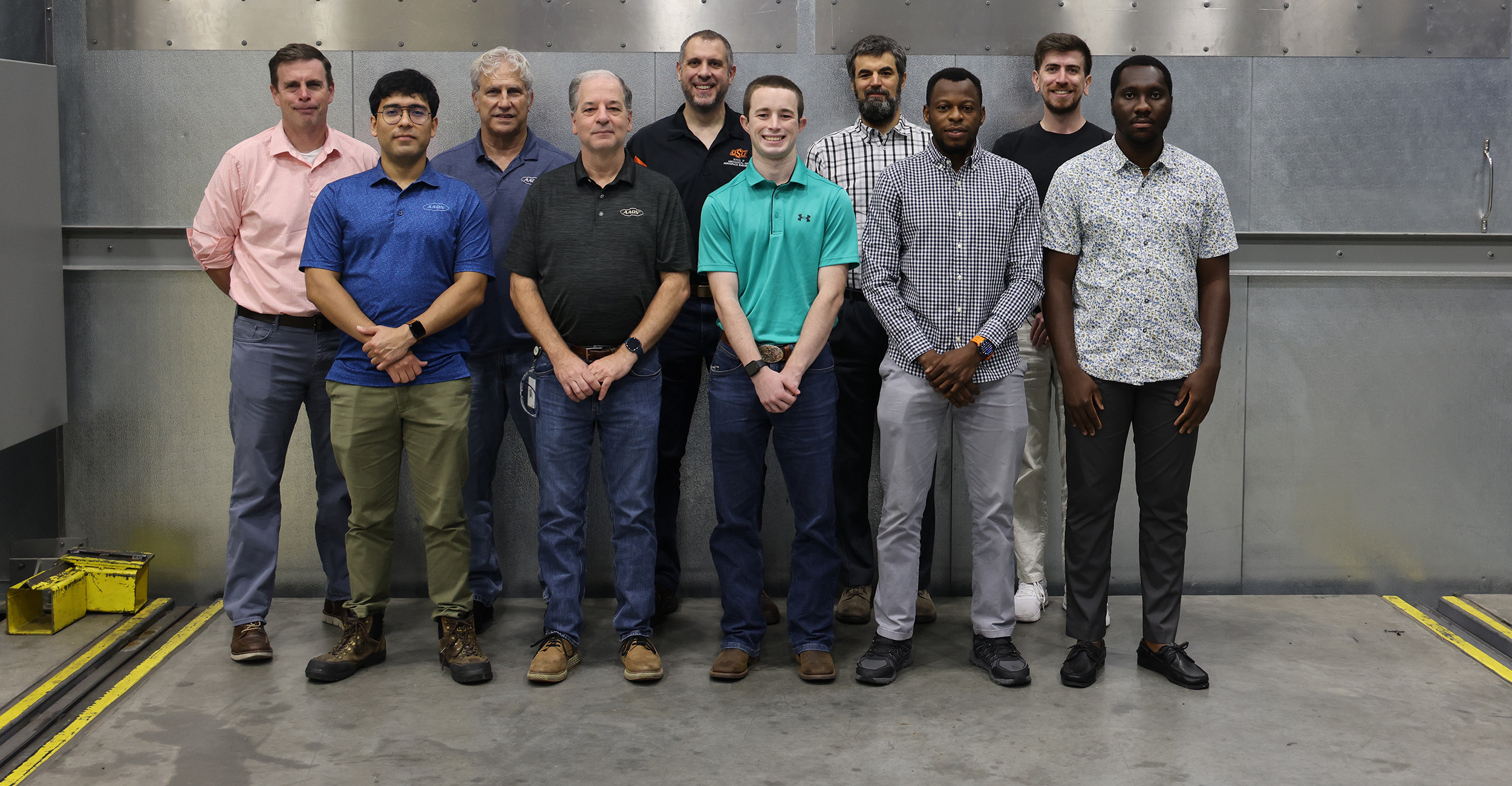
One such proprietary project will see CEAT researchers collaborate with AAON, an Oklahoma-based HVAC company, on a project titled "Superheat Control Algorithm Development for AAON's High-Efficiency Heat Pumps."
This project is led by Dr. Christian Bach, professor in the School of Mechanical and Aerospace Engineering , as the principal investigator. Dr. Mike Xiang, associate MAE professor and Dr. Aaron Alexander, professor in Mechanical Engineering Technology, are co-PIs.
The team will address operational challenges with AAON's cold-climate heat pumps and increase their efficiency for the company's customers by developing an artificial intelligence superheat control algorithm for heat pump operation. The team will use dynamic modeling and simulations to create a prototype of an AI-based approach to manage superheat controls that can adjust to system operational challenges. They will also use laboratory testing to debug the approach before AAON field tests it.
The superheat control algorithm handles the loading of the heat exchanger, pulling heat from indoor air, for air conditioning, or the outdoor air, for heating the building.
"Load the heat exchanger too much and you start damaging the compressor with unevaporated refrigerant and load it too little and you lose capacity and efficiency,” Bach said. “In heat pump mode, one may choose to unnecessarily defrost the heat exchanger with a superheat controller that cannot work properly under frosted conditions, which reduces energy efficiency."
One of the biggest challenges the researchers face in developing the algorithm is accounting for changes in the system's behavior when the heat pump is running.
Frosting in heat pump mode and the use of an airside economizer in air-conditioning mode can cause the system to behave differently. This can cause simple algorithms to become unstable.
"Experimental time in lab facilities is quite costly and constrains you to real-time testing, which is why we are using simulations for accelerating the algorithm development," Bach said.
This project grew out of relationships, networking and opportunities for students fostered through CIBS.
For OSU, these collaborations provide research funding and support the professional development of graduate and undergraduate students. It's also an opportunity to research industry-relevant projects that lead to discoveries used by companies in their products.
For companies like AAON, OSU can take on various research and development tasks, giving students the opportunity to make a lasting impression on future employers.
"AAON hired my last three graduate-level alumni, and I can say it has turned out to be very beneficial for all involved," Bach said.
Bach said companies like AAON are committed supporters of CIBS and OSU and contribute significantly to the development of infrastructure that eventually becomes facilities used for CIBS experiments. Bosch Home Comfort and the Oklahoma Center for the Advancement of Science and Technology also helped OSU develop facilities and software that contributed to CIBS before the center was even established.
This project builds on prior research with AAON to demonstrate what heat pumps can accomplish in cold climates and to bring the technology to the market more quickly.
"AAON's history of supporting my research area at OSU was one of my key factors in my decision to join OSU," Bach said. "A huge thanks to everyone on the AAON side for their support that has made past projects a success. All of my former collaborators and students who have worked on prior research projects with AAON were a large part of those successes, and the research wouldn't have been possible without them."