

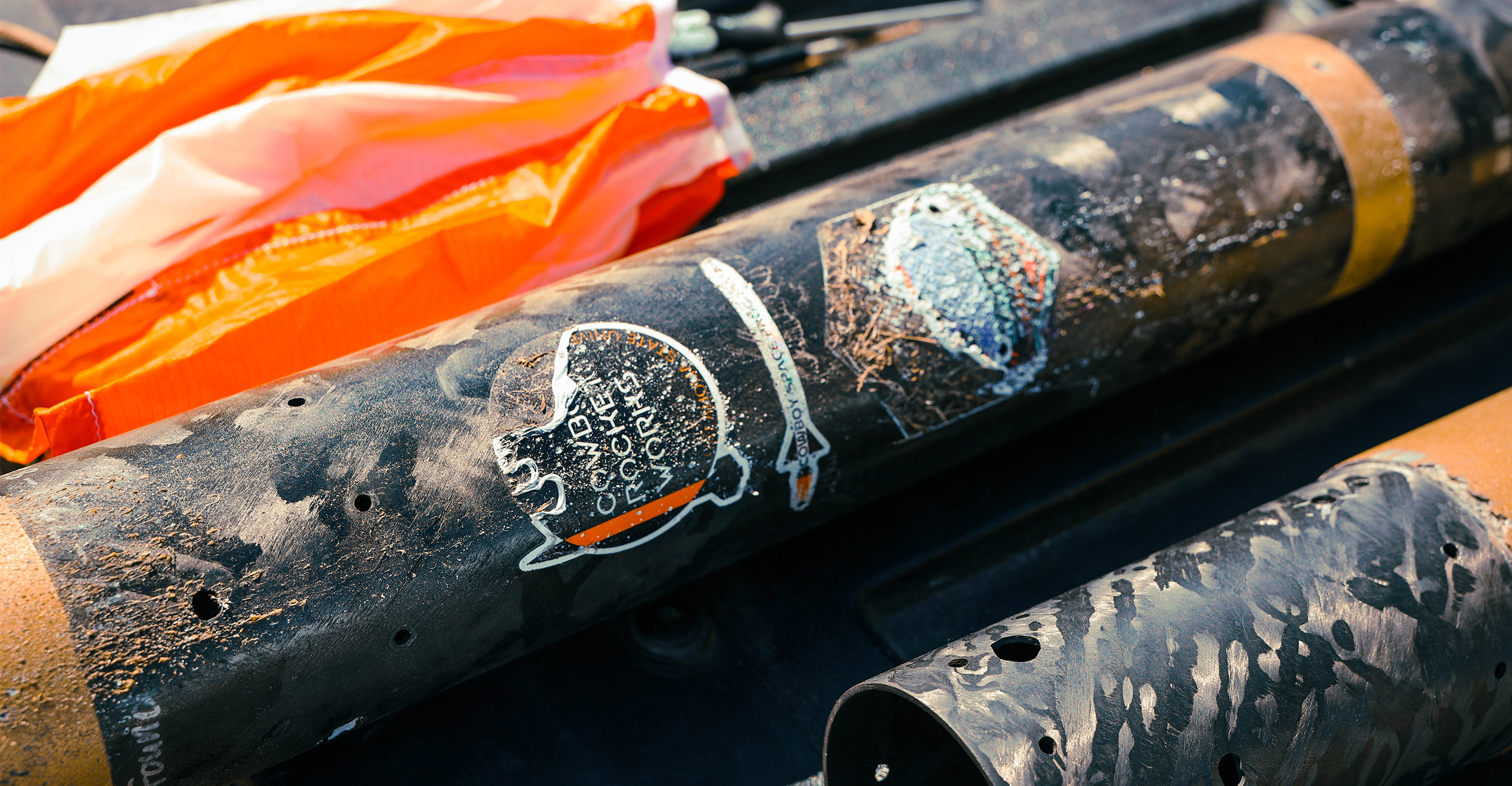
Cowboy Rocketworks vies for the Argonia Cup
Thursday, April 16, 2026
Media Contact: Desa James | Communications Coordinator | 405-744-2669 | desa.james@okstate.edu
In March, Cowboy Rocketworks competed for one of the most prestigious collegiate rocketry design competitions in the nation: the Argonia Cup.
The competition, founded in 2017, is held annually at the Rocket Pasture, just a few miles south of the competition’s namesake, Argonia, Kansas. The primary goal of this collegiate design competition is for student organizations and design groups to compete with one another, driving innovation and fueling the next generation of engineers with a passion for rocketry. The challenge is simple: send as many golf balls as high as possible, within a range of 9,000 to 40,000 feet.
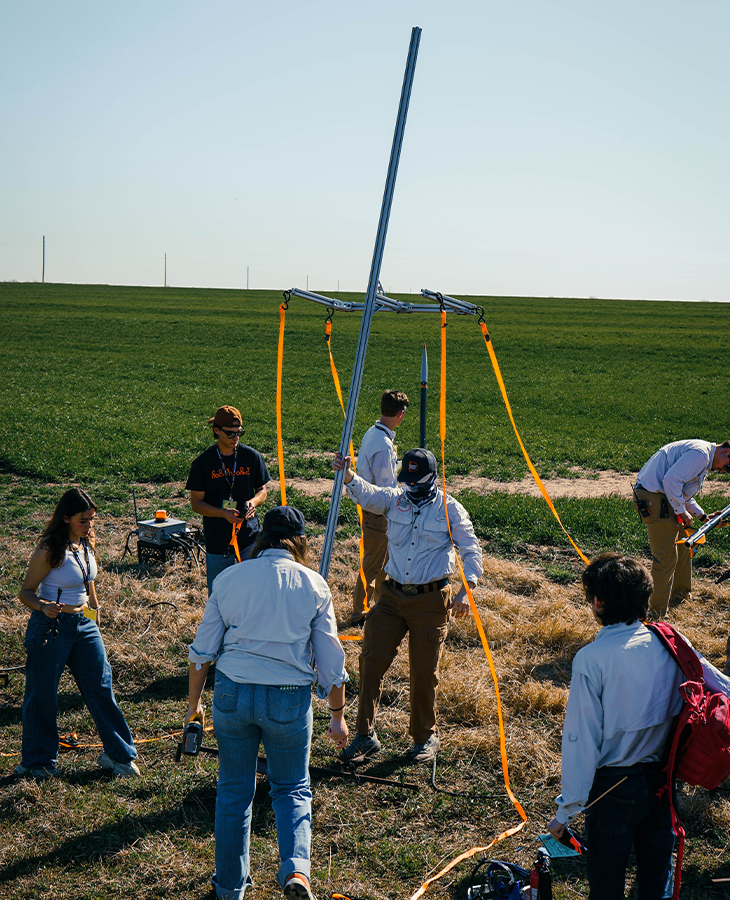
Cowboy Rocketworks has been an Oklahoma State University student organization since August 2016, starting as the OSU AIAA (American Institute of Aeronautics and Astronautics) student branch. It has since grown into an independent, student-led organization under the Zink Center for Competitive Innovation.
The team has a storied history with the competition, winning four consecutive titles from 2017 to 2020. The past few years, however, have brought more hardship and lessons learned than trophies. This year, Cowboy Rocketworks came ready and prepared to win.
Over the past two semesters, the team has worked tirelessly designing, testing, prototyping and manufacturing the 2026 Argonia Cup rocket, “Raymond,” named after Zink Center Competitions Manager Ray Lucas, who oversees the Zink Center competitive design teams. The team had one goal for this rocket: to show other teams that OSU has the best rocketry team in the nation.
The design cycle began in July, with the team planning the main design and rocket strategy using score optimization calculations and past experience. The team followed an iterative design process, meaning they revisited the previous rocket and improved upon it. From the preliminary design, the team conducted a full-scale flight test in November, gathering valuable data to improve flight performance and structural integrity.
After designing and testing the rocket, students began manufacturing all components. Club members work with cutting-edge, aerospace-grade materials and processes, such as carbon fiber, aluminum, high-precision machining and advanced 3D printing. They ensure that as the rocket ascends, it remains intact — and avoids any “rapid disassembly protocol.”
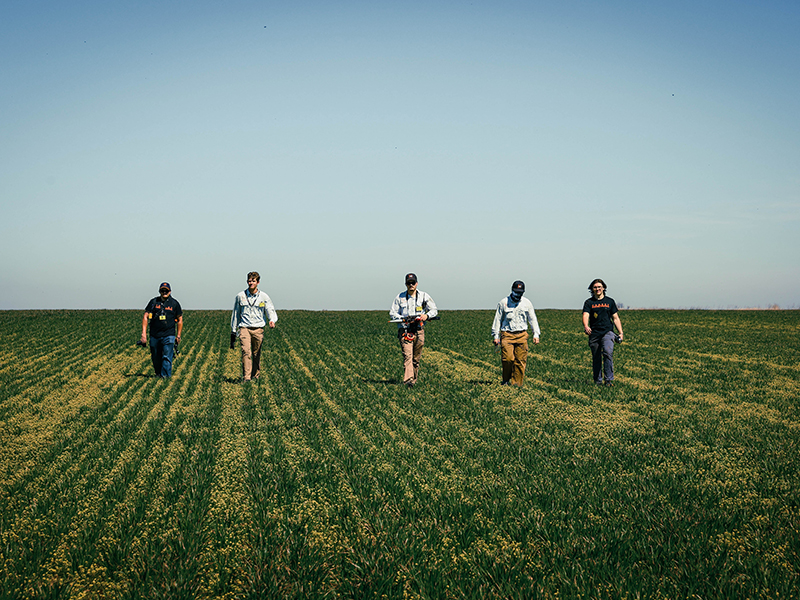
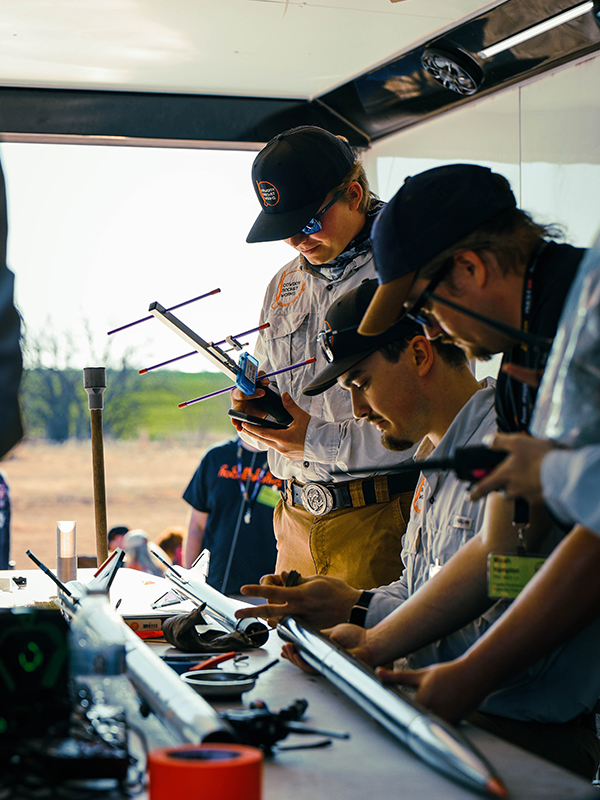
Once manufacturing, assembly and preparation were complete, the team made the two-hour trek to the Rocket Pasture for the weekend-long event. By six in the morning, with the sun barely up, the team arrived and began setting up for the day. Throughout the competition, 21 teams launch each of their rockets twice, and only six teams achieve a qualifying flight.
With clear blue skies and near-perfect weather, Oklahoma State’s Cowboy Rocketworks launched “Raymond,” carrying a payload of nine golf balls and reaching an altitude of 24,657 feet at a top speed of Mach 1.5, experiencing 26 times the force of gravity. Overall, the team placed 2nd out of the 21 teams that participated, becoming the first and only club team to ever place in the competition, as all other placing teams have been senior design capstone projects rather than student-led organizations.
When asked how it felt to see the club’s first qualifying flight in the past three years while scoring second place, Argonia Cup Project Manager Grant Biggers stated:
“It feels awesome to finally see the fruits of our labor. We work on the shoulders of those who came before us, taking their lessons learned and implementing them throughout the design.
Notably, our mentor, Gavin Stearman, greatly helped us through the design and optimization process.
We could not have accomplished all we have done without the support of Ray Lucas and the Zink Center for Competitive Innovation, as well as Dr. Jamey Jacob and the Oklahoma Aerospace Institute for Research and Education.”
Wrapping up this season, Cowboy Rocketworks will begin preparing for the next, with hopes of taking first place and pushing new heights.
The Argonia Cup


Story By: Marianne Phu, Jack Sadler | mphu@okstate.edu; jack.sadler@okstate.edu