


Kenawy earns NSF CAREER Award to advance infrastructure resilience to extreme events
Thursday, August 6, 2026
Media Contact: Desa James | Communications Coordinator | 405-744-2669 | desa.james@okstate.edu
Dr. Maha Kenawy, assistant professor for Oklahoma State University’s School of Civil and Environmental Engineering, is leading research to help communities better prepare for and recover from extreme natural disasters such as earthquakes and severe storms.
Supported by the National Science Foundation’s prestigious Faculty Early Career Development (CAREER) Award, Kenawy’s work focuses on improving how engineers simulate and understand the risks that rare but devastating events pose to critical infrastructure systems such as buildings, bridges and power grids.
"Our goal is to enable engineers and planners to better understand the consequences of extreme events to infrastructure systems," Kenawy said. "The uncertainty associated with such events makes it difficult to reliably assess the risk of infrastructure damage, and how long it could take for the community to recover."
Tackling uncertainty in extreme events
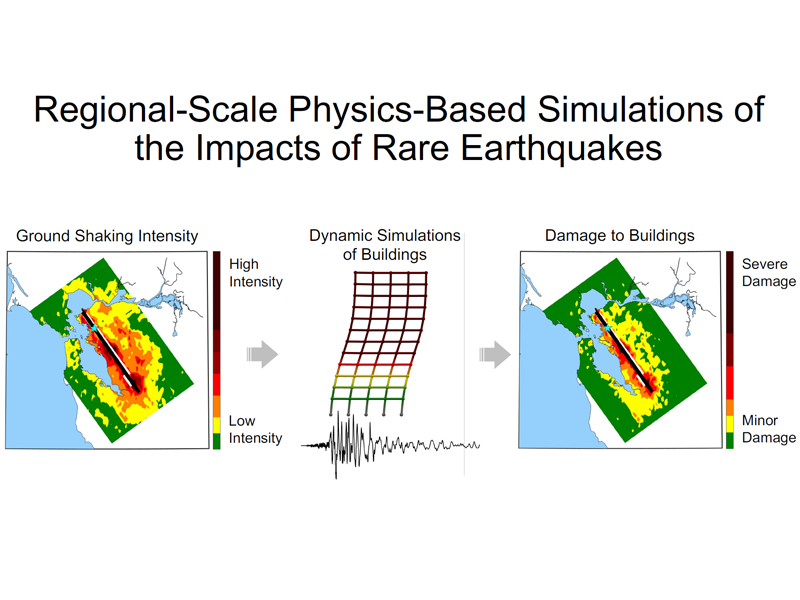
While engineers regularly assess the consequences of natural hazards to civil infrastructure, Kenawy’s research addresses a major challenge: uncertainty quantification for rare events. The impacts of extreme events such as large-magnitude earthquakes on communities may vary widely across space and different possible scenarios, making them difficult to study using conventional numerical analysis methods.
“Such events do not happen often, so we do not have enough observational data,” Kenawy explained. “That means we have to rely on simulations — but even those can only capture part of the whole picture, unless we carefully decide which extreme scenarios to study.”
To overcome this gap, Kenawy is developing a new computational approach that combines two major strategies used in engineering today:
- Probabilistic models, which rely on statistical methods to quantify uncertainty
- Physics-based models, which represent physical processes using detailed high-resolution numerical simulations that capture how seismic waves travel through the earth and affect civil structures
By integrating these approaches, her research will help engineers identify the most informative extreme-event scenarios to simulate and reduce the computational cost of large-scale numerical simulation campaigns.
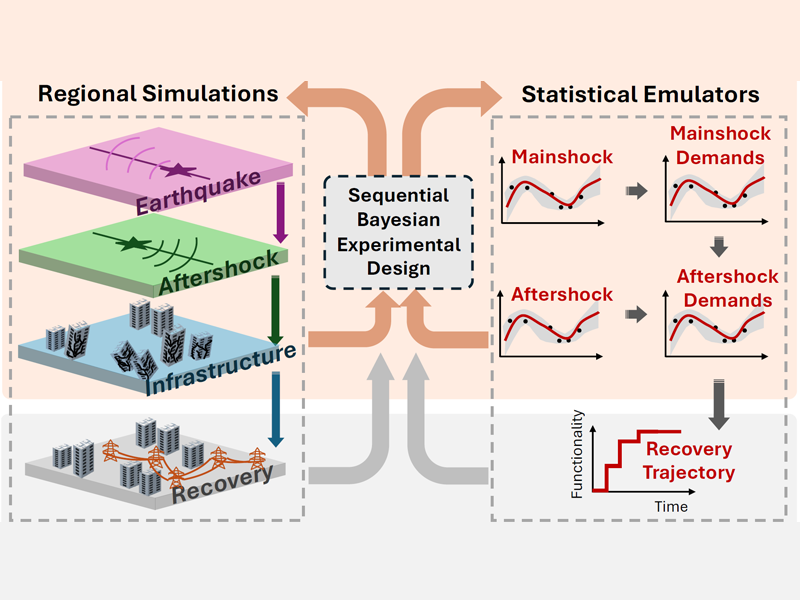
A key innovation in Kenawy’s work is the focus on cascading hazards or secondary events triggered by an initial event that can significantly amplify damage to infrastructure systems.
“An earthquake is often not just a single event,” she said. “It can trigger aftershocks, or other hazards such as soil instabilities, all of which can cause additional damage to infrastructure.”
Similarly, hurricanes and tornadoes can generate debris, flooding and other compounding hazards that amplify their impact on communities.
Kenawy’s research aims to capture these cascading effects using regional-scale numerical simulations — something that is rarely done in current infrastructure risk assessments.
“If we only study the main event, we miss a big part of the risk,” she said. “Considering cascading hazards can make us better prepared for what communities may face during and after extreme events.”
From damage to recovery
Beyond predicting damage, Kenawy is also focused on understanding how communities recover after extreme natural events.
“Recovery is difficult to study,” she said. “It’s not just about whether a building is damaged. It’s about whether power is available, roads are accessible, and services are functioning.”
The research examines how interconnected systems, such as transportation networks, utilities and buildings, affect one another during recovery. These interdependencies can significantly influence how quickly a community returns to normal operations.
By modeling these relationships, Kenawy aims to help decision-makers plan recovery operations more effectively and prioritize investments in infrastructure resilience.
Kenawy’s work is designed with community impact in mind. Her team is collaborating with NSF-funded national research networks to integrate new tools into platforms used by engineers and emergency planners.
These tools will allow users to:
- Identify the most critical extreme event scenarios to analyze
- Simulate infrastructure performance across entire regions
- Determine where to collect field data after consequential events to maximize what we learn from the event.
“Agencies often run ‘what-if’ scenarios, but choosing the right ones is a challenge,” Kenawy said. “Our methods help ensure those scenarios are both realistic and informative, leading to better decisions about preparedness and risk mitigation.”
Training the next generation
As part of the CAREER award’s educational mission, Kenawy is also developing new coursework and training opportunities focused on uncertainty quantification in engineering.
Her efforts include:
- New graduate-level modules on understanding and modeling uncertainty in natural hazard engineering
- Professional webinars for practicing engineers
- Hands-on research and field data-collection opportunities for undergraduate students
“Teaching structural engineers about uncertainty quantification is critical,” Kenawy said. “The consequences of natural hazards are accompanied by substantial uncertainties, and engineering analysis and design methods must rigorously account for those uncertainties.”
Ultimately, Kenawy’s research supports national efforts to improve disaster resilience, including the National Earthquake Hazards Reduction Program.
By advancing reliable methods to assess infrastructure risk and recovery at a regional scale, her work aims to protect lives, reduce economic losses, and help communities recover more quickly after extreme natural events.
"Extreme events may be rare, but they may have devastating consequences. By improving how we model and understand them, we can improve risk mitigation strategies, recovery operations and community resilience.”