

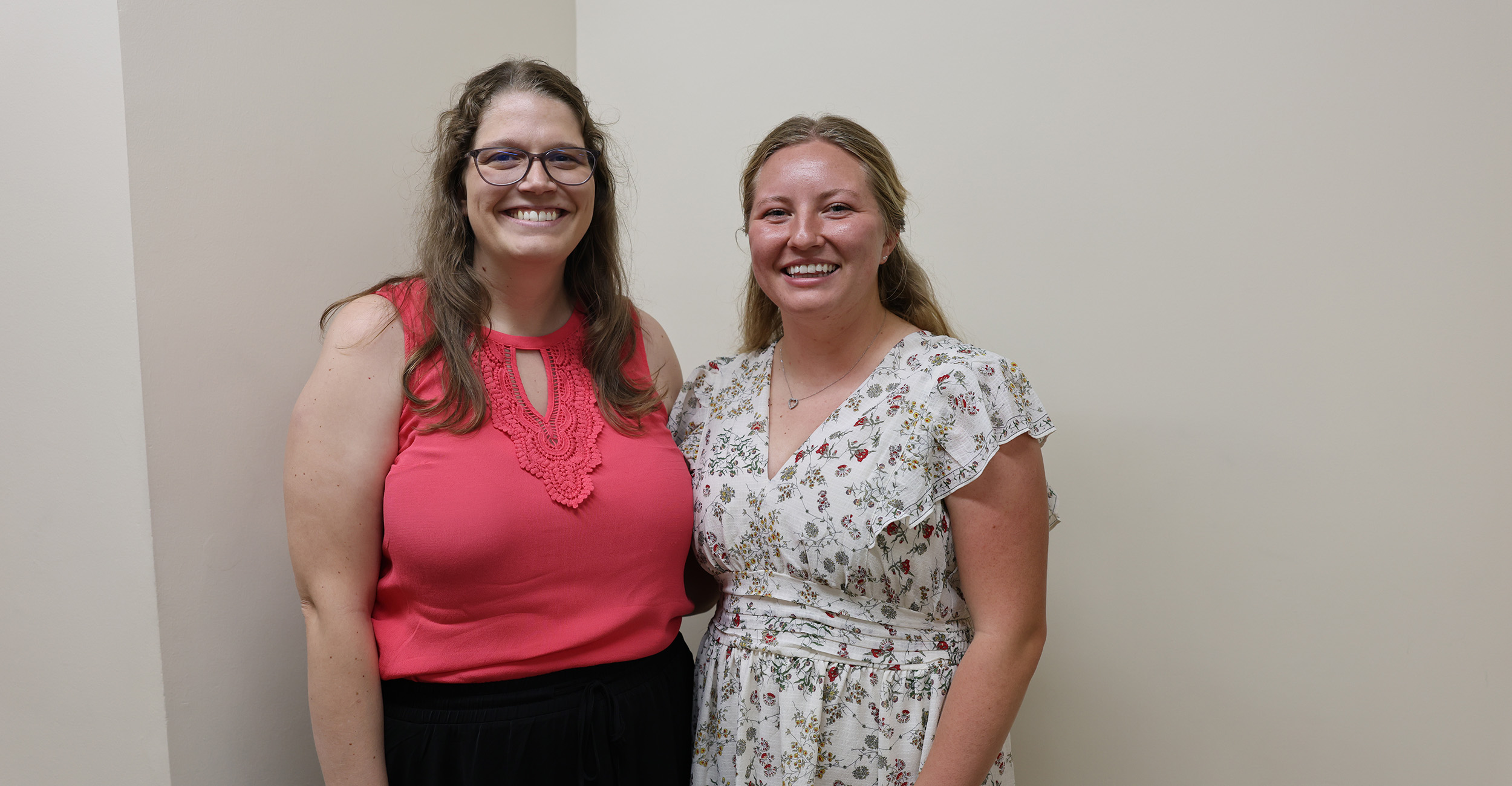
Foltz receives 2026 Excellence in Research Mentoring Award
Tuesday, April 21, 2026
Media Contact: Tanner Holubar | Communications Specialist | 405-744-2065 | tanner.holubar@okstate.edu
Dr. Mary Foltz has a long history of mentoring students, dating back to her undergraduate years at Indiana University.
Teaching and guiding others has always brought her joy, and her students have benefited from her philosophy centered on openness, understanding and kindness.
For her impact as a professor and mentor to undergraduate students in the School of Civil and Environmental Engineering in the College of Engineering, Architecture and Technology at Oklahoma State University, Foltz has been named a recipient of the 2026 Excellence in Research Mentoring Award.
This honor recognizes faculty mentors for success and impact in supervising undergraduate research students.
Foltz was nominated by Vicktoria Holdaway, a student currently mentored by Foltz, and Shelby Maggard, a former undergraduate student.
"It means a lot when students let me know that I have made an impact on them, and getting this award emphasizes that my approach to mentorship has been successful,” Foltz said. “It gives me encouragement to keep mentoring and impacting students, which I have always thought was my calling in life.
“I share nearly everything with my students, from resources and space to thoughts and knowledge. I am extremely open with my students, sharing my personal experiences, failures, fears and approaches, and making expectations transparent and continually communicated.”
Foltz enjoys the energy and passion her students have and seeks out those qualities when interviewing prospective students to join her research team.
“Past work experience and GPA are things I don’t even ask about because they aren’t what makes a great team member,” Foltz said. “Great teams are built from people who genuinely want to work together and are excited about what they do."
She said the most rewarding moments are seeing students walk across the stage at graduation or accept an award at a conference or symposium.
"It is often in that moment that you see them realize their value and that they are more than good enough, something I work on instilling in them all along,” Foltz said.
When teaching students to be engineering researchers, Foltz first shows them the many ways research is shaped. They try several different projects, including field-based projects and lab and computer modeling, giving them a broad overview of what they can take part in in the future.
"Often, students gravitate to one area or another,” Foltz said. “Some love computer modeling and spending hours sifting through data. Others prefer the hands-on approach to field work and collecting field samples. My favorite thing is when they realize what they are passionate about, and we can guide their research in that direction from then on.”
Showcasing the variety of opportunities in civil and environmental engineering allows students to try their hand in several different areas, which is crucial to them learning what passions they want to pursue.
"Oftentimes, they come in wanting to be a civil engineer or an environmental engineer without really knowing much about what that means,” Foltz said. “The application through research shows them another layer on top of their coursework that solidifies course materials and develops tangible connections that make lasting impacts on their future trajectory.”
In her years of teaching students, Foltz has, in turn, learned from them. Each student is different, providing a new opportunity to learn from one another while discovering each student’s passion. Working with each student to tailor mentorship to their needs is one of the aspects of mentoring she enjoys most.
“My students have also taught me that with the right encouragement and support, anyone can thrive,” Foltz said. “Those students who dare to ask to be mentored or to join a research team receive additional support that makes them even more likely to reach their goals. They need not have any prior experience or knowledge, just the courage to try and the perseverance to work through the challenges that inevitably arise.”
Foltz joined CIVE in 2021, where she focuses her research on greenhouse gas emissions, sustainability, agricultural nutrient cycling, passive treatment systems for biogeochemical water treatment and nature-inspired solutions to environmental issues.
Her team incorporates multiphase contaminant transformations and uses a combination of field and lab work and modeling at different scales to accomplish research goals.