

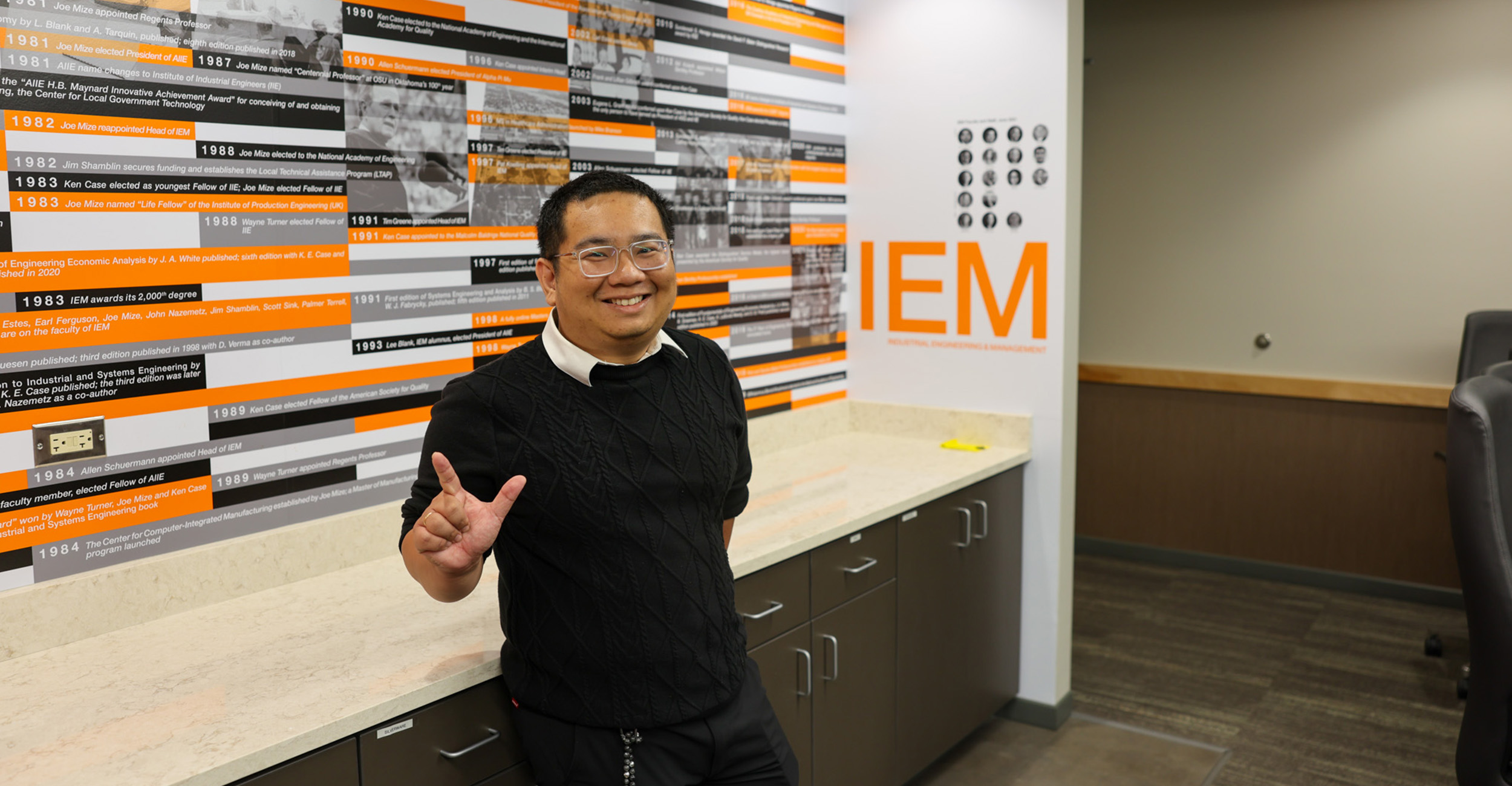
IEM’s Vo earns Distinguished Graduate Fellowship
Monday, September 14, 2026
Media Contact: Tanner Holubar | Communications Specialist | 405-744-2065 | tanner.holubar@okstate.edu
Research is like a puzzle for Lucius Vo. Each piece represents a part of the problem, and the challenge is figuring out how to complete the picture.
Vo’s research focuses on scientific computing, mathematical optimization and in-memory computing, using devices that operate differently than conventional computer hardware. For Vo, the ultimate puzzle is determining how to adapt algorithms so that all the pieces work together on an unconventional architecture.
Vo is a Ph.D. student in the School of Industrial Engineering and Management who was recently named a recipient of the Distinguished Graduate Fellowship by the Oklahoma State University Foundation for 2026-27. The fellowship provides a financial award to graduate students who have demonstrated outstanding achievements in academics and research along with leadership.
"It is a tremendous honor and still feels a bit surreal,” Vo said. “When you spend so much time deeply focused on your own research, it is easy to forget that people from the outside are paying attention. It serves as a significant boost of confidence, and I am incredibly grateful for the recognition.”
Vo is from Ho Chi Minh City (also known as Saigon), Vietnam, and expects to earn his Ph.D. in 2028, with a minor in statistics. He earned his bachelor’s from Metropolia University of Applied Sciences and his master’s from Aalto University in Finland.
In-memory computing is a burgeoning research field that has the potential to significantly improve energy efficiency and reduce latency compared to conventional computational architecture found in many modern devices.
"Specifically, I study the fabrication of hardware that is based on resistive random-access memory technology and design complex algorithms tailored to run on these devices,” Vo said. “Ultimately, my goal is to build solutions that effectively bridge the gap between theoretical mathematics and physical hardware.”
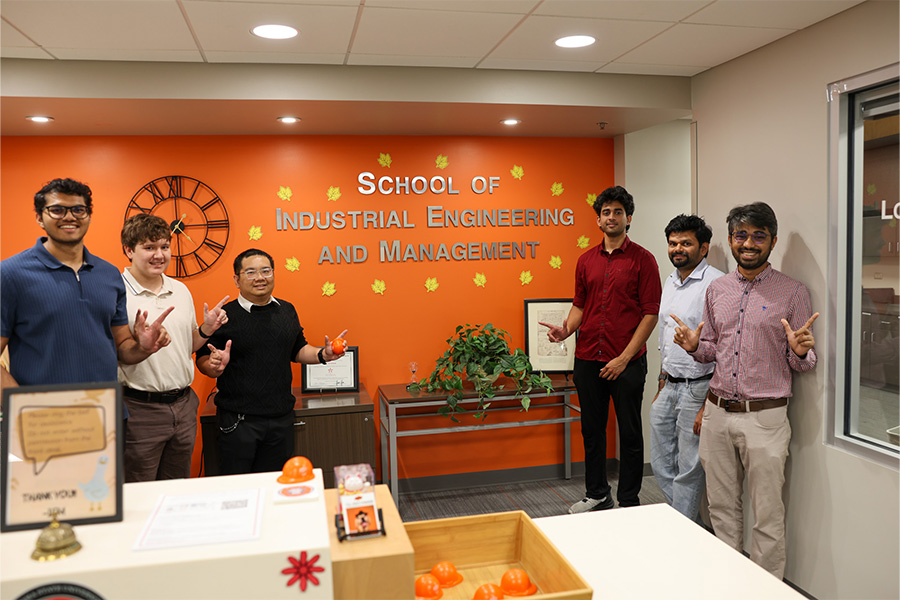
“The Cowboy Code reminds us to always give it everything we have, but it also teaches us the profound value of community. I truly did not get here on my own.”
A mentor and a community
For Vo, having the right mentor has been just as important as asking the right research questions.
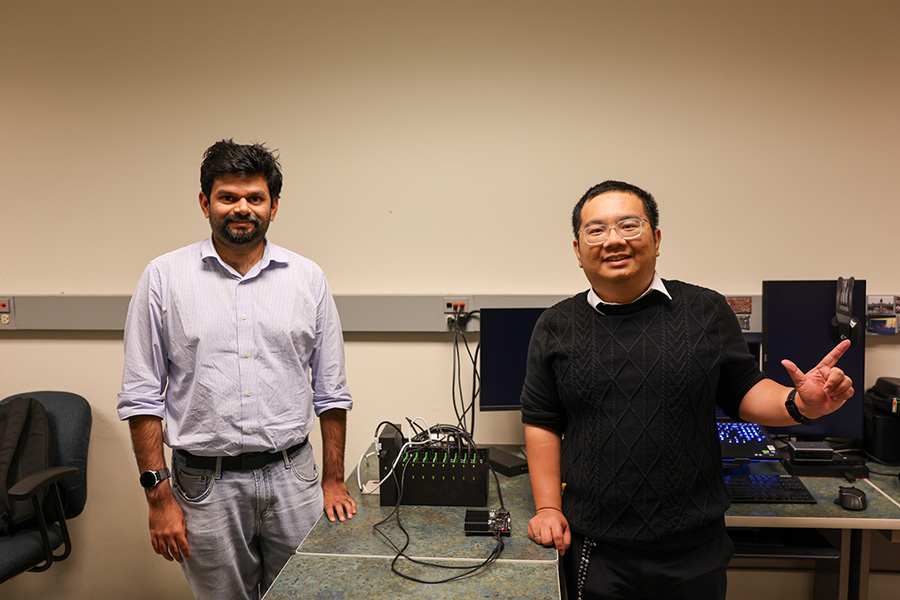
Working with Dr. Paritosh Ramanan, assistant professor in IEM, has given Vo both technical guidance and an example of what it means to approach research with determination and integrity.
“He is the epitome of getting things done and is always willing to support his students, even if it means getting less rest to ensure a project crosses the finish line successfully,” Vo said.
Ramanan has also helped Vo become a better version of himself as a researcher, pushing him to step out of his comfort zone and encouraging him to work with new people and take ownership of his ideas.
This has shaped how Vo approaches his work, challenging him to ensure his ideas are not only theoretically sound but also practical and scalable. The balance between theory and application has shaped the heart of Vo’s career goals.
Ramanan said this award represents Vo's dexterity and persistence to tackle tough problems that lie at the intersection of hardware, computation, operations research and statistics.
"Lucius has been a very valuable member of my research group and brings with him a lot of drive, motivation and zeal," Ramanan said. "His contributions towards in-memory computing for operations engineering as well as privacy-friendly optimization and statistical computational paradigms through his Ph.D. work are truly impressive. Lucius’ energy invigorates our entire research team!
After internships with First Solar and Argonne National Laboratory, and working full-time at Intel for a few years, Vo developed an appreciation for fast-paced environments where he can collaborate with talented researchers and engineers.
“Ultimately, I want to balance being a strong individual contributor who pushes the boundaries of compute-in-memory solutions by being a dedicated mentor who guides and elevates innovative teams,” Vo said. “Whether I pursue a tenure-track academic position or return to the tech sector, my focus will be on developing next-generation computing architecture while empowering the people I work with.”
For IEM School Head Dr. Linkan Bian, Vo’s recognition also represents something larger than one student’s accomplishment.
“Lucius's achievement speaks to his talent and hard work,” Bian said. “At the same time, it reflects the strength of IEM's graduate student community and the outstanding work being done by our students.”
Bian said the fellowship demonstrates that IEM students are tackling important problems, producing high-quality research and competing successfully with some of the best graduate students across campus.
It also underscores the role faculty mentorship plays in helping students reach those heights.
“Dr. Paritosh Ramanan's guidance and support have helped Lucius develop as a researcher and reach this important milestone,” Bian said.
For Bian, seeing an IEM student receive one of OSU’s most prestigious graduate school recognitions is a point of pride for the entire school.
“When one of our students receives a distinction like the OSU Distinguished Graduate Fellowship, it is a proud moment for the entire school,” Bian said. “It recognizes not only the student's achievements but also the dedication of the faculty and the research environment we have built.”
Bian said Vo’s success raises the visibility of IEM and can inspire other students to pursue ambitious research of their own.
“It reminds us of what is possible when talented students and committed faculty work together,” he said.
A bigger swing
For Vo, this fellowship provides more than financial support. It offers reassurance that the abstract nature of the problems he spends time solving are worth pursuing.
When working at the intersection of hardware, algorithms and software, the research can become so abstract that one can second-guess oneself at times.
“Receiving this fellowship was a massive, ‘OK, I’m on the right track’ moment for me,” Vo said. “Frankly speaking, it does not change my overall direction, though it definitely hits the gas pedal. It makes me feel comfortable taking bigger swings and tackling riskier, more ambitious research problems.”
Vo hopes he can eventually contribute to practical solutions, from preventing large-scale power outages to reducing operational delays in logistics. But while research might be his puzzle to solve, Vo is quick to point out that this is not accomplished alone.
He credits professors Dr. Terry Collins and Dr. Baksi Balasundrum, as well as Dr. Murat Yildirim and Dr. Gozde Tutuncuoglu of Wayne State University for their guidance and support. He also credited his peers in Ramanan’s lab and in the IEM department, as well as the Vietnamese Scientists and Engineers Network in the United States and the Vietnam Education Foundation Fellowship Program for being an inspiring community during his academic journey.
Above all, he credits his family and wife, Ngoc-Doan, for providing the foundation that has allowed him to thrive in pursuit of his work.
“The Cowboy Code reminds us to always give it everything we have, but it also teaches us the profound value of community,” Vo said. “I truly did not get here on my own.”
For Vo, the community that has supported him has helped turn a collection of abstract problems, unconventional hardware and ambitious ideas into a research career that is being assembled one piece at a time.