


Soliman receives the 2026 President’s Fellows Faculty Research award
Thursday, March 26, 2026
Media Contact: Desa James | Communications Coordinator, CEAT | 405-744-2669 | desa.james@okstate.edu
Steel construction remains one of the most labor-intensive and hazardous phases of the building process. At Oklahoma State University, Dr. Mohamed Soliman is working to change that.
For his impactful research, Soliman has been awarded the 2026 President’s Fellows Faculty Research Award. This award, facilitated by President Hess and the President’s Fellows Organization, recognizes outstanding research by OSU faculty.
“This is a highly prestigious award, and I am truly honored by the trust and confidence placed in me by CEAT and OSU,” Soliman says.
Soliman is an associate professor and the Decker Dawson Chair in the School of Civil and Environmental Engineering at OSU, where he has taught since 2015. After earning his bachelor’s and master’s degrees in civil engineering at Alexandria University in Egypt, he moved on to receive his Ph.D. in structural engineering from Lehigh University in Bethlehem, Pennsylvania. With 22 awarded research projects spanning steel and aluminum structures in both civil and marine applications, Soliman can be considered an expert in his research field.
The construction phase of the steel industry has seen far less automation compared to concrete and precast construction. As those sectors continue to advance, the steel industry faces increasing pressure to develop new automation strategies to remain competitive.
The construction phase is also among the most time-consuming and hazardous periods for construction crews.
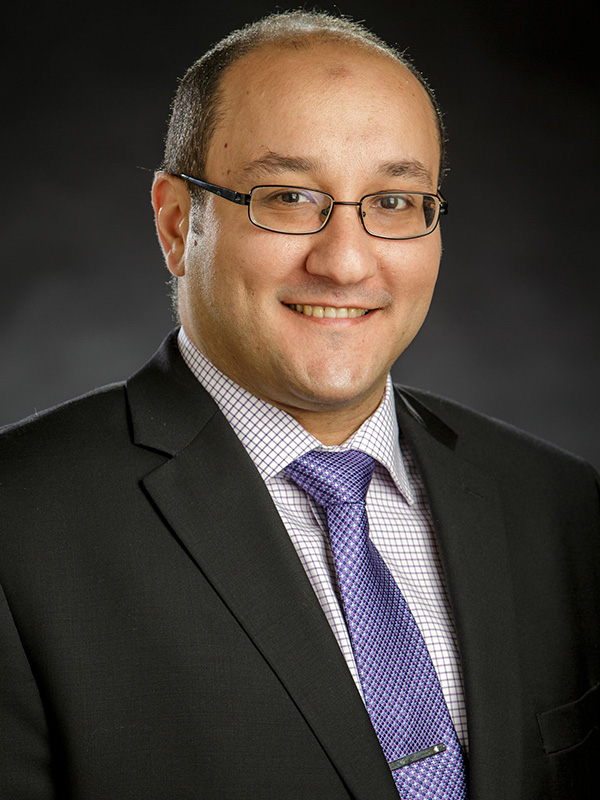
Soliman says the idea for this research “originated in late 2019 after the tragic collapse of the Hard Rock Hotel building in New Orleans, which occurred during construction.” He says this event highlights the “risks associated with construction-stage activities when structural systems are not yet fully stabilized.”
The goal of “Toward Robotic Construction of Steel Structures: A Scaled Testbed for Automated Assembly and Multi-Robot Coordination,” Soliman’s research project, aims to mitigate the lack of automation and improve worker safety by developing an experimental platform to design, benchmark, and demonstrate new automation strategies. This project will demonstrate the feasibility of robotically automated steel placement and assembly systems while developing preliminary communication and coordination protocols to enable multiple robots to perform the tasks.
“This grant serves as a critical first step towards establishing protocols to advance automation in steel construction. While the current effort focuses on proof-of-concept and small-scale demonstrations, the long-term vision is much broader,” Soliman said.
Soliman and his team plan to accomplish these goals by creating a scaled-down model of the system in the Bert Cooper Engineering Laboratory at OSU.
“In five years, I envision the development of integrated large-scale systems that combine robotics, smart sensing, artificial intelligence and decision-making techniques to enable safer, faster and more economic construction practices,” Soliman said.
This internal grant program, facilitated by OSU, fosters transformative and impactful faculty research by providing a one-time $20,000 award to support the selected research project.
Story By: Nick Napoliello | nick.napoliello@okstate.edu