

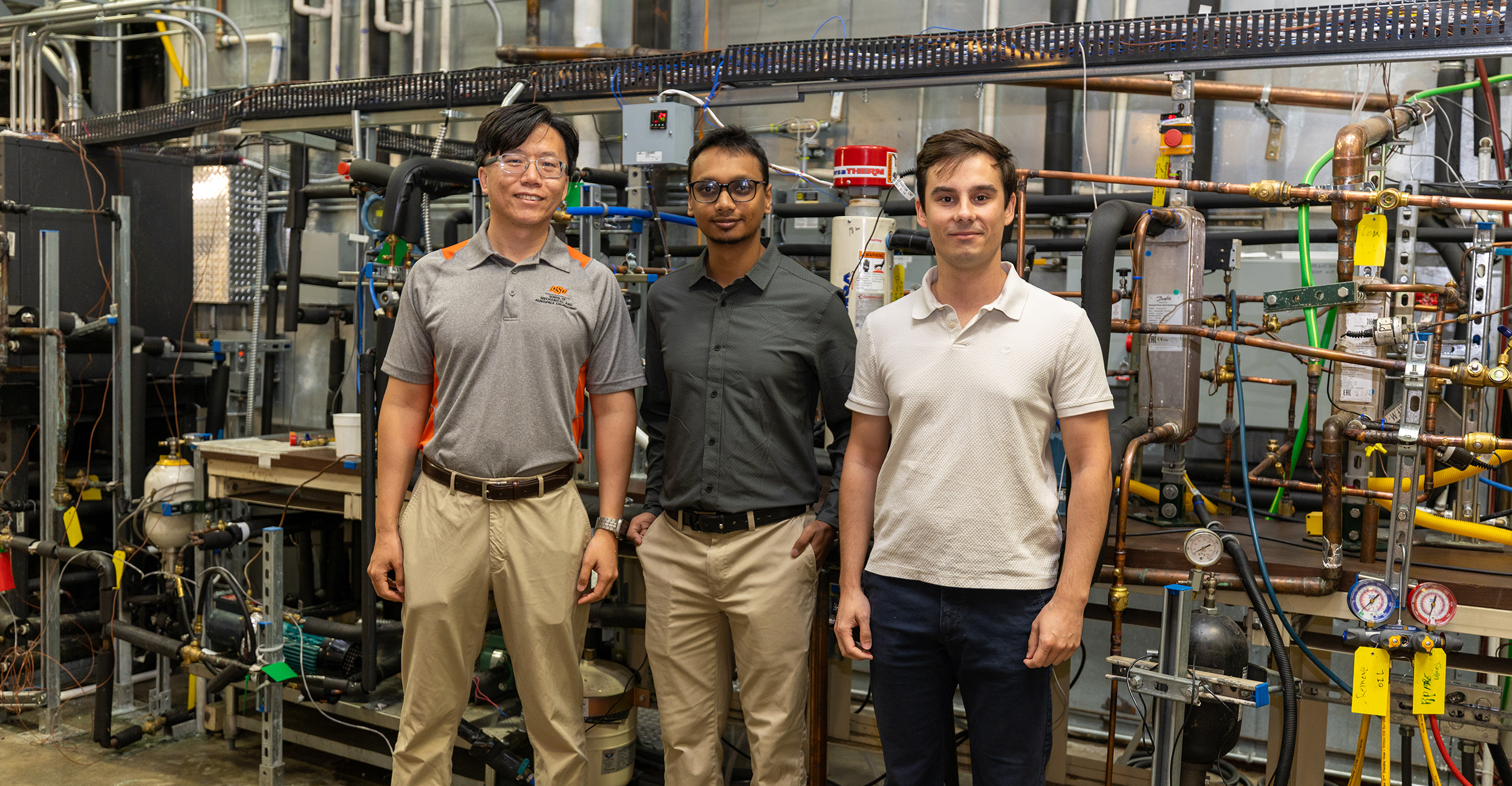
OSU, Trane collaborate to advance next-generation HVAC design
Thursday, October 22, 2026
Media Contact: Desa James | Communications Coordinator | 405-744-2669 | desa.james@okstate.edu
Key Facts
- Dr. Liu and OSU's Center for Integrated Building Systems are collaborating with Trane to model next-generation HVAC systems using lower-global-warming-potential refrigerants.
- The project aims to help engineers identify effective HVAC designs before building physical prototypes, reducing development time and cost.
- The collaboration includes a graduate student internship with Trane, providing industry experience and access to real-world product performance data.
As the heating and cooling industry moves toward refrigerants with lower global warming potential, engineers face a challenge that extends beyond simply replacing one refrigerant with another. Changes to refrigerants can affect how the components inside an HVAC system perform, potentially influencing the efficiency, size and cost of equipment used in homes and businesses.
Dr. Haotian Liu, associate director for Oklahoma State University's Center for Integrated Building Systems, is working with Trane, a global leader in thermal management and energy services, to understand how those changes can inform future HVAC designs by developing a computer model that represents how the components of a heating and cooling system work together.

"We want to understand which combinations of component designs can deliver the required performance within practical size and cost constraints," Liu said. "Modeling allows us to explore many possibilities and identify promising options for further development and testing."
The model will be validated against performance data from Trane before Liu's team from the College of Engineering, Architecture and Technology uses it to explore different component designs, sizes and operating conditions.
The goal is to help engineers identify promising designs before investing in physical prototypes and testing.
"Ultimately, we hope to support the refrigerant transition while keeping equipment efficient, compact and cost-effective," Liu said.

The project also includes a graduate student internship with Trane, connecting a School of Mechanical and Aerospace Engineering student's modeling work with industry engineers and real-world equipment. The collaboration gives the research team access to product performance data and practical design requirements while providing the student with experience applying engineering analysis to an industry challenge.
Trane is a member of CIBS, and the relationship developed through the center helped make this research project possible. The collaboration connects industry needs with university research while creating opportunities for students to work on real engineering challenges.
FAQ
-
Why are OSU and Trane collaborating on HVAC research?
Oklahoma State University and Trane are studying how lower-global-warming-potential refrigerants affect HVAC system performance. The research will help engineers design efficient, compact and cost-effective heating and cooling equipment as the industry transitions to new refrigerants.
-
What is Dr. Haotian Liu's role in the OSU-Trane project?
Dr. Haotian Liu, associate director of Oklahoma State University's Center for Integrated Building Systems, is leading the research effort. His team is developing a computer model that simulates how HVAC system components interact under different design conditions.
-
What will the computer model developed by OSU and Trane do?
The model will evaluate how different combinations of HVAC components perform with emerging refrigerants. After validation using Trane performance data, the model will be used to explore component designs, sizes and operating conditions.
-
How will the research benefit HVAC manufacturers and engineers?
The project will help engineers identify promising HVAC designs before investing in physical prototypes and laboratory testing. This approach can support the refrigerant transition while maintaining equipment efficiency, size and cost targets.
-
How does the project benefit Oklahoma State University students?
The collaboration includes a graduate student internship with Trane. The internship gives a student from OSU's School of Mechanical and Aerospace Engineering experience working with industry engineers, real equipment data and practical design challenges.