


OSU research explores ways to increase recycled asphalt use across Oklahoma
Monday, October 12, 2026
Media Contact: Desa James | Communications Coordinator | 405-744-2669 | desa.james@okstate.edu
Key Facts
- Increasing recycled asphalt use could reduce demand for new construction materials while extending the value of pavement already in service.
- OSU researchers are testing whether Oklahoma roads can successfully incorporate nearly double the state's current recycled asphalt limit.
- A statewide inventory will give transportation planners a clearer picture of where recycled pavement materials are available and how they vary across regions.
- Drone technology is making large-scale pavement recycling inventories more efficient by generating 3D measurements of stockpiled materials.
- The findings will help inform future Oklahoma pavement specifications and sustainable transportation practices.
Reusing asphalt from existing roads could help Oklahoma conserve natural resources and reduce material costs for future pavement projects. Oklahoma State University researchers are working with the Oklahoma Department of Transportation to increase the use of reclaimed asphalt pavement while maintaining road performance.
Dr. Mohamed Elkashef, an associate professor for the School of Civil and Environmental Engineering in the College of Engineering, Architecture and Technology, leads the project examining how reclaimed asphalt pavement is stored, managed and used across the state.
According to the National Asphalt Pavement Association, approximately 101 million tons of RAP were incorporated into new asphalt mixtures during the 2024 construction season, reflecting the widespread use of recycled asphalt in the United States.
Mapping Oklahoma's recycled asphalt
RAP can vary in quality depending on the age and source of the original pavement, as well as the regional climatic conditions. Storage and processing practices also differ among ODOT districts and contractors, making a statewide inventory important.
Elkashef and his team are surveying ODOT districts and industry partners across Oklahoma to document current RAP management practices, usage and availability. The surveys show that ODOT districts use RAP in roadway shoulders, aggregate base layers and new asphalt mixtures, but differ in how they manage the material and in their policies for sharing RAP with contractors.
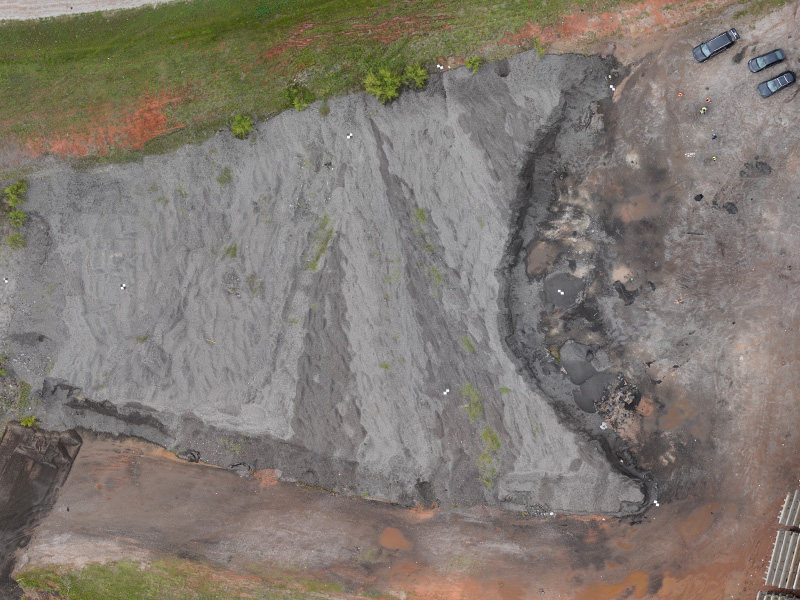
Locations of RAP stockpiles across the state are being mapped, and a statewide RAP inventory is being developed across all eight ODOT districts. In support of the RAP inventory effort, Elkashef is working with fellow CIVE faculty Dr. Jaime Schussler to evaluate drone technology for mapping RAP stockpiles and estimating material quantities.
Graduate students Hafiz Hassan and Meg Ryan are assisting with this work, which gives students hands-on experience in field research and laboratory testing.
"The team is using drones to capture aerial images of RAP stockpiles and generate 3D models that can be used to estimate material quantities," Elkashef said. "Compared to traditional surveying methods, drones provide a faster, safer and more efficient way to inventory RAP across Oklahoma."
Beyond estimating available quantities, Elkashef and his team are examining RAP's material properties, including how much its asphalt binder has aged. These differences matter because the condition of the recovered binder can influence the performance of new asphalt mixtures.

Testing higher percentages of recycled material
ODOT specifications currently allow up to 25% RAP in new asphalt mixtures. The OSU team is evaluating mixtures containing up to 45% RAP to determine whether higher recycled content can be used without compromising pavement performance.
The work supports ODOT's efforts to implement Balanced Mix Design.
“BMD involves using performance testing which ensures that mixes incorporating RAP are performing similar or better than virgin mixtures,” Elkashef said.
Researchers first evaluate RAP to determine the properties of its aged asphalt binder, along with the gradation and characteristics of the recovered aggregate. OSU's asphalt laboratory provides advanced capabilities to characterize RAP aging and assess how the material can be incorporated into new mixtures.
The team test mixtures with varying RAP percentages for resistance to cracking and rutting in addition to durability, to determine whether higher recycled content can maintain long-term pavement performance.
Informing future pavement decisions
This research is part of broader ODOT efforts to advance sustainable pavement practices and implement BMD. Their team, led by Matt Romera, Drs. David Vivanco and Biswajit Bairgi, has been working toward implementation, with several pilot projects underway.
By providing stockpile access and sharing recycling practices, ODOT districts and industry partners are helping researchers identify opportunities to increase RAP use.
By combining statewide inventory data with laboratory testing, the research could help ODOT identify where RAP is available, understand how its properties vary and determine which mixtures can accommodate higher recycled content, putting the Cowboy Code's spirit of service to Oklahoma communities into practice.
FAQ
-
Why is OSU researching recycled asphalt in Oklahoma?
OSU researchers are studying reclaimed asphalt pavement (RAP) to help Oklahoma use more recycled road materials while maintaining pavement performance. Increasing RAP use can reduce the need for new raw materials and lower construction costs.
-
How much recycled asphalt is currently allowed in Oklahoma roads?
Oklahoma Department of Transportation specifications currently allow up to 25% reclaimed asphalt pavement in new asphalt mixtures. OSU researchers are testing mixtures with as much as 45% RAP to determine whether higher percentages can perform just as well.
-
How are OSU researchers using drones map RAP stockpiles?
OSU researchers are using drones to capture aerial images of RAP stockpiles across Oklahoma. Those images are used to create 3D models that help estimate material quantities more quickly and safely than traditional surveying methods.
-
How could asphalt research benefit Oklahoma drivers and communities?
The research will help ODOT better understand where recycled asphalt is available, how its quality varies across the state and whether more recycled material can be used in future pavement projects. The findings could support more sustainable and cost-effective road construction and maintenance.