


OSU research puts mechanical force to work making stronger materials
Monday, November 16, 2026
Media Contact: Desa James | Communications Coordinator | 405-744-2669 | desa.james@okstate.edu
Key Takeaways
- Dr. Pranjal Nautiyal received an American Chemical Society Doctoral New Investigator award to study mechanocatalysis for producing diamond-like carbon coatings.
- Mechanocatalysis uses mechanical force instead of heat and solvents to drive chemical reactions, offering a potentially more energy-efficient manufacturing approach.
- The research examines how mechanical stress converts hydrocarbons into diamond-like carbon, a material used to protect engine parts, bearings and cutting tools from wear.
- Researchers will use atomic force microscopy and cold-spray metal 3D printing to observe carbon film growth and develop predictive models for mechanocatalytic manufacturing.
The parts that keep cars, aircraft and industrial machinery moving are constantly working against friction. Special coatings can help those components resist wear and last longer. But producing these protective materials can require considerable energy and specialized manufacturing equipment.
What if mechanical force itself could help make them?
At the College of Engineering, Architecture and Technology, Dr. Pranjal Nautiyal is investigating a manufacturing approach that uses mechanical stress to drive chemical reactions, potentially offering a more energy-efficient way to produce diamond-like carbon, or DLC coatings. The American Chemical Society’s Doctoral New Investigator award funds the project.
Most people associate chemical reactions with heat or mixing liquids. But what if a chemical reaction could be triggered by pushing, rubbing or squeezing materials together?
That's the idea behind mechanocatalysis. The process uses mechanical force and specially designed materials called catalysts to help chemical reactions happen.
"Mechanical energy can replace the heat and toxic solvents that many chemical processes rely on today," Nautiyal said.
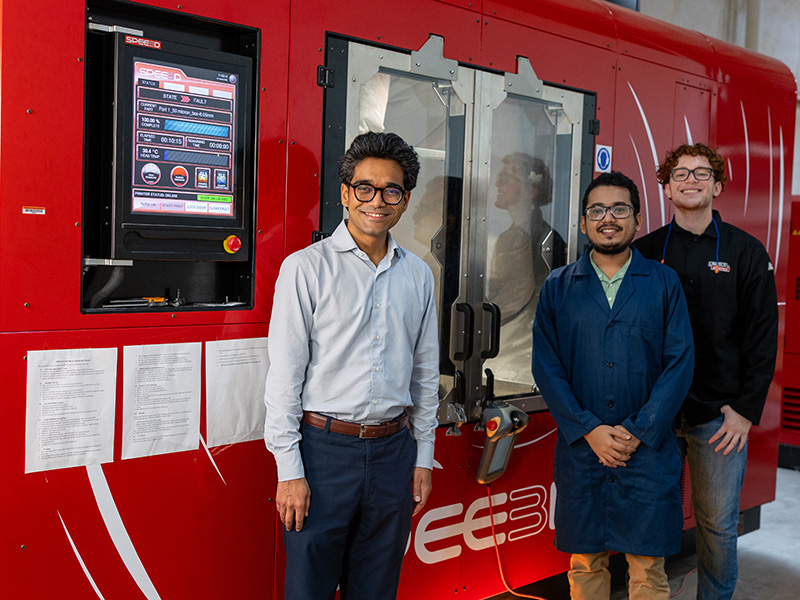
Nautiyal, an assistant professor in the School of Mechanical and Aerospace Engineering, is studying how controlled mechanical forces influence the chemical reactions that transform hydrocarbons into diamond-like carbon, a durable material used in protective coatings.
Known for its hardness and ability to reduce friction, DLC helps protect components such as engine parts, bearings and cutting tools from wear.
Today, DLC coatings are typically manufactured through chemical or physical vapor deposition. These processes often require vacuum chambers, plasma and elevated temperatures. Mechanocatalysis could provide an alternative by allowing the material to form under ambient temperature and pressure without specialized vacuum equipment, making it more economical and environmentally friendly.
However, making that approach practical requires a better understanding of how mechanical forces influence chemical reactions.
Mechanical stress can distort chemical bonds, changing how quickly a reaction occurs and what products it creates. Nautiyal's research will investigate which types of stress are most effective at driving the conversion of hydrocarbons into carbon films and how the properties of the catalyst affect the resulting material.
To see how these reactions unfold, Nautiyal will use a tool called an atomic force microscope. Imagine a tiny probe, with a tip only a few nanometers wide, moving across a surface much like a finger tracing the bumps and grooves of an object in the dark.
The microscope's tip can act on materials at the nanoscale, allowing researchers to apply mechanical forces while observing how new material forms. Nautiyal hopes to use the technique to watch DLC films begin to form and grow under precisely controlled conditions.
"This allows us to directly correlate mechanical forces with reaction rates and develop highly precise models that can predict reaction outcomes," Nautiyal said.
The research also involves building custom materials (catalysts) to help control the chemical reaction. To do that, Nautiyal will use a metal 3D-printing technique called cold spray.
Rather than melting metal and pouring it into a mold, cold spray uses tiny metal particles that are propelled at high speeds and bond together to build a structure.
By changing the structure and composition of these catalysts, researchers can investigate how individual material characteristics influence carbon film growth.

The findings could help researchers develop predictive models that connect mechanical stress with chemical reaction rates and material properties. Those models could eventually guide the design of more efficient mechanocatalytic manufacturing processes.
If successful, the research could contribute to faster, more energy-efficient methods for producing thin films, with potential applications across the automotive, aerospace, energy and advanced manufacturing industries.
The project also provides opportunities for students to work with advanced manufacturing and nanoscience technologies, including metal 3D printing, atomic force microscopy and materials characterization. Collaboration with scientists at national laboratories will further expose students to research environments beyond the university.
"We are bringing together tools and techniques from mechanical engineering, materials science, chemistry and nanotechnology to develop a novel way of fabricating materials," Nautiyal said. "Success of this effort will have far-reaching consequences for fabricating and designing novel materials in a more sustainable manner."
FAQ
-
What is Dr. Pranjal Nautiyal studying?
Dr. Pranjal Nautiyal, an assistant professor in the OSU School of Mechanical and Aerospace Engineering, is studying how mechanical force can drive chemical reactions that produce diamond-like carbon coatings. The goal is to develop a more energy-efficient manufacturing process for protective materials.
-
What is mechanocatalysis?
Mechanocatalysis is a process that uses mechanical force and specially designed catalysts to trigger or accelerate chemical reactions. Instead of relying primarily on heat or chemical solvents, mechanocatalysis uses actions such as pushing, rubbing or squeezing materials together.
-
Why are diamond-like carbon coatings important?
Diamond-like carbon, or DLC, is valued for its hardness and low-friction properties. DLC coatings help protect components such as engine parts, bearings and cutting tools from wear, extending their service life.
-
How does OSU's mechanocatalysis research differ from current DLC manufacturing methods?
Most DLC coatings are currently produced through chemical or physical vapor deposition, which often requires vacuum chambers, plasma and elevated temperatures. The OSU research explores forming DLC under ambient temperature and pressure without specialized vacuum equipment.
-
What tools and technologies will OSU researchers use in this project?
The project uses atomic force microscopy to apply and observe mechanical forces at the nanoscale and cold-spray metal 3D printing to create custom catalyst materials. Researchers will also use materials characterization techniques to study how catalyst properties affect carbon film growth.
-
How will OSU students benefit from this research project?
Students will gain hands-on experience with advanced manufacturing and nanoscience technologies, including metal 3D printing, atomic force microscopy and materials characterization. The project also includes collaboration with national laboratory scientists, exposing students to research environments beyond the university.