


OSU research reveals the hidden journey of soybean seedlings through soil
Wednesday, July 22, 2026
Media Contact: Desa James | Communications Coordinator | 405-744-2669 | desa.james@okstate.edu
A study from the School of Biosystems and Agricultural Engineering in the College of Engineering, Architecture and Technology combines X-ray imaging, force measurement and computer modeling to uncover how seedlings overcome soil resistance.
Every successful soybean crop begins with a seedling’s struggle to reach sunlight. While growers often focus on weather, soil moisture and planting depth, this new study is shining light on a largely invisible process: how a seedling physically navigates its way through soil during emergence.
Using advanced X-ray computer tomography, custom-built force measurement technology and sophisticated computer simulations, researchers have captured the underground journey of soybean seedlings in unprecedented detail. The findings provide new insights into the mechanical challenges seedlings face and could help guide future advances in seedbed preparation, tillage practices and planting systems.
“Every grain-bearing crop starts with successful emergence,” said Dr. Bob Zeng, associate professor for BAE. “If a seedling cannot overcome the mechanical resistance of the soil, that plant may never establish, even when water and temperature are otherwise favorable.”
The research addressed a longstanding challenge in agricultural engineering: understanding exactly how seedlings interact with soil before they emerge above the surface.
For decades, studying seedling emergence has been difficult because the process occurs underground. Traditional methods often relied on destructive excavation, two-dimensional systems or indirect measurements that could not fully capture what was happening around the seedling.
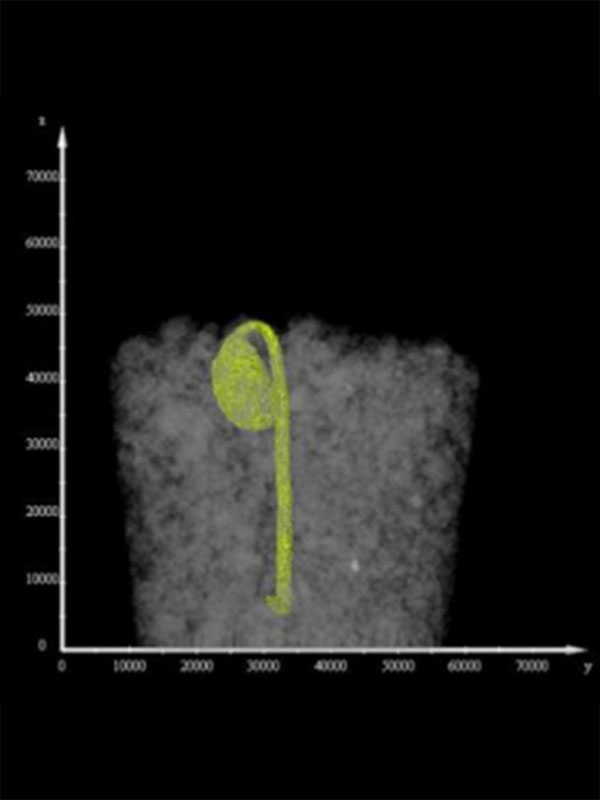
To overcome these limitations, the team, including collaborators from South China Agricultural University and Yunnan Normal University, used in situ X-ray CT imaging to observe soybean seedlings growing within real soil. The technology allowed Zeng to monitor emergence without disturbing the soil environment and reconstruct three-dimensional growth trajectories over time.
"The biggest missing piece was a clear, non-destructive view of what the seedling is actually doing inside real soil,” Zeng said. “By combining in situ X-ray CT imaging, direct force measurement and computer modeling, we could observe real emergence paths, measure the forces involved and then build a physics-based digital twin model that could reproduce and extend those results.”
The images revealed that soybean seedlings do not simply grow straight upward. Instead, they navigate through a complex landscape of soil particles, pores and aggregates, continually adapting their paths as they seek routes with less mechanical resistance.
A key innovation of the study was the development of a custom instrument capable of directly measuring what the team calls the “ultimate emergence force,” the maximum upward force a seedling generates just before breaking through the soil surface.
The system included a specially designed ring-shaped holder, fine copper wires, a spring mechanism and a high-precision electronic force sensor, allowing seedlings to grow naturally while force measurements were continuously collected.
The measurements showed that soybean seedlings generated emergence forces ranging from 0.14 to 0.47 newtons, demonstrating significant variation among individual plants.
To put that force into perspective, the upward push generated by a soybean seedling is roughly equivalent to the weight of a handful of U.S. quarters. Although small, that concentrated force is enough to displace soil particles and propel the seedling toward the surface.
One of the study’s most significant findings showcases hidden engineering in soil. Emergence is a mechanical process, not just a biological one. The seedling must generate force, navigate soil structure and adapt its path as it grows.
Complementing their previous work, researchers observed substantial variability in how seedlings moved through soil, even under controlled conditions. Those differences matter because they reveal how plants respond to the heterogeneous nature of soil.
“Soil is made up of particles, pores and aggregates, so from the seedling’s perspective, it is a highly variable mechanical environment,” Zeng said. “The path itself is telling us something about how plants cope with a complex soil environment.”
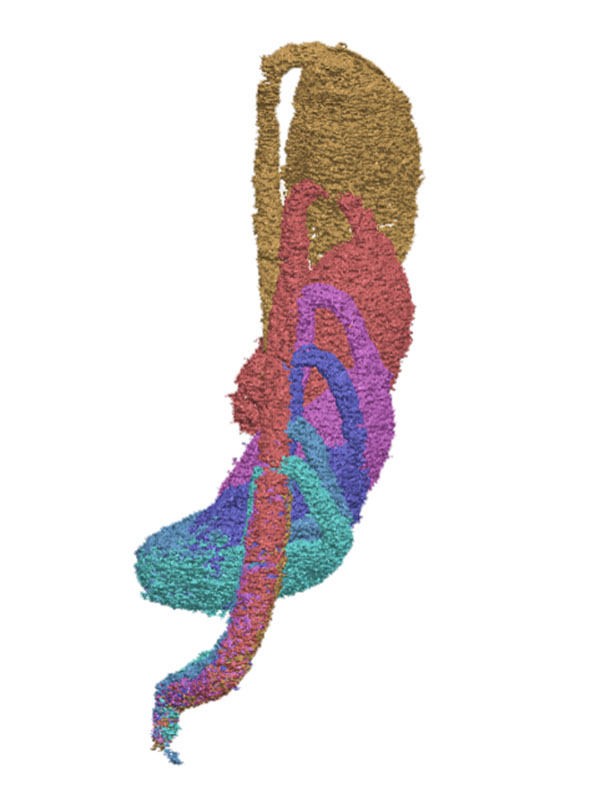
Previous research by the team has shown that seedlings can deviate significantly from a vertical path as they navigate through soil. Modeling studies suggest that selecting a natural route through the soil can reduce resistance by approximately 20%, even if the path itself is longer.
To further understand the physics of emergence, the study paired experimental observations with Discrete Element Method simulations. Researchers built a seed-soil interaction model capable of recreating seedling growth under different emergence paths.
The simulations closely matched the measured force data, validating the model and providing new opportunities to explore soil mechanics that are difficult to measure directly.
“The experiments grounded the model, and the model expanded what we could learn from the experiments,” Zeng said. “It suggests we can begin building predictive digital tools for crop emergence without losing sight of the biology.”
The successful integration of physical measurements and digital modeling opens the door to future digital twin technologies that could help predict crop emergence under varying soil conditions.
Uniform emergence is one of the foundational requirements for strong crop establishment and maximum yield potential. When emergence is delayed or uneven, plant stands become less uniform, reducing productivity. Under unfavorable conditions such as severe soil compaction or crusting, seedlings may fail to emerge entirely.
The research highlights the importance of soil microstructure in determining emergence success.
“A better understanding of seed-soil mechanics can help us improve how we evaluate seedbed quality, how we think about compaction and soil structure, and how equipment is designed or adjusted to place seed into a more favorable environment,” Zeng said.
The findings also support the broader goal of developing improved planting and tillage practices that promote faster and more uniform crop establishment.
The study is part of a larger research program focused on understanding the interaction among soil, plants and agricultural machinery. Previous projects have examined seed-soil contact, seed expansion during hydration and the influence of cotyledon characteristics on soil resistance.
Zeng hopes the work will foster collaborations among agricultural engineers, agronomists, crop scientists, equipment manufacturers and producers.
Together, these efforts are helping researchers better understand one of agriculture's most critical but least visible processes.
“The long-term value is that it helps turn emergence from a largely hidden process into a measurable and modellable one,” Zeng said.
A better understanding of seed-soil mechanics can help us improve how we evaluate seedbed quality, how we think about compaction and soil structure, and how equipment is designed or adjusted to place seed into a more favorable environment.