


OSU researchers discover new function in catalysts, opening the door to more efficient industrial processes
Tuesday, September 8, 2026
Media Contact: Tanner Holubar | Communications Specialist | 405-744-2065 | tanner.holubar@okstate.edu
Researchers in the School of Chemical Engineering in the College of Engineering, Architecture and Technology at Oklahoma State University are challenging long-held assumptions about how catalysts work.
Catalysts are materials that help chemical reactions proceed faster and more efficiently without being consumed in the process. They are used in many industrial processes to turn raw materials into a variety of products, and they often represent a significant cost in the overall process.
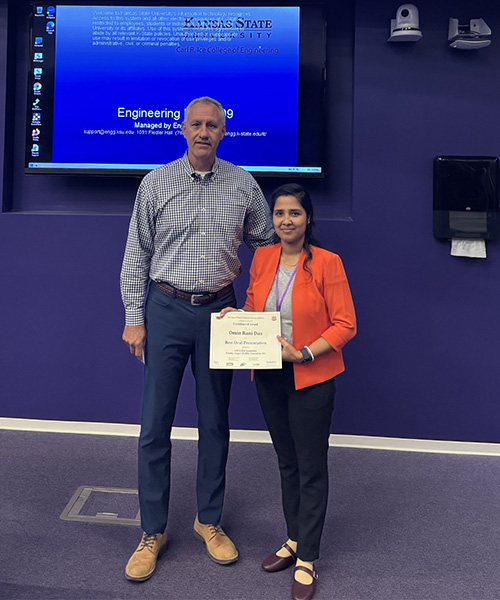
Dr. Jeffery White, Professor and BP Chair in Chemical Engineering, along with Ph.D. student Omio Rani Das and former student and Ph.D. graduate Anya Zornes, recently reported a new method for synthesizing and testing zeolite Y catalysts used in fluid catalytic cracking processes. Their research was published in a recent issue of the Journal of the American Chemical Society (2026, v. 148, p. 27975), the flagship research journal of the American Chemical Society. Their work was funded by the National Science Foundation.
Zeolites are materials with tiny, cage-like structures that break down large hydrocarbon molecules into smaller, usable ones. They are used in the production of fuel and many other consumer products.
White’s group tested the assumption that, for these reactions to occur, hydrocarbon molecules must directly adsorb onto active sites within the zeolite. Researchers have conventionally believed that a catalyst becomes more active as the number of these accessible active sites increases.
“This project specifically seeks to understand, modify and improve zeolite catalysts used for fluid-catalytic cracking processes in industry to produce liquid fuels, with the expectation that new learnings in this process can translate to other zeolite-catalyzed processes,” White said.
Working with Drs. Steven Crossley and Bin Wang at the University of Oklahoma used synthesis and characterization techniques developed in White’s lab to create zeolite Y catalysts containing the maximum theoretical number of active sites allowed by the team's chemical composition.
“Our research has introduced a direct, quantitative and non-invasive method to actually count the number of active sites present that are responsible for the catalysis,” White said.
This was a breakthrough because conventional versions of these catalysts typically contain 30-50% of their potential active sites. This, in turn, led the team to an unexpected discovery.
About 60% of the active sites in the high-density catalysts were located inside “cages” too small for hydrocarbon molecules to directly access. These sites were considered inaccessible or trapped based on past literature and patent publications. Unexpectedly, hydrocarbon conversion actually increased in direct proportion to the number of “inaccessible” active sites.
“Most surprisingly, we identified that the sites that were ‘trapped’ and considered inaccessible to reagents actually dictated catalyst performance,” White said.
The finding suggests that active sites may not be as isolated from the reaction as previously thought. Instead, the team found that the zeolite structure may respond to molecules in structurally dynamic ways that allow even inaccessible sites to influence the reaction.
The team found another unexpected result when they introduced rare-earth elements into the catalysts. By selectively replacing the trapped active sites with rare-earth elements, they increased reaction rates beyond those observed in catalysts with the maximum number of active sites.
Their results indicated that catalysts with significantly different levels of activity can be intentionally produced by controlling their structure and composition, showing that more is not always better, but “location, location, location” may be the operative catchphrase.
It also points to a previously unrecognized form of flexibility within the zeolite structure. Similar behavior has been documented in enzymes but has not previously been demonstrated in this way in zeolite catalysts.
These findings could have practical benefits for the petroleum and chemical industries. Because catalysts can be made substantially more active, manufacturers could possibly use smaller amounts of these costly materials while maintaining or improving performance.
“Efforts to maximize the production of desired products and eliminate side products that have to be disposed of are of ongoing interest in industry,” White said. “This work provides new routes to improve performance not only of FCC catalysts, but also of other zeolite catalysts as well.”