


OSU researchers earn Hamm Institute seed grants to advance Oklahoma’s energy future
Monday, June 29, 2026
Media Contact: Brandy DeVous | Multimedia Producer | 405-744-5766 | brandy.devous@okstate.edu
Two researchers in the College of Engineering, Architecture and Technology have received grants from the Hamm Institute of American Energy to support innovative projects aimed at addressing some of the energy sector’s most pressing challenges, managing the growing power demands of artificial intelligence and transforming oilfield waste streams into valuable resources.
The awards provide early-stage funding to help researchers generate proof-of-concept data, build collaborative teams and pursue larger federal and industry-funded research opportunities. While the projects focus on vastly different challenges, both share a common goal: developing smarter, more sustainable solutions that support Oklahoma's energy sector.
Building smarter, more efficient data centers
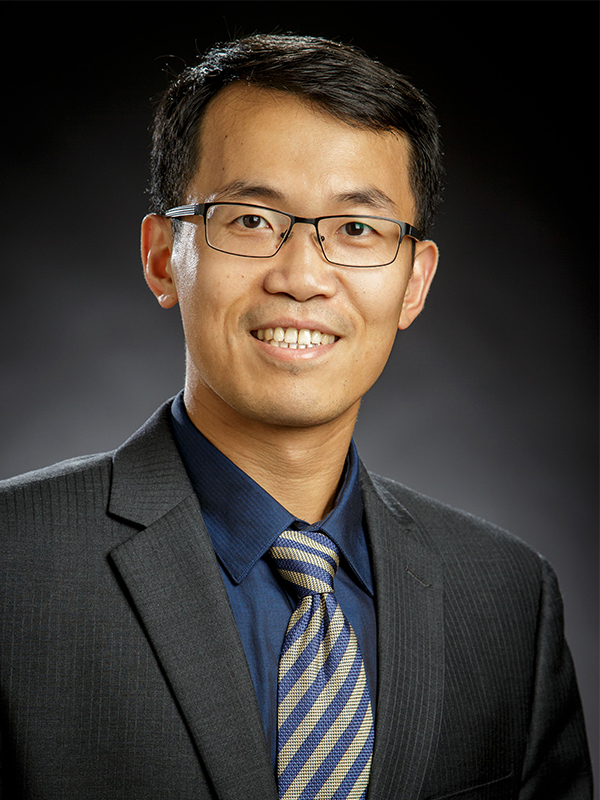
Dr. Yu Feng, professor in the School of Chemical Engineering, with the help of postdoctoral researcher Dr. Hang Yi, is leading research that combines computational fluid dynamics, AI and digital twin technology to improve the efficiency of data center cooling systems.
This project comes at a pivotal time as investments in AI and high-performance computing infrastructure continue to rise across the state. New and expanding facilities from major companies are expected to increase demand for electricity, cooling and water resources throughout Oklahoma.
“A data center is like a large building filled with thousands of powerful computers,” Feng explained. “These computers generate a lot of heat, and if the cooling system is not well designed, the system wastes energy and can even become unreliable.”
The team plans to create a physics-informed digital twin, a virtual replica of a data center that can simulate airflow, temperature, cooling performance and energy consumption, before changes are implemented in a real facility. Unlike many AI systems that rely solely on data, Feng’s approach includes established physical laws governing fluid flow, heat transfer and energy conservation, producing a model that is efficient and more dependable.
Looking ahead, Feng sees the work as a tool not only for data center operators but also for utilities and infrastructure planners.
“Most people may never see the inside of a data center, but they are affected by the electricity grid, water resources, local infrastructure, and economic development around these facilities,” Feng said. “If data centers are designed and operated more efficiently, they can place less pressure on utility systems, reduce the chance that infrastructure costs are shifted to residents, and support more reliable power.”
This research could help reduce energy waste, improve grid reliability, support renewable energy integration and lessen pressure as Oklahoma continues to attract large-scale data center investments.
Turning oilfield waste into a valuable resource
Dr. Praveen Meduri, assistant professor for the School of Chemical Engineering, is working alongside CHE professors Dr. Prem Bikkina and Dr. Clint Aichele to explore a different challenge with similar implications for the state’s energy industry. The project seeks to recover bromine from produced water and convert it into calcium bromide; a product commonly used in drilling and well completion operations.
Produced water is typically treated as a waste stream requiring costly management and disposal. However, Meduri’s team sees it as an untapped resource.
“The raw ingredients for the very product operators need are present in the waste stream they produce, which struck me as an opportunity,” Meduri said. “The problem we are solving is whether we can close that loop electrochemically, recovering bromine from produced water and converting it directly into CaBr₂ on-site without shipping anything in or adding supplemental reagents.”
The project brings together expertise from Meduri, Aichele and Bikkina, along with industry partner D&B Oilfield Services, which will provide produced water samples from Oklahoma operations.
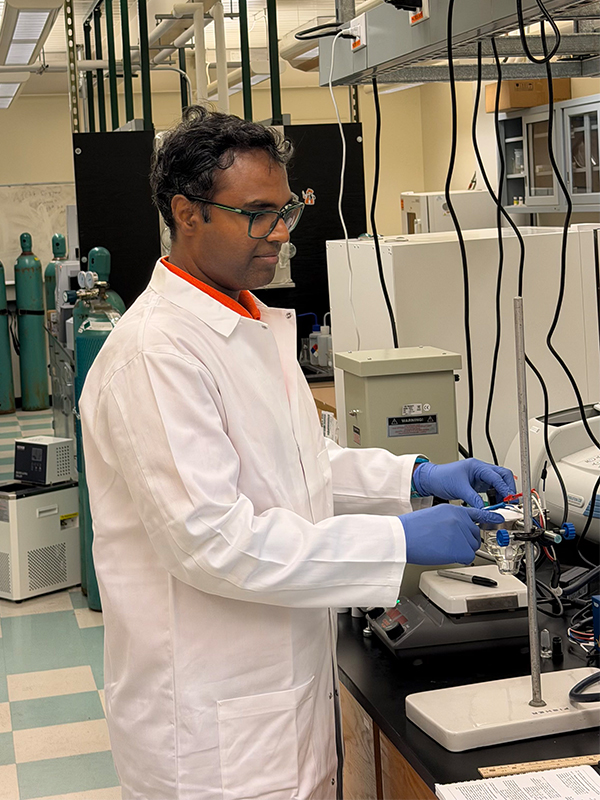
Researchers plan to investigate whether bromine can be selectively recovered from produced water and combined with existing calcium in the same stream to directly produce calcium bromide on-site. If successful, the process could reduce waste, lower costs and decrease dependence on external supply chains for designated critical minerals.
One of the project’s greatest scientific challenges is achieving selective bromine recovery from water containing dramatically higher concentrations of chloride ions. Solving that challenge could create a simple, deployable technology for oilfield operations across the state.
Beyond its technical goals, the research reflects a broader shift in how the energy industry views produced water.
“Conventional thinking about produced water is that it is a problem to be managed,” Meduri said. “This project proposes a fundamentally different framework in which produced water serves as feedstock for industrial materials.”
Long term, the team envisions modular electrochemical systems operating at Oklahoma well sites, producing valuable materials and reducing disposal burdens. These changes have the opportunity to strengthen domestic supply chains for critical minerals.
Together, these projects highlight how Oklahoma researchers are addressing emerging challenges at the crossroads of energy, technology and sustainability. By supporting early-stage ideas with significant long-term potential, the Hamm Institute is helping OSU researchers develop solutions that could benefit industry and improve the quality of life for Oklahomans.