


OSU researchers look to stop phosphorus at the edge of the field
Friday, September 18, 2026
Media Contact: Desa James | Communications Coordinator | 405-744-2669 | desa.james@okstate.edu
Phosphorus that accumulated in agricultural soils years ago continues to pose a challenge for water quality in the Illinois River Watershed. Drs. Jaime Schussler and Mary Foltz are working to develop a way to capture that nutrient before it reaches waterways.
Supported by the Oklahoma Conservation Commission, the researchers in the School of Civil and Environmental Engineering are launching a five-year project to design, construct and monitor an edge-of-field biofilter that uses locally available byproduct materials to reduce phosphorus in agricultural runoff.
The Illinois River Watershed spans Oklahoma and Arkansas and includes significant agricultural land use. Although the application of supplemental nutrients has slowed, excess or “legacy,” phosphorus remains in soils and can be carried by runoff into receiving waters.
Because of the high phosphorus concentrations, the watershed is considered impaired, meaning it cannot fully support its designated uses. This is particularly important to Oklahoma because the Illinois River feeds Lake Tenkiller, a significant recreational and water resource in the state.
“Basically, we have an overabundance of phosphorus on the land which runs off to the receiving water, leading to nutrient pollution, algae growth and low dissolved oxygen in the Illinois River Watershed,” Schussler said.
The project will investigate whether an engineered area placed at the edge of an agricultural field can intercept runoff and improve its water quality before it reaches nearby waterways.
As water moves through the biofilter, it will pass through media selected for its ability to capture phosphorus. The researchers initially plan to evaluate biochar, iron filings and granular limestone, with laboratory testing used to determine which materials or combinations are most effective.
“We believe these materials have the highest sorption or ‘stickiness’ capacity for the phosphorus,” Schussler said.
The first phase of the project will establish the conditions needed to design the field-scale biofilter. The team will identify a suitable site, establish baseline water flow and pollutant loading and test potential media in laboratory columns. Using those results and site-specific data, the team will develop the biofilter design and plans to install and instrument the system by the end of the second year.
The final three years will focus on monitoring the biofilter’s performance and evaluating how long the media remain effective. Researchers will track water quality and quantity while also examining potential environmental tradeoffs, including greenhouse gas emissions associated with nutrient cycling. This combination of laboratory and field research will help the team understand how biofilter design and media selection affect long-term performance.
“We’ll be identifying the best byproduct media or media combinations by doing lab-scale column testing and work on sizing and design of the biofilter based on the site-specific parameters,” Schussler said.
The project is also designed to extend beyond the research site. Researchers will work with landowners involved in the project and plan to hold workshops and provide technical support for communities and landowners interested in using the technology.
Additionally, extension will be incorporated through Gals in Green Infrastructure, or GiGI, an outreach and education group formed in 2023 by Foltz and Schussler. GiGI introduces students and community members to green infrastructure, including nature-based approaches to water treatment and stormwater management.
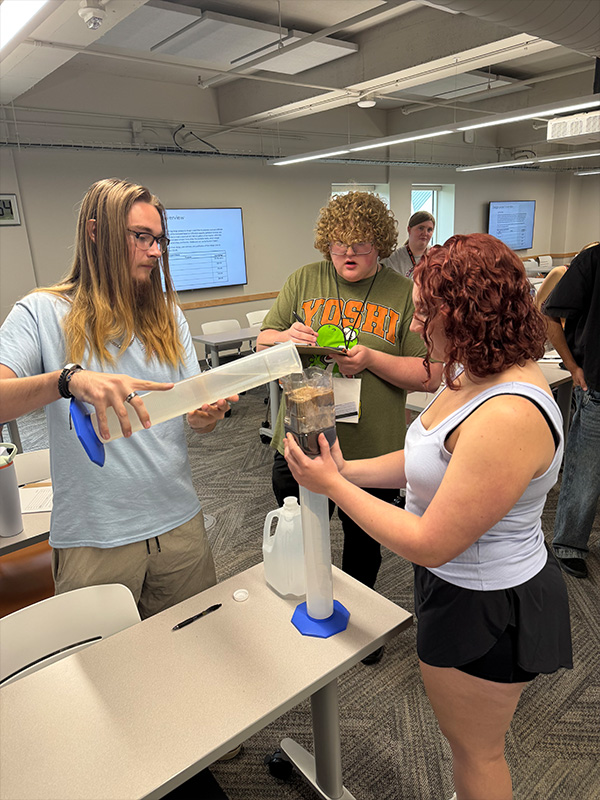
One of the group’s existing activities, “biofilter in a bottle,” allows students to design, construct and test small biofilters using 1-liter bottles. The new project will allow researchers to expand the activity into agricultural applications and introduce students to the potential benefits of byproduct materials.
“We have traditionally done this with urban applications in mind, but this project will allow us to include agricultural applications and discuss the beneficial uses of byproducts,” Foltz said.
Outreach opportunities may include 4-H, FFA and other organizations near the watershed, as well as existing Oklahoma State University programs.
The project will also provide research opportunities for a multitude of students. Three graduate students are already involved, with additional graduate and undergraduate researchers expected to participate throughout the five-year project.
Students will contribute to different aspects of the work, including modeling, laboratory testing, field data collection, data visualization and communication. Undergraduate research assistants will work alongside graduate students and contribute to research tasks throughout the project.
The researchers said the range of work will allow students to develop experience in different areas while learning how the individual pieces of a large-scale environmental research project fit together.
“We’re excited to lead these students in the areas of sustainable agricultural and stormwater management,” Foltz said.
For Schussler and Foltz, the project also represents an opportunity to connect their work to the health of a watershed they value personally.
“We believe that the results from our research can be applied to support the health of one of our state’s most critical waters,” Schussler said. “We both love outdoor recreation and feel that this project aligns both professionally and personally.”
Ultimately, the field-scale biofilter will serve not only as a research site but as a demonstration and education location, with signage and outreach activities designed to help others understand how the technology could be applied.
If widely adopted, the researchers hope that byproduct-based biofilters can provide another tool for reducing nutrient pollution and supporting healthier waterways throughout the Illinois River Watershed and beyond.
“We believe that the results from our research can be applied to support the health of one of our state’s most critical waters.”