


OSU researchers studying an innovative approach to reduce construction runoff pollution in Oklahoma
Wednesday, June 3, 2026
Media Contact: Desa James | Communications Coordinator | 405-744-2669 | desa.james@okstate.edu
While construction sites are a sign of growth in a community, the exposed soil during earthwork can create serious water quality problems long after the equipment has left the site.
Researchers in the School of Civil and Environmental Engineering at Oklahoma State University are studying an emerging stormwater treatment approach designed to reduce sediment and pollutant runoff from construction sites before it reaches nearby bodies of water.
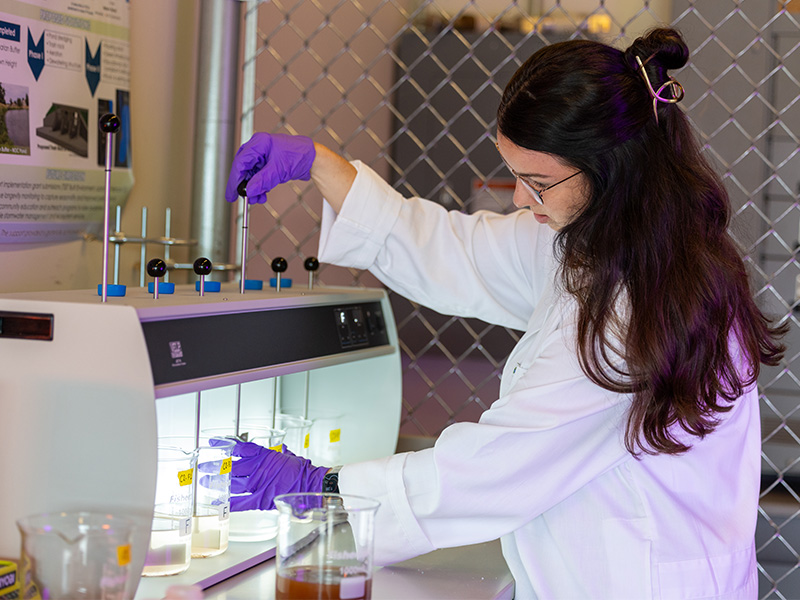
Under the guidance of Dr. Jaime Schussler, assistant professor in the College of Engineering, Architecture and Technology, the research evaluates the use of flocculants in temporary stormwater management. Flocculants are agents that bind fine sediment particles together, making them larger and heavier so that they settle out of suspension in stormwater runoff. The lab work is led by Ph.D. student Mamata Pandey and focuses specifically on polyacrylamide-based flocculant blocks and examines how effectively they reduce turbidity, nutrients and metals in runoff from construction areas.
Under the Clean Water Act, waterways are evaluated based on whether they can safely support uses such as recreation, aquatic life and drinking water. In Oklahoma, turbidity - the measure of cloudiness caused by suspended sediment - remains one of the leading causes of impaired surface waters.
When runoff carries large amounts of fine sediment into streams and lakes, the effects extend far beyond muddy water. Excess sediment can block sunlight needed by aquatic vegetation, damage fish habitats and increase maintenance demands on drainage infrastructure.
“When turbidity becomes too high, it affects the entire system,” Schussler said. “It can degrade water quality, impact ecosystems and further strain stormwater infrastructure and water treatment facilities.”
Traditional construction stormwater controls, such as silt fences and inlet protection practices, are generally effective at capturing larger particles like sand but do not provide enough holding time to settle finer materials such as clay and silt. Those smaller particles are often the primary drivers of turbidity and can also carry attached pollutants to surface waters.
Flocculants may provide an important advantage in these cases.

“Flocculants work almost like magnets,” Pandey said. “They pull very small particles together into larger clumps that settle much quicker, leaving clearer water behind.”
The research combines laboratory testing with channelized flow experiments designed to simulate real-world construction conditions. Laboratory jar tests help researchers determine which flocculant formulations work best with specific soil types, while channel testing evaluates how the materials perform under changing flow conditions and over time.
The study also examines residual concentrations, or the amount of flocculant remaining in the water after treatment, to ensure environmental safety.
“Selecting the appropriate flocculant type and dosage is critical,” Pandey said. “We are monitoring water quality throughout the process to ensure the treatment is effective while also minimizing environmental risk. We want to ensure that we are not pollutant swapping, which is why we are holistically looking at sediment, nutrient, and metal concentrations.”
Early observations show significant reductions in turbidity, though researchers continue studying how the treatment influences nutrient and metal concentrations under different conditions.
If successful, the work could help improve stormwater management practices across construction sites by providing guidance on how flocculants can be effectively integrated alongside existing best management practices.
The implications extend beyond construction projects themselves. Cleaner runoff can reduce stress on storm sewer systems, culverts and detention basins while helping protect local waterways and reduce drinking water treatment demands.

The project is funded through the U.S. Geological Survey 104(b) program with additional support from the International Erosion Control Association University Partners Program. Industry partners are also supporting the research through commercially sourced flocculant materials.
The project provides hands-on research opportunities for OSU students working in environmental engineering and water resources. Like Pandey, who is leading the research as part of her dissertation work, and undergraduate students Connor Bailey and Jason Sauer, who are assisting with laboratory testing, data collection and analysis.
Schussler said the experience gives students, like undergraduate researcher Sam Phelps, exposure not only to technical testing and water quality analysis but also to the broader environmental and policy considerations tied to stormwater management.
“Students are learning how engineering decisions affect real communities and ecosystems,” Schussler said. “They are gaining technical skills, but they are also learning the responsibility that comes with protecting public and environmental health.”
The research reflects OSU’s continued focus on applied engineering solutions that address practical challenges facing Oklahoma communities while preparing students to lead in environmental stewardship and infrastructure resilience.
"Ultimately, this work is about protecting water resources for future generations. I want people to be able to fish, swim and safely use Oklahoma surface waters for years to come. "