

OSU researchers using AI to help inhalers reach the smallest airways
Tuesday, May 12, 2026
Media Contact: Desa James | Communications Coordinator, CEAT | 405-744-2669 | desa.james@okstate.edu
For millions of people living with lung diseases such as chronic obstructive pulmonary disease, inhalers are a daily lifeline. Yet even when medication is taken correctly, much of it may never reach the small airways where the disease often begins and progresses. Instead, drug particles can deposit unevenly throughout the lungs – or miss their target altogether.
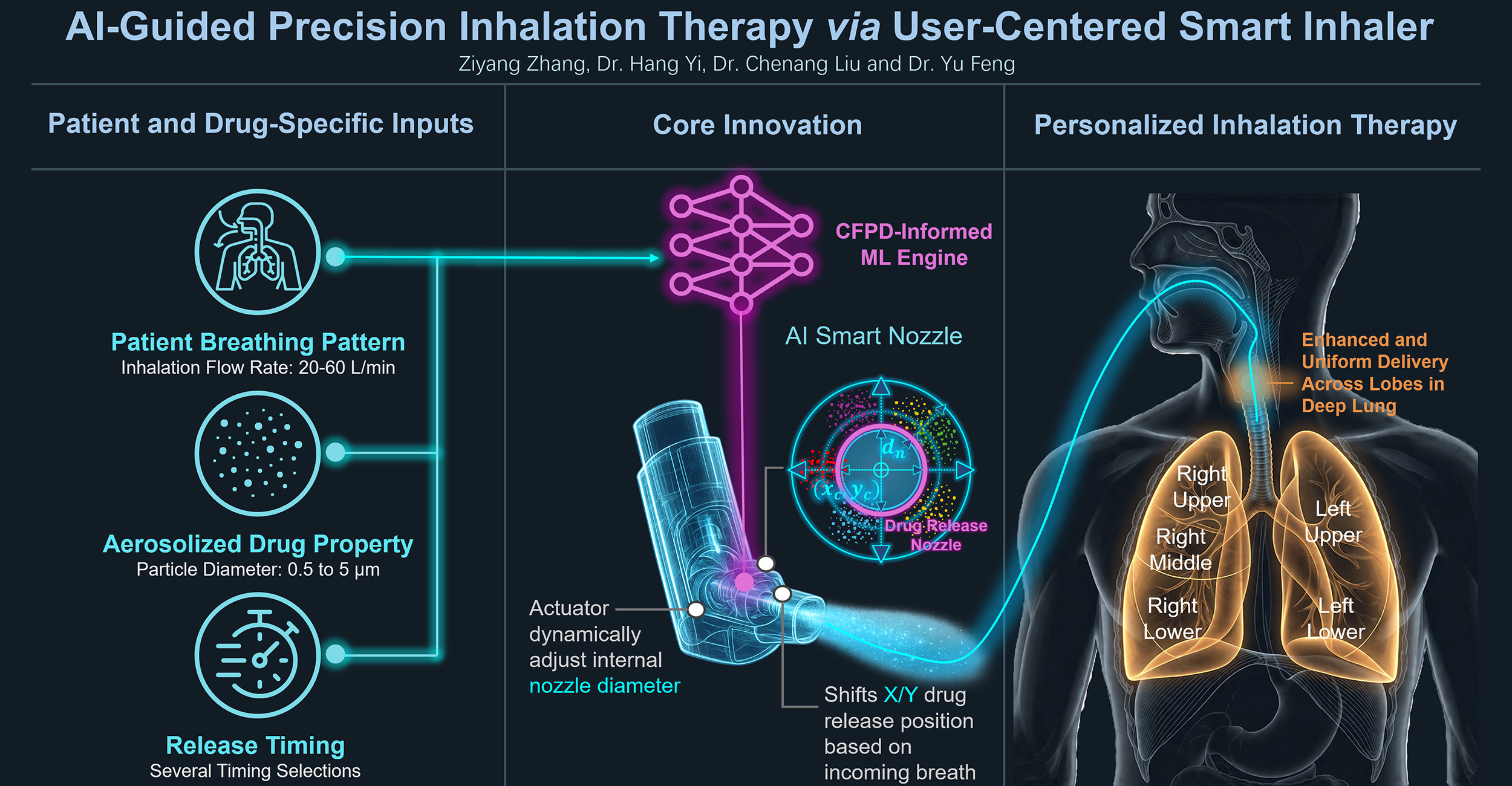
A research team at Oklahoma State University’s College of Engineering, Architecture, and Technology has developed a computational fluid particle dynamics and artificial intelligence-driven framework designed to help inhaled medications reach those airways more effectively and uniformly.
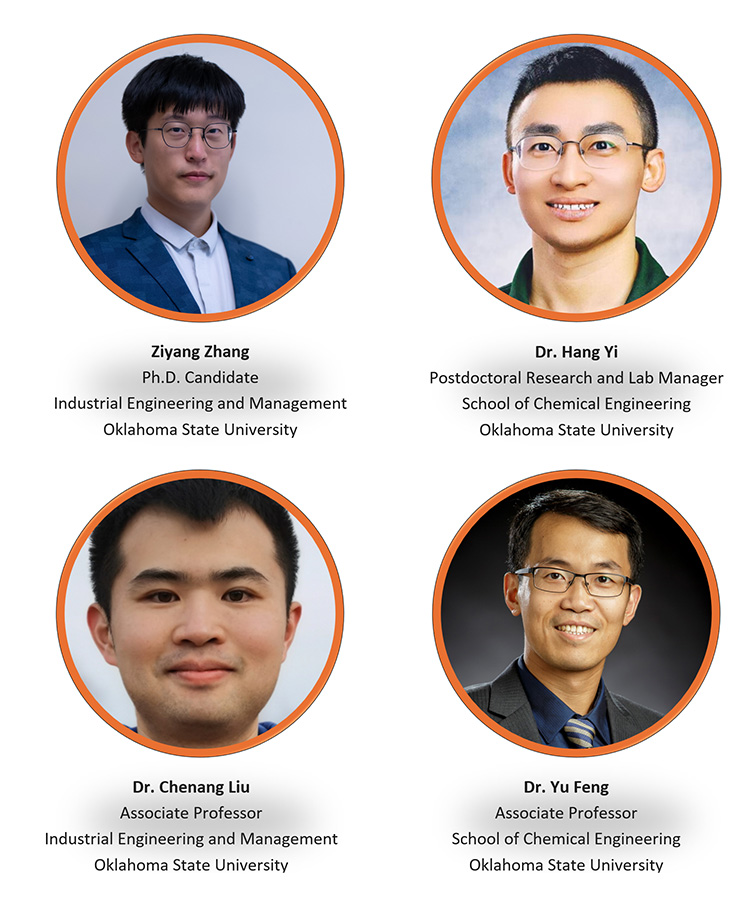
The multidisciplinary team comprises Ph.D. Candidate Ziyang Zhang and Associate Professor Dr. Chenang Liu, both from the School of Industrial Engineering and Management, and Postdoctoral Researcher Dr. Hang Yi and Associate Professor Dr. Yu Feng from the School of Chemical Engineering.
By combining physics-based simulations of airflow and drug particle dynamics in the lungs with machine learning, their research lays the groundwork for a new generation of user‑centered smart inhalers that can adapt to individual patients.
“An easy way to think about this research is like GPS navigation for drug aerosol particles that travel inside the complex road maps in the lung airways,” Feng said. “A conventional inhaler releases the medication broadly, somewhat like sending many delivery trucks (i.e., drug particles) into a big city (designated lung sites) without specific routes. Some particles could reach the intended neighborhoods, but others may stop too early or even end up in the wrong places. Our research jointly uses CFDP and cutting-edge ML approaches to efficiently identify the best ‘route’ for inhaled drug particles so that more of the medicine reaches the small airways, where diseases such as COPD often begin and progress.”
“This is not just about telling patients how they used an inhaler. It’s about using engineering and AI to help the inhaler work better for them.”
Small airways are the primary sites of airflow obstruction in COPD and other pulmonary diseases, yet they remain some of the most difficult regions for inhaled medications to reach. Conventional inhalers typically release drug particles across the full mouth opening, a method that often results in insufficient delivery to deep lung regions and uneven distribution among the five lung lobes.
To better understand and address this challenge, the researchers rely on CFPD.
“CFPD enables us to create physiologically realistic virtual human respiratory systems and accurately simulate how air and small drug particles move through complex airway passages,” Feng said. “It is very detailed and physics-based, so it can provide high‑resolution information about where particles travel, where they deposit, and how different breathing patterns, airway geometries, particle sizes, and release conditions affect delivery.”
One key advantage of this approach is its ability to generate data that would be extremely difficult – or sometimes impossible – to collect through traditional laboratory or human studies.
“CFPD can track millions of particles throughout a subject-specific airway model and identify how changes in release position, release timing, inhalation flow rate, and particle size influence deposition in different lung regions,” Feng explained.
That high‑fidelity simulation data then becomes the foundation for ML.
“Machine learning can learn from these high‑fidelity CFPD datasets and rapidly predict improved inhaler settings for new patient‑specific and drug‑specific conditions,” Feng said. “In simple terms, CFPD acts like a high‑resolution virtual laboratory, and ML turns the knowledge generated from that laboratory into a fast decision‑making tool.”
Together, the CFPD-ML framework enables a shift away from one-size-fits-all inhalation therapy toward more patient-specific drug delivery. The combined approach is noninvasive, cost‑effective and time‑efficient, and it forms the algorithmic foundation for future smart inhalers that can adapt aerosol release based on individual breathing patterns and medication properties.
To ensure the approach was reliable, the ML models were tested using more than 100 detailed computer simulations that showed how air and medicine particles move through the lungs. Most of the simulations were used to train the models, while the remaining data were used to evaluate prediction accuracy.
Validation studies showed this approach significantly improved the uniformity of drug delivery and reduced off‑target deposition in the mouth, throat and upper airways when compared with conventional full‑mouth release strategies.
That improvement has meaningful implications for patients. More efficient delivery could increase treatment effectiveness while reducing medication waste and unwanted side effects.
Most smart inhalers currently available focus on tracking usage or reminding patients to take medication. The OSU research takes a different approach.
Rather than focusing solely on monitoring, the proposed smart inhaler concept actively optimizes medication delivery. Based on inputs specific to the patient and drug, the device could adjust internal release conditions such as nozzle location and diameter so that more medication reaches diseased regions of the lungs.
“This is not just about telling patients how they used an inhaler,” Feng said. “It’s about using engineering and AI to help the inhaler work better for them.”
For the research team, the work is driven by more than advancing technology. It is rooted in a commitment to applying engineering, mathematics and AI to real clinical challenges faced by millions of people who rely on inhalers every day.
While inhalation therapy is essential for managing pulmonary disease, its effectiveness still depends heavily on factors such as breathing patterns, airway anatomy and device design, limitations that leave room for improvement.
The team sees computational modeling as a way to bridge that gap, transforming foundational STEM principles into tools with direct healthcare impact.
“This work shows that the same equations and principles students learn in classrooms can be transformed into practical tools with real healthcare applications,” Feng said.
They also emphasize that computational models are not meant to replace experiments or clinical studies, but to complement them. High‑fidelity simulations offer a human‑relevant, repeatable way to study complex lung behavior, helping reduce trial‑and‑error while informing smarter device design.
“That connection between challenging STEM fundamentals and future patient benefit is what keeps us motivated,” Feng said.