


OSU students gain global perspective in International Summer School for Sustainability
Wednesday, September 30, 2026
Media Contact: Tanner Holubar | Communications Specialist | 405-744-2065 | tanner.holubar@okstate.edu
KEY TAKEAWAYS
- Sept. 7-11, 2026: OSU participated in the fifth International Summer School on Sustainability in Karlsruhe, Germany.
- Three universities: OSU, Karlsruhe University of Applied Sciences and Eastern Switzerland University of Applied Sciences collaborate on the annual sustainability program.
- 2026 topics: Students explored renewable energy, energy storage, sustainable cooling, clean water and sustainability implementation through lectures, workshops and excursions.
- Global collaboration: Students worked with peers from Europe, Africa, Asia and the Americas to examine sustainability challenges from different perspectives.
Sustainability is a concept that transcends borders.
International collaboration can foster new perspectives on situations as well as new solutions to issues that are common worldwide.
Oklahoma State University students recently joined their international peers to explore solutions for a more sustainable future. From Sept. 7-11, OSU students and faculty took part in the fifth International Summer School on Sustainability (i3s), held at Karlsruhe University of Applied Sciences (HKA) in Karlsruhe, Germany.
Students from around the world, from a variety of academic disciplines, convened to exchange ideas, collaborate, and examine sustainability challenges from different international perspectives.
The summer school is a collaboration between HKA, Eastern Switzerland University of Applied Sciences (OST) and OSU. For 2026, topics studied included environmental engineering and renewable energy, energy storage, sustainable cooling and heat-pump technologies, clean water and sustainability implementation. Students also took part in workshops and excursions.
Dr. Christian Bach, professor in the School of Mechanical and Aerospace Engineering, said OSU began this partnership in 2024. Architectural engineering professor Dr. Khaled Mansy, as well as Drs. Aditya Jayadas and Hebatalla Nazmy from the Department of Interior Design and Merchandising, and Bach saw an opportunity for their students to benefit from international collaboration.
"We saw an opportunity to contribute our expertise to excite the next generation for the one planet we deeply care about," Bach said. "Michael Kauffeld (HKA) and Mihaela Dudita-Kauffeld (OST) graciously allowed us to join their efforts."
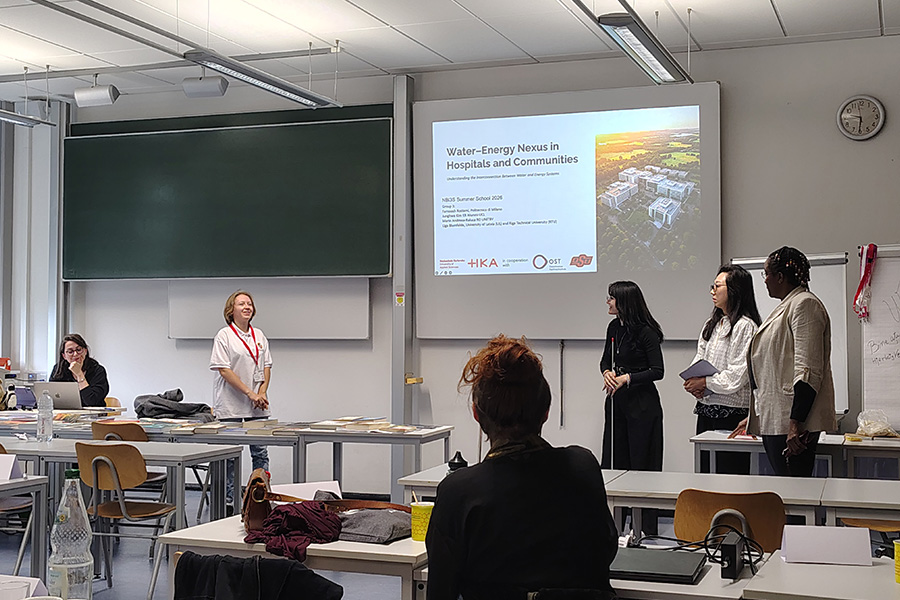
Global perspectives shed new light on possible local solutions
The international makeup of the school is what defines its success. Students from developed nations interact with those from developing nations, allowing collaboration to focus on problems from different academic and geopolitical perspectives.
This type of interaction between students from differing backgrounds is invaluable, something Bach said is difficult to replicate in a traditional classroom setting.
"My impression is that different backgrounds not only bring a diversity of thought but also enable all participants to think more freely," Bach said. "In past online pre-sessions, as well as this time in person, I have been impressed by how quickly the students collectively identify issues that subject matter experts traditionally miss."
It also gives OSU students, many of whom are from the region, an opportunity to see challenges familiar to Oklahoma and the United States through a broader lens. This can provide new perspectives on problems that may be common worldwide, fostering potential solutions and ideas.
During one site visit, students examined a situation involving "forever chemical" contamination in irrigation water. Students learned how agricultural practices, industrial waste and water treatment can become interconnected environmental challenges.
"Many of our students have never had the chance to spend time and work together with people from other regions of the planet," Bach said. "When students can interact with international peers, they then realize how interconnected all actions are, giving our students an edge in an increasingly global world."
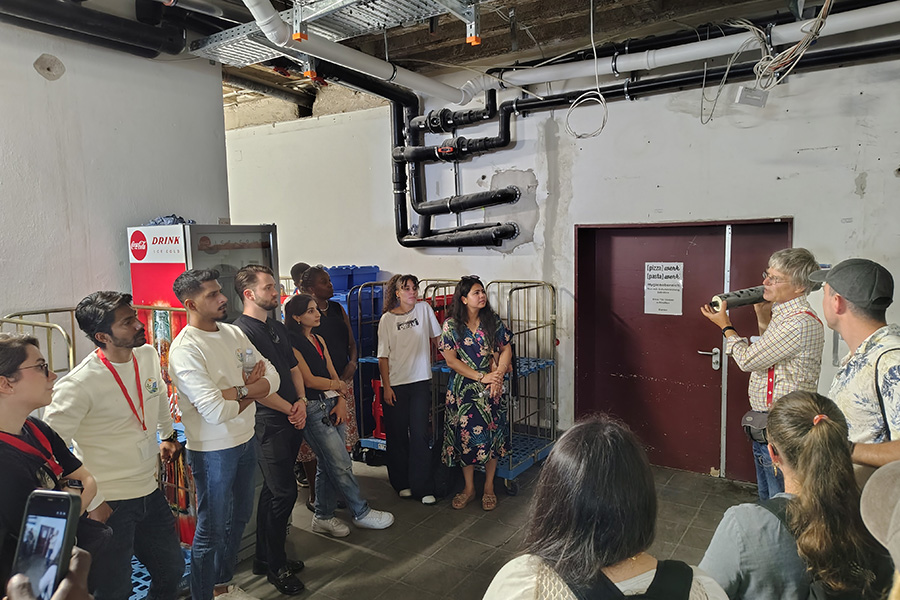
Seeing sustainability as a connected system
OSU contributed lectures and exercises on sustainable residential building energy systems, occupant-centric low-impact buildings, evaluation of existing and new building stock, biomimicry, biophilic design and industrial ecology.
This complemented KHA topics on sustainable refrigeration using natural refrigerants and Li-ion battery life extension. OST contributed lectures on solar energy and industrial heat pumps. Numerous guest speakers from both academia and industry covered additional topics relevant to sustainability.
These lectures culminated in a well-rounded experience, with students focusing on how different parts of a system affect one another.
“Sustainability by definition must mean that all waste is an input to another process or product,” Bach said. “Optimizing solely one process entirely misses what happens downstream.”
Mihaela Dudita-Kauffeld, an enthusiastic project manager at the Institute for Solar Technology at OST, said that having American students' and researchers' perspectives strengthens the experience for all involved.
"Our collaboration with Oklahoma State University enriches our Nobel Banadda International Summer School with valuable perspectives from the U.S. and strengthens the global exchange between students from Europe, Africa, the Americas and Asia — we're all the more looking forward to welcoming students and colleagues from Oklahoma in person at OST in Switzerland for the first time in September 2027," Mihaela said.
Building long-term connections
Bach said the connections students made in Karlsruhe were among the most rewarding parts of the week.
"It has been an absolute pleasure to see the students form bonds during the week in Karlsruhe," Bach said. "I don't think any of them will ever forget their time at i3s."
The experience creates a broader understanding for students in how they fit in an increasingly connected world. It can foster future academic and research collaboration by encouraging students to keep in touch and maintain relationships.
"I'd love to see OSU students who have not traveled much interact and work with students from Europe, Africa and Asia in one of the mini projects during i3s," Bach said. "The expansion of their horizon would likely make it clearer for our OSU students that we are not operating in a vacuum and adopt a more global mindset."
For Bach, students building a well-rounded global perspective is why an international approach to sustainability matters.
"We cannot address global challenges with an overly constrained mindset," Bach said. "I believe humanity is at the cusp of where we will either work together to ensure the well-being of the planet or succumb to the seven deadly sins illustrated by Hieronymus Bosch around the year 1,500. Humanity has made much progress in understanding science and humanity since the 1,500s, but we have to catch up on learning and understanding at the individual level. I am naive (or optimistic enough) to think we can plant the seed for a sustainable future that starts with a global understanding of each other."