

Research aids future development of bio-inspired underwater vehicles
Friday, March 20, 2026
Media Contact: Tanner Holubar | Communications Specialist | 405-744-2065 | tanner.holubar@okstate.edu
The biological swimming technique of the vast majority of aquatic creatures could influence the design of unmanned and autonomous underwater vehicles.
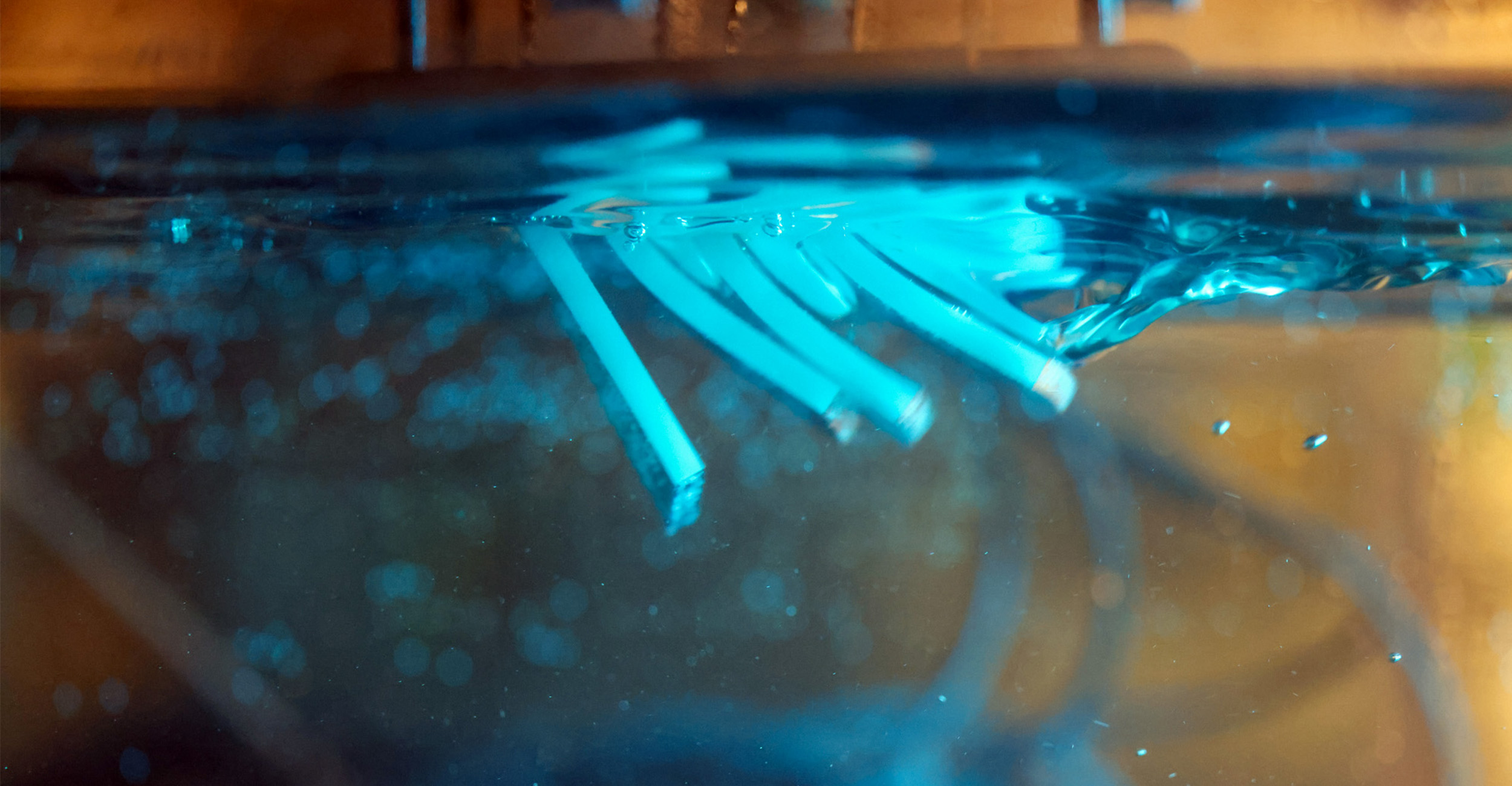
Crustaceans such as krill, shrimp and lobsters use metachronal swimming to navigate oceanic depths. These animals have multiple, closely spaced legs that move in a coordinated sequence from back to front, propelling them through the water.
This swimming technique and its applications in unmanned underwater vehicles and autonomous underwater vehicles are the subject of a research endeavor funded by the National Science Foundation and led by Dr. Arvind Santhanakrishnan, an associate professor in the School of Mechanical and Aerospace Engineering in the College of Engineering, Architecture and Technology at Oklahoma State University.
A large group of metachronal swimmers is heavier than water, meaning they sink if they stop paddling their legs. Some animals use this technique to swim in reverse or hover in place.
“These natural examples show that metachronal rowing can be used for a range of maneuvers, far beyond simple forward motion along a straight line,” Santhanakrishnan said. “In traditional UUVs, maneuvering requires the use of thrust vectoring using multiple thrusters/propellers. An individual thruster produces force along one direction. Response times are slower in traditional UUVs due to the complex repositioning (of several propellers) needed for thrust vectoring to make the vehicle climb upward or hover in place.”
UUVs and AUVs are used for many applications, including environmental monitoring, search and rescue, and military missions. They traditionally use a single propeller to generate the required force, but if that propeller fails, the vehicle’s failure can disrupt a mission. Their large size makes them expensive and hard to maneuver, as they create more drag through the water.
Making the vehicles smaller is key, and metachronal swimming would be more effective than a single propeller on small-scale vehicles.
“An alternative approach to increase operational space and scope at lower cost would be to deploy swarms of miniaturized UUVs with metachronal propulsion systems,” Santhanakrishnan said. “In fact, our study from last year showed that metachronal rowing can provide robust propulsive performance across a broad range of sizes and speeds.”
Their research shows that a metachronal swimming vehicle would have similar performance at different sizes. One factor currently being studied is the amount of input power vehicles would need and how that varies with size.
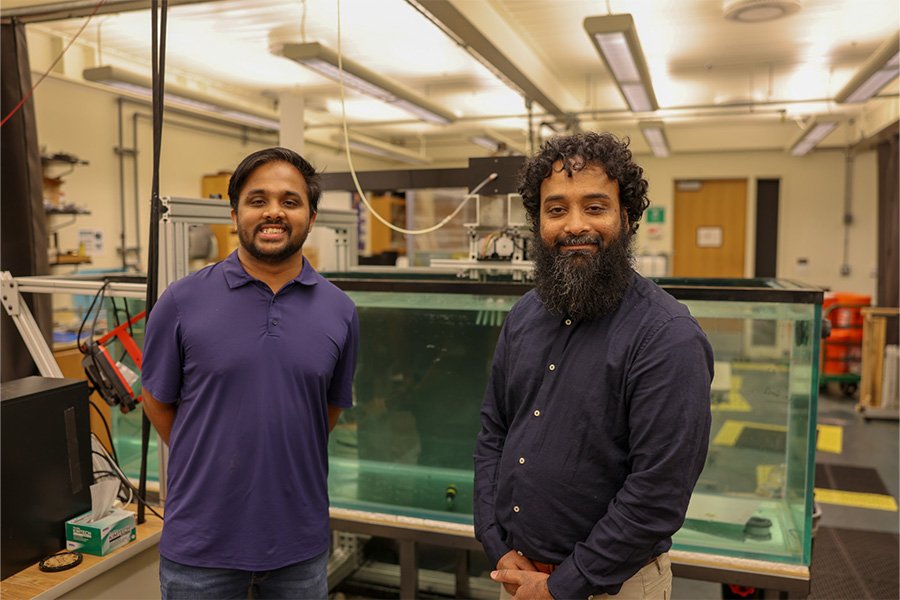
To test this, the researchers use a large-scale remotely operated vehicle to test how different-sized vehicles would perform with metachronal swimming. The team studies what would happen if that test vehicle were miniaturized or enlarged without having to create multiple ROVs.
They use different fluids in which the vehicles are tested, allowing them to study how a differently sized vehicle would perform.
“If one wanted to study how a child swims compared to an adult, this could be done by having the adult swim in a fluid thicker than water, such as molasses,” Santhanakrishnan said. “Due to their smaller size, a child would feel a lot more resistance from the surrounding water as compared to an adult. Such increased resistance from the fluid can be recreated by making the adult swim in a fluid far more viscous than water.”
This research is in collaboration with Dr. Robert Guy of the University of California-Davis Department of Mathematics and Dr. David Fields at the Bigelow Laboratory for Ocean Sciences in Maine.
The CEAT team will work with the UC Davis group to receive training in mathematical modeling, numerical simulations, and scientific computing.
Working with Dr. Fields, Santhanakrishnan and his students will study live metachronal swimming marine animals.
Through this interdisciplinary collaboration, students will be trained in fluid mechanics, robotics and scientific computing, applying these collective skills to the design of bio-inspired UUVs.
“In general, research experiences can be transformative in a student’s academic journey and enhance conceptual understanding of classroom content,” Santhanakrishnan said. “Undergraduate engineering courses typically focus on a specific topic/area, but solving practical problems requires learning and integrating knowledge from multiple areas. I believe engineering students should challenge themselves by working on interdisciplinary projects.”
This research represents CEAT’s commitment to the pursuit of research that uses innovation and collaboration to solve real-world problems, harkening to OSU’s land-grant mission.