


Researchers explore terahertz technology for faster, more reliable wireless networks
Thursday, October 8, 2026
Media Contact: Tanner Holubar | Communications Specialist | 405-744-2065 | tanner.holubar@okstate.edu
Key Takeaways
Oklahoma State University and the University of Oulu in Finland are developing AI-powered terahertz communication technology for faster, more reliable wireless networks using drones.
The National Science Foundation is funding $700,000, and the Research Council of Finland is contributing $835,000 to support the research.
Researchers are developing AI models to predict connection failures and adjust antenna alignment as drone movement, vibration and atmospheric conditions affect signals.
The project will investigate how multiple drones can maintain connected networks and reroute data when individual wireless links fail.
Researchers are looking for innovative ways to move large amounts of data without relying on traditional fiber-optic connections, especially as wireless networks become faster and more demanding.
A promising possibility is terahertz communication, which uses high-frequency signals to transmit data at fast speeds. The development of wireless links could serve as a "backhaul" connection, linking larger networks to smaller ones in places where installing fiber is too expensive, difficult or disruptive.
A collaboration between Oklahoma State University and the University of Oulu in Finland is studying how terahertz technology could improve wireless communication.
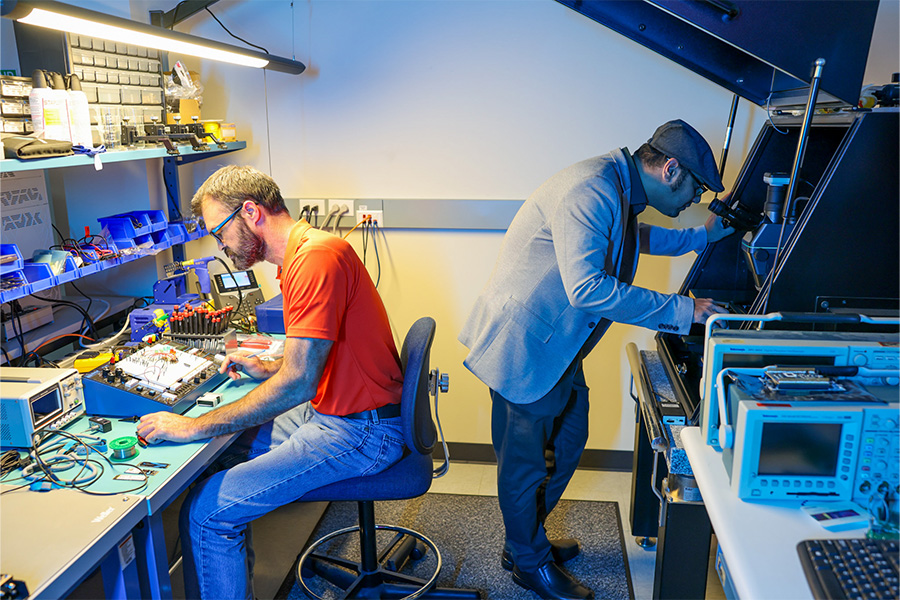
In OSU's School of Electrical and Computer Engineering, assistant professor Dr. Shahriar Shahabuddin and Dr. John O'Hara are partnering with Dr. Joonas Kokoniemi of Oulu.
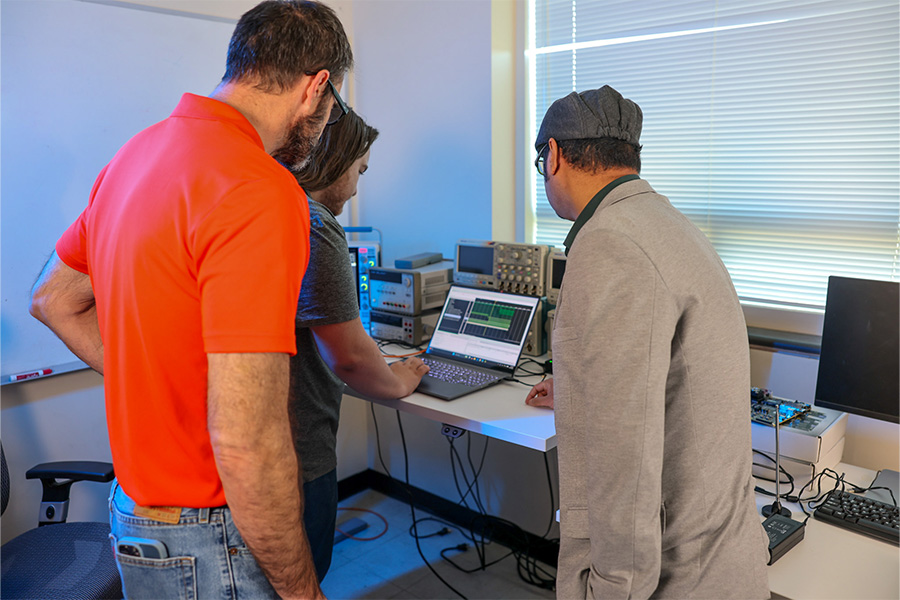
The National Science Foundation is funding $700,000 for this project and the Research Council of Finland is contributing $835,000.
The project will cover three main research areas. The first is studying measurements gathered from drones and other aerial platforms. The team will study how movement, vibration, atmospheric conditions and antenna alignment affect terahertz signals. Combining these measurements with data from the drones' sensors will help them identify why connections fail and develop models to predict failures.
The team will then use artificial intelligence to predict problems before they can interrupt a connection. AI models will analyze wireless signals alongside information about the drone and its surroundings. The system could then adjust antenna alignment or other communication settings as conditions change.
That real-time adaptability is crucial because terahertz signals travel in narrow beams that need precise alignment between antennas. Movement from a drone or wind can disrupt that alignment, while turbulence can weaken or distort the signal, especially over long distances.
The third phase is exploring how multiple drones can operate as part of a connected network. Ground stations will be able to adjust communication beams as drones move, while network technology could reroute data when a single connection is lost.
"Although extremely high-speed terahertz connections have already been demonstrated between fixed locations, maintaining them reliably over long distances using moving drones remains a significant challenge," Shahabuddin said.
Connecting Oklahoma and Finland
Oulu brings decades of expertise in wireless communications to the project, building on the region’s rich history of innovation, including its role in Nokia’s rise during the 1990s.
Shahabuddin also has a personal connection, having earned his Ph.D. from Oulu. He has known Kokkoniemi for many years, and a visit to OSU in 2024 helped lay the foundation for the current project.
"This collaboration gives us a unique opportunity to combine our expertise and benefit from decades of terahertz research at OSU and decades of wireless research at Oulu," Shahabuddin said.
Oklahoma and Finland have vastly different climates, giving researchers a chance to study how these differences affect terahertz signals, which are sensitive to atmospheric conditions, and discover techniques to make them more efficient and reliable.
This will help researchers understand how aerial terahertz connections perform and evolve across different environments, enabling them to discover techniques to make them more efficient and reliable.
"Our goal is to establish the foundations for intelligent, self-healing aerial communication networks that can provide reliable, high-capacity connectivity wherever it is needed," Shahabuddin said.
FAQ
-
What is OSU researching about terahertz communication?
Oklahoma State University is partnering with the University of Oulu in Finland to develop more reliable, high-speed wireless communication using terahertz signals and artificial intelligence. The research focuses on maintaining connections between moving drones and other aerial platforms.
-
How much funding is OSU’s terahertz research project receiving?
The National Science Foundation is providing $700,000, and the Research Council of Finland is contributing $835,000 to support the collaboration between OSU and the University of Oulu.
-
How will AI help OSU improve terahertz communication?
OSU researchers are developing AI models to predict wireless connection failures before they occur. The system will analyze wireless signals, drone sensor data and environmental conditions to help adjust antenna alignment and communication settings in real time.
-
Why is terahertz communication difficult to use with drones?
Terahertz signals travel in narrow beams that require precise antenna alignment. Drone movement, vibration, wind and atmospheric turbulence can disrupt alignment or weaken signals, making reliable long-distance communication challenging.
-
Who is leading OSU’s terahertz communication research project?
Dr. Shahriar Shahabuddin, an assistant professor in OSU’s School of Electrical and Computer Engineering, and Dr. John O’Hara are collaborating with Dr. Joonas Kokoniemi of the University of Oulu in Finland.
-
How will OSU and the University of Oulu collaborate on terahertz research?
OSU and the University of Oulu are combining their expertise in terahertz technology and wireless communications. Researchers will also study how differences between Oklahoma’s and Finland’s climates affect signal reliability and performance.