


Spitler co-develops award-winning geothermal technology platform
Tuesday, September 29, 2026
Media Contact: Desa James | Communications Coordinator | 405-744-2669 | desa.james@okstate.edu
A tool developed through a four-year collaboration between Oklahoma State University and Oak Ridge National Laboratory is making it easier to evaluate and design geothermal heating and cooling systems.
GeoWISE, the Geothermal heat pump Web-based Integrated Simulation and Economic analysis tool, has received a 2026 R&D 100 Award in the software/services category. The technology was co-developed by Regents Professor Dr. Jeffrey Spitler and researchers at ORNL.
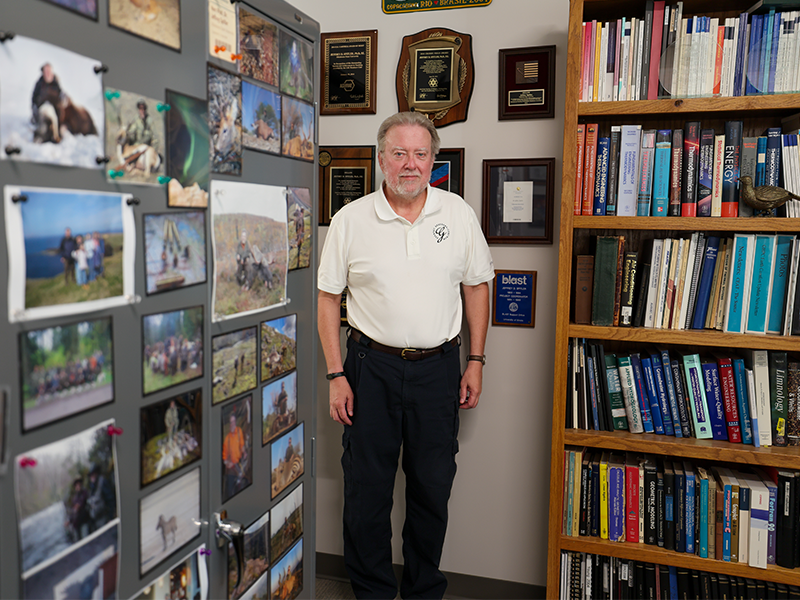
Spitler, OG&E Energy Technology Chair in the School of Mechanical and Aerospace Engineering, said the recognition reflects the practical value of the team's work.
"GeoWISE automates much of the analysis needed to make investment decisions on ground-source heat pump systems," Spitler said.
The R&D 100 Awards, presented annually by R&D World, recognize significant technological innovations from industry, government and academia around the world. The 2026 competition featured 149 finalists from eight countries and was evaluated by a panel of more than 50 industry professionals.
Designing large geothermal heat pump systems requires engineers to consider a range of factors, from a building’s heating and cooling needs to the thermal properties of the ground and the placement of underground boreholes.
“GeoWISE automates a significant part of the design process and enables very quick analysis at the preliminary design stage,” Spitler said.
“The design of large geothermal heat pump systems is inherently complicated, with a lot of information required, including building heating and cooling loads, ground thermal properties and the layout of the boreholes. GeoWISE leverages work at ORNL to provide the heating and cooling loads for almost any building in the USA very quickly, and it leverages our work to automatically determine a layout for the boreholes that takes full advantage of the available property. In short, it relieves the engineer of a lot of tedious work, particularly at the early design stages.”
GeoWISE builds upon ORNL’s former Ground Source Heat Pump Screening Tool.
"The biggest technical challenges for OSU were obtaining sufficient computation speed to make the tool practical and developing new ways to automatically locate boreholes," Spitler said.
Those borehole calculations are a key part of the system. They identify a field layout that can meet a building's heating and cooling demands while keeping the temperatures entering the heat pump within an appropriate range.
A significant portion of that work was performed by Ph.D. student Timothy West.
“Timothy West did most of the heavy lifting on developing the ground heat exchanger design algorithms that go into the GeoWISE tool,” Spitler said. Spitler also acknowledged earlier work by then-OSU mechanical engineering master’s student Jack Cook and collaborative work with a former OSU Ph.D. student, Matt Mitchell, at the National Laboratory of the Rockies.
Those algorithms determine a borehole field design that can meet a building’s heating and cooling loads while keeping the temperatures entering the heat pump within a specified range. Getting that design right is essential as an improperly designed borehole field can either fail to meet performance requirements or become too expensive to be economically feasible.
For West, whose research focuses on the automated design of vertical borehole ground heat exchangers, seeing that work incorporated into an award-winning tool provided a measure of validation for the research direction he has pursued.
“With the amount of time we spent on the part of our work that made its way into GeoWISE, it is reassuring to receive some validation that it is likely to be of some use,” West said.
West said the project also reinforced his interest in finding ways to reduce the cost of geothermal systems through more efficient bore field designs. He noted that bore field layouts can sometimes be selected from libraries of pre-existing designs, while automated approaches can identify alternatives that make better use of a particular property.
“I hope that users can see (as we have) the possible reductions in VB-GHE installation costs that can be found by utilizing non-standard bore field layouts,” West said.
“A ‘just-right’ design is necessary for the system to function and to minimize the first cost of the system," Spitler said. "Properly-sized GSHP systems can significantly reduce energy costs; GeoWISE designs borehole fields that perform well at the lowest possible cost, maximizing the return on investment.”
The platform is designed for engineers, planners, utilities, universities, government agencies and others evaluating geothermal options. By reducing the time and effort required during the early stages of a project, GeoWISE can help decision-makers determine where geothermal systems may make sense.
The team is continuing to consider ways to expand the technology, with Spitler identifying district ground-source heat pump systems as a likely area for future development.
The project demonstrates how research conducted through university and national laboratory partnerships can move from technical development toward tools with practical applications in the energy sector.