

Athletic training students find their place off the field
Monday, March 30, 2026
Media Contact: Kayley Spielbusch | Digital Communications Specialist | 918-561-5759 | kspielb@okstate.edu
Athletic trainers don’t just have a spot on the sidelines; they belong on warehouse floors, too.
At Oklahoma State University Center for Health Sciences, athletic training students complete five eight-week clinical rotations at sites nationwide, including industrial settings where the physical demands rival those of competitive sports.
“We want to ensure that our students are exposed to as many clinical settings as possible. As the non-traditional settings grow, we want students to be prepared to be successful at any clinical site,” said Jennifer Volberding, the athletic training department chair and director at OSU-CHS.
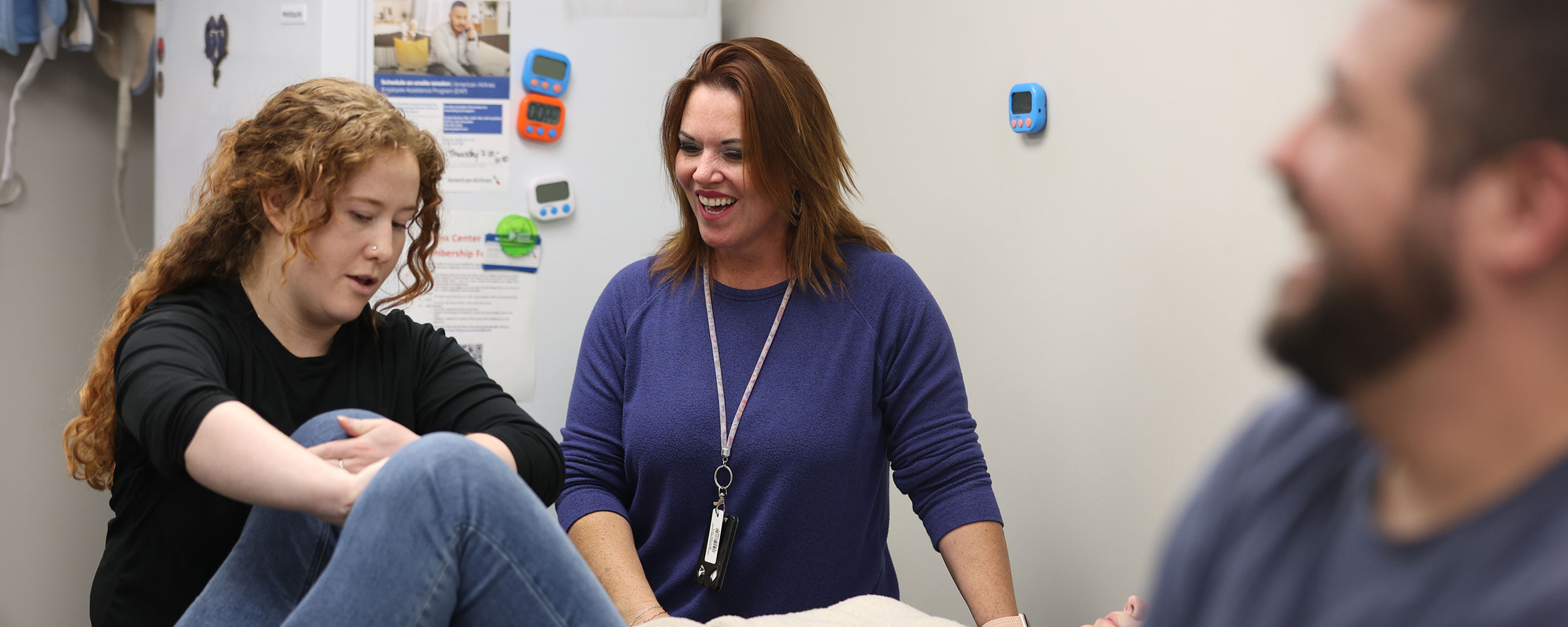
Erin O’Brien is an athletic trainer with the WorkStrategies Program by Select Medical and is based at a major airline in Tulsa. As a preceptor, she said industrial rotations are important for athletic training students because they help them become well-rounded.
“You’re not just working with one population. In an industrial setting, you’ll see a lot more chronic injuries than acute ones,” she said. “You become well-versed in a lot of things you wouldn’t if you just stayed within athletics.”
For Julia Quinton, a first-year athletic training student at OSU-CHS currently on rotation with O’Brien, that has proven to be true.
Inside the hangar
Quinton decided to pursue athletic training after becoming a gymnastics and tumbling coach and realized she wanted to help athletes walk away with minimal injuries.
Working at the airline is her second rotation, and she chose the site because of her family’s ties to aviation.
“It lets me see what they do, because they always come to me and say their back or something is hurting. It gives me insight into what they go through every day,” she said.
Although she has only been on site for a couple of weeks, this rotation has presented challenges she didn’t experience at her previous one. Industrial sites must comply with Occupational Safety and Health Administration regulations. The athletic trainers are not allowed to prescribe exercises and stretches to patients and can only use certain terminology.
They also cannot use modalities, such as electrotherapy, dry cupping and massage guns. Instead, they rely on treatments such as heat and ice therapies.
Quinton said that while it’s a challenge, it also helps her learn.
“It’s a very big change from having all the modalities at hand to nothing at all and only using yourself. But it’s helped ingrain into me how the body works and what we can do by ourselves to treat the patients,” she said.
Another of O’Brien’s and Quinton’s responsibilities is safety walks and ergonomic evaluations. They will walk the warehouse floors and evaluate the repetitive movements employees use on the job and any injuries that can result from them.
“If people are getting injured on the job, we’ll come up with better ways of doing things. Or if something actually needs to be changed, we’ll get the engineers involved,” O’Brien said.
The aviation industry isn’t the only industrial setting to rely on athletic trainers — manufacturing sectors do as well.
On the production and front lines
Tanner Gracey, a second-year athletic training student at OSU-CHS, rotated at the Whirlpool Corporation manufacturing plant in Tulsa. Safety and ergonomic evaluations were also his and his preceptor's responsibility.
They would take videos and upload them to a software program that would evaluate every part of the body and the associated injury risks with the movements.
It was part of the job he didn’t expect, but he enjoyed it.
“We’d check the equipment and see the person working the station to make sure it was what they needed. The safety team would also evaluate, and we’d all collaborate from there. It was really cool to see,” Gracey said.
"Athletic trainers on-site help improve the overall health and wellness of an organization … It all comes down to keeping employees healthier on the job."
Gracey’s Whirlpool rotation had a nurse and EMT on-site as well. Some of the cases he handled with them included an overdose and a laceration so deep it required stitches. While these aren’t the typical responsibilities of an athletic trainer, he was glad to be on site to assist.
“It’s stuff that you hope doesn’t happen, but if it were, you hope to be there to help,” he said.
Some athletic training students work even more closely with EMTs, such as Hope Ables, a second-year athletic training student at OSU-CHS who rotated with the San Antonio Fire Department.
“When I had to choose my non-traditional rotation site, I looked at the different options and decided I wanted to help the people who are normally helping others,” Ables said.
She was part of a clinic associated with the fire department that treated on- and off-duty firefighters and EMS workers.
Like with other industrial rotation sites, she found herself treating a different age demographic. Instead of high schoolers like her prior two rotations, she worked with adults, which provided a different experience.
“The firefighters liked to straight-up be told what was wrong with them, as opposed to having to simplify it for high school athletes. It challenged me in having to apply what I learned in class without simplifying it,” Ables said.
A safer workplace
Aviation, manufacturing and emergency services may not be environments where most people expect to find athletic trainers, but they are just as valuable there as they are in sports.
“Athletic trainers on-site help improve the overall health and wellness of an organization. As employers recognize this benefit, they have seen improvements in employee satisfaction, decreased time loss and an amazing return on investment. It all comes down to keeping employees healthier on the job,” Volberding said.
O’Brien encourages athletic training students to give industrial and non-traditional settings a chance, even if they think they won’t be interested.
“You might come into a rotation like this and think it’s not what you want to do, but there’s something to learn and gain out of everything and everyone you encounter. Take full advantage of it. It’s only eight weeks of your life, and you might change your mind,” she said.