


Baby T. rex were out of the nest and hunting early
Tuesday, July 14, 2026
Media Contact: Sara Plummer | Senior Communications Coordinator | 918-561-1282 | sara.plummer@okstate.edu
Baby Tyrannosaurus were cute, but still dangerous, according to a new study published in the peer-reviewed journal Biology.
A team of paleontologists and researchers, including Eric Snively, PhD., an Oklahoma State University Center for Health Sciences professor of anatomy and cell biology, identified the first known fossils of hatchling tyrannosaurs.
The small foot bone was found among a collection of fossils at the T. rex Discovery Centre of the Royal Saskatchewan Museum in Canada by paleontologist Nicholas Longrich, the study’s lead author, who then contacted Snively because of his research experience with T. rex metatarsal fossils.
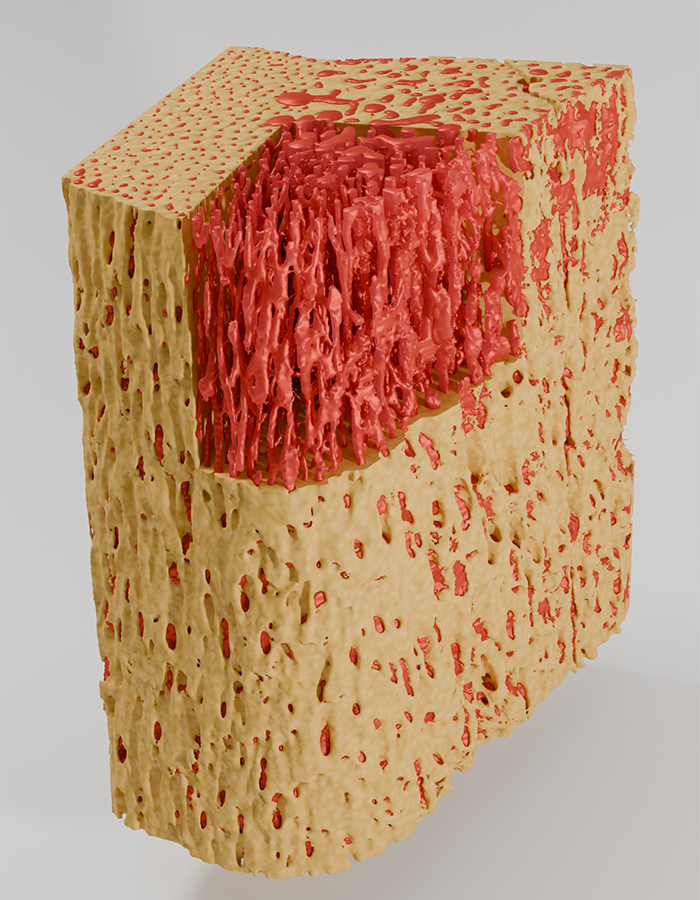
“Metatarsals of a baby Tyrannosaurus might tell us if the babies were hunting right away or were in the nest for a longer time,” Snively said. “Sure enough, we found canals in the bone that indicate they were quickly out of the nest and running around.”
Using high-tech CT scanning equipment, Snively and his colleagues were able to see inside the fossil and found no growth rings, meaning the fossil belonged to an animal less than a year old. The scans also showed evidence of abundant, interconnected blood vessels and bone cell spaces, indicating that the animal was growing rapidly.
Snively said the evidence from the foot fossil also lined up with findings from T. rex hatchling teeth, which were thick and worn.
“The babies were smashing into the bones of their food, just like giant adults,” he said, adding that the T. rex hatchling weighed about five pounds and was about the size of a small house cat. “Tyrannosaurus were unsafe at any size. Babies were quickly out of the nest and killing the heck out of things.”
The fossil evidence and the team’s findings also suggest that T. rex laid around 30 eggs at a time, each about the size of a half-gallon of milk. The number of eggs laid also points to T. rex's parenting style.
“Because animals have limitations in what they can invest in the next generation, they can either invest in having lots of young, or invest a lot in their young, but not both,” said Longrich. “The small size of tyrannosaurs suggests they pursued the first strategy — they had lots of small young and had a light touch when it came to parenting.”
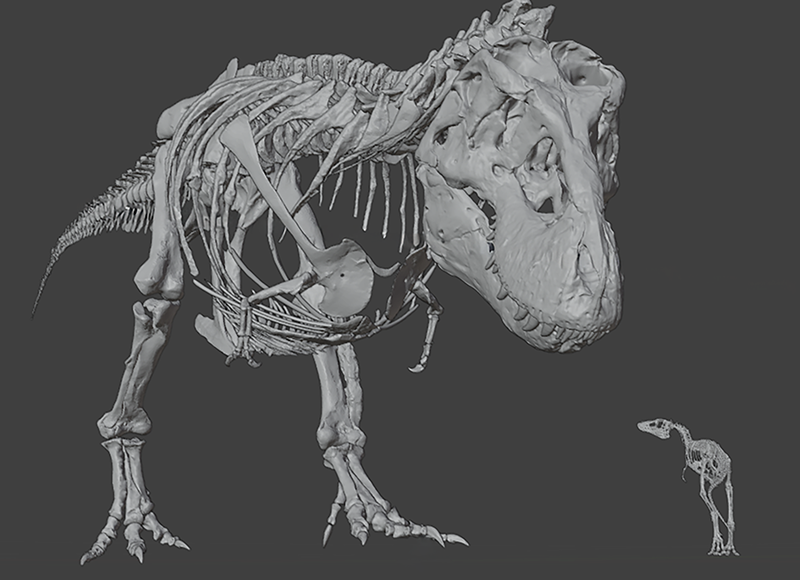
It’s a strategy still employed by animals today. Turtles lay between 80 to 125 eggs and offer little to no parental care, while birds lay one to 20 eggs, depending on the species, and offer robust parental care before and after their young hatch.
Snively said T. rex parents fell somewhere in between.
“There was probably a fair amount of parental investment, like nest guarding and guiding the young for a while, like in crocodilians and larger ground birds like ostriches. But the babies could fend for themselves pretty soon after hatching,” he said.
This study helps fill in the gaps of what we know about the lifespan of T. rex, Snively said.
“The research documents the full range of size for Tyrannosaurus individuals as they grew, and how throughout their life, they held similar ecosystem roles as bone-crushing predators in their size classes,” he said.
But findings like this wouldn’t have been discovered if researchers didn’t revisit fossil collections.
“Little fossils collected in the field and curated in museums can have the biggest long-term impact on how we study Tyrannosaurus and how it lived,” Snively said.