

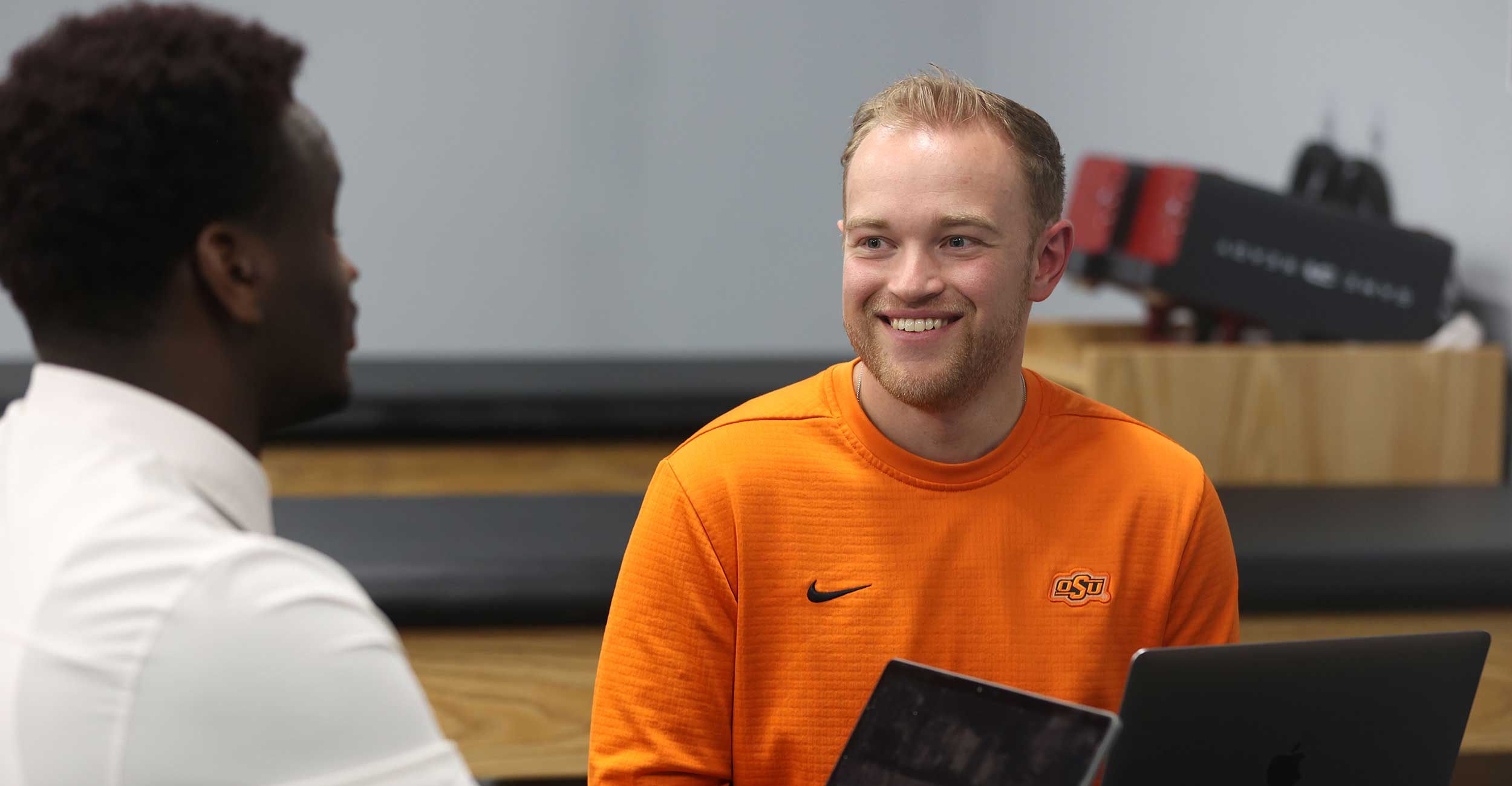
OSU-CHS alum Mike Daniels builds supportive team of athletic trainers
Friday, March 20, 2026
Media Contact: Sara Plummer | Senior Communications Coordinator | 918-561-1282 | sara.plummer@okstate.edu
Like a lot of athletic trainers, Mike Daniels was an athlete first.
“I ended up getting hurt and I saw the athletic training side of things and fell in love with it,” he said. “I enjoyed anatomy, physiology and the emergency management classes in undergraduate and graduate school that made me confident I was in the right field.”
After Daniels earned his master’s in athletic training from OSU Center for Health Sciences in 2022, he completed an internship with the Dallas Cowboys and worked with Southern Methodist University’s football and tennis teams.
He then returned to Tulsa about a year after graduating when he accepted a position with OSU Sports Medicine as the athletic trainer with the Tulsa Oilers Football indoor football team.
“They just threw me in the deep end,” Daniels joked. “When I got the position, I wanted to show that I was confident in my knowledge and skills.”
Daniels was thrown into the deep end again when he became a head athletic trainer and now oversees the other Tulsa-based OSU Sports Medicine athletic trainers who work with FC Tulsa soccer, Tulsa Oilers hockey and USA BMX teams.
“I still don’t believe I’m in this position,” he said. “I just hit the ground running and figured it out on the spot.”
Daniels said part of his role as a head athletic trainer is mediating the partnership between the teams and OSU Sports Medicine, visiting the team’s training and competition sites, and figuring out logistics for treatments and care.
He also meets regularly with the OSU Sports Medicine athletic trainers he oversees — Luke Akande with USA BMX, Destiny Lalaguna with FC Tulsa and Sara Latos with Tulsa Oilers hockey.
“I was in their shoes not that long ago. I know the trouble-shooting things they’re going through,” he said. “I wanted to make sure I could be a resource I wish I had had when I started my career.”
Akande said Daniels is very organized and mature for his age, but it’s not surprising once you get to know him.
“Mike advocates for us, and OSU does a good job too of taking care of us,” he said.
That culture of support is pervasive among all the athletic trainers in Tulsa.
“We all get along and we all work well together, we have a great group,” Akande said. “We go to each other’s games and help each other.”
Lalaguna agrees.
“They are like teammates,” she said. “They just hop in and help when they see we need it.”
Daniels said he also thinks the social aspect of the job is important as well, so he and his team, along with others from OSU Sports Medicine, get together outside of work a few times a month to do something fun.
“For medical professionals, burnout is a leading cause of stress, so our support of each other is important,” he said. “They can count on me no matter what.”
Daniels — who is still the athletic trainer for Tulsa Oilers Football — said overseeing the health and well-being of a team of athletes can be a lot for one person, which is why having that support system is so important.
“It’s an overwhelming feeling for new athletic trainers when they are all alone with a team, but you learn to manage a workload quickly when all eyes are on you,” he said. “Getting to work hands-on with athletes and work in sports, but also get to help Luke and Sara and Destiny, it’s definitely a positive of this job.”