

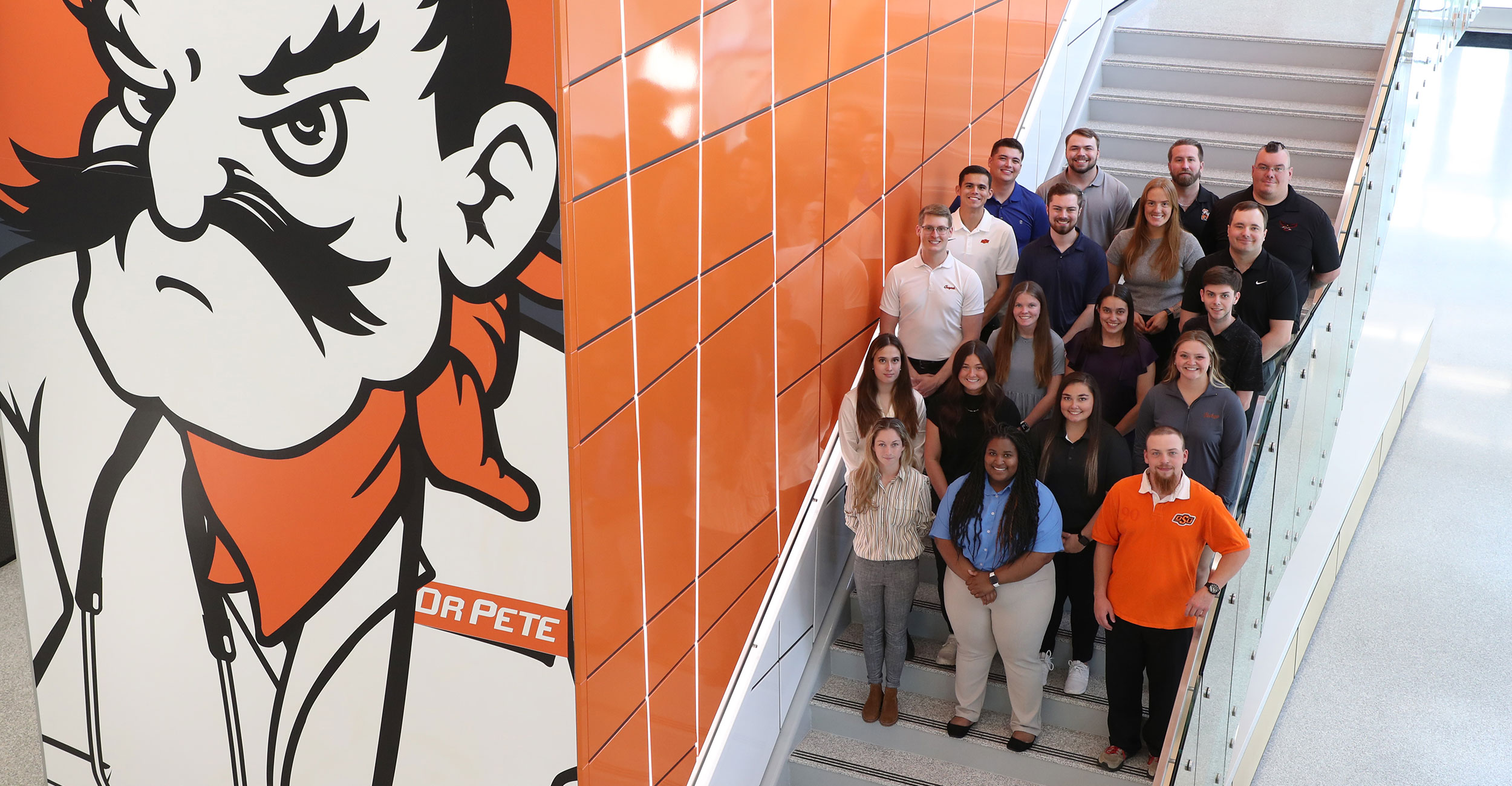
OSU-CHS athletic training program celebrates its largest graduating class
Friday, May 15, 2026
Media Contact: Kayley Spielbusch | Digital Communications Specialist | 918-561-5759 | kspielb@okstate.edu
OSU Center for Health Sciences’ athletic training program celebrated the graduation of its largest cohort of 19 students on May 9.
The athletic training program was established in 2015, with an initial enrollment of approximately six students. It has continued to steadily grow to where it is today, with the continued mission of preparing individuals to become clinicians and advance the profession.
“We don’t just graduate athletic trainers. We’re graduating clinicians who can work in a variety of patient populations,” said Matthew O’Brien, Ph.D., athletic training professor and director of clinical education at OSU-CHS.
One way the program is preparing students is through its fully immersive clinical education model. Students complete five rotations — four eight-week sessions and one 16-week session — in a variety of traditional and non-traditional settings.
Additionally, students alternate between classroom instruction and clinical experiences instead of completing both at the same time. This unique model is one reason Carlos Vallejo, a class of 2026 graduate, chose OSU-CHS.
“Having our classroom courses and rotations split into eight-week semesters allowed us to dedicate more time and focus to each of them. I believe this helped me be more successful throughout my time in the program,” he said.
These rotations allow students to gain experiences they wouldn’t have in a traditional athletic training setting.
For example, seven students in the class of 2026 assisted with life-saving measures and over half completed sutures or administered IV fluids on their rotations.
“We were able to assist in encounters and collaborate with other healthcare professionals to improve our understanding of non-orthopedic conditions,” said Tucker Smith, another member of the newest graduating class.
Jennifer Volberding, Ph.D., the athletic training department chair and director at OSU-CHS, said the program continues to grow its clinical opportunities.
“Our students are able to complete their clinical rotations across the country, and it is fantastic to see that three to four new sites are added each semester. It’s a testament to our students that we can offer such diverse clinical sites,” she said.
Another testament to the program’s impact is its 100% pass rate on the 2025 Board of Certification Exam.
“We don’t just graduate athletic trainers. We’re graduating clinicians who can work in a variety of patient populations.”
Smith credited the supportive environment at OSU-CHS to his success.
“There was a great sense of connection and support within the program, whether it be from my professors or student peers. I was mentored by experienced professionals whom I respect, and these relationships ultimately helped me find and accept a job opportunity after graduating,” he said.
O’Brien emphasized the importance of this environment for current and future students.
“We never want to lose the Cowboy Family atmosphere. We want to make sure our students feel like they’re part of a family, because they are paving the way for another graduate,” he said.
Volberding, O’Brien and the rest of the faculty aim to sustain the current trajectory while looking for opportunities to innovate.
“We see the program continuing to maintain the quality of students entering the profession. It’s important to our faculty that students are prepared as clinicians to provide the best care possible,” said Volberding.
The athletic training program is preparing to welcome its next cohort of 18 students in June.
Vallejo shared some advice for any future athletic training students.
“Take the time to take care of yourself, because having good work-life harmony allows you to have the most success in your educational and personal lives. Understand that your classmates are your teammates. Work together and allow yourselves to learn from each other,” he said.