

OSU paleontology students help research prehistoric ecosystems
Thursday, April 9, 2026
Media Contact: Sara Plummer | Senior Communications Coordinator, OSU-CHS | 918-561-1282 | sara.plummer@okstate.edu
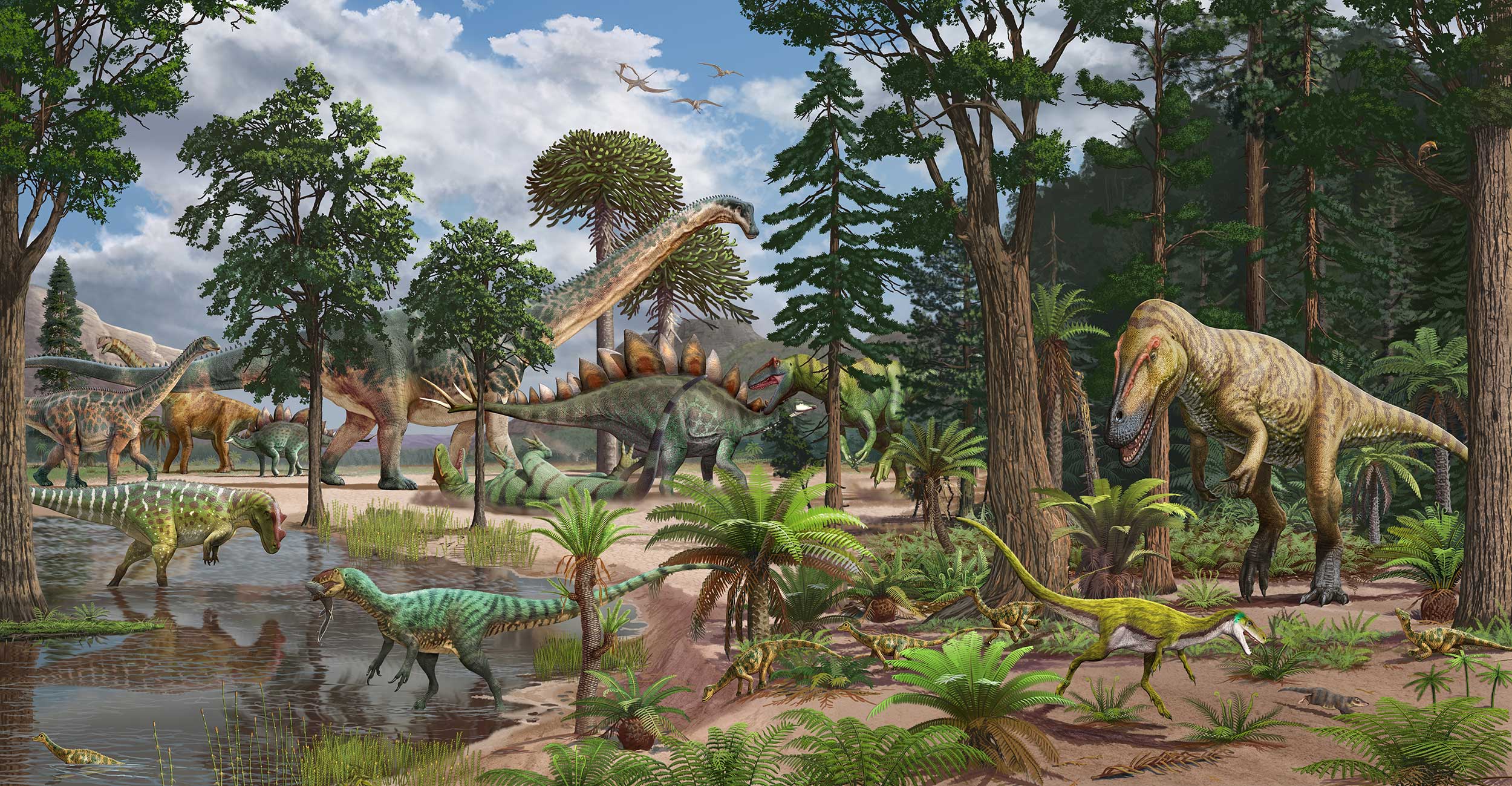
Two anatomy and vertebrate paleontology students from the Oklahoma State University Center for Health Sciences helped author studies examining the prehistoric food web and the broader ecosystem of a section of North America during the late Jurassic period.
Colin Boisvert and Andy Danison joined several other international researchers and paleontologists on two research papers that were published in the New Mexico Museum of Natural History and Science Bulletin in January.
The teams studied the ecology of dinosaurs and other prehistoric animals that lived alongside each other in an area of the Morrison Formation that stretches across the Rocky Mountain region into eight states, including the Oklahoma Panhandle.
“It’s vast. We’re talking over 1.2 million square kilometers,” Boisvert said, and estimates are that the fossils and prehistoric evidence found in the formation date back to 156 million and 147 million years ago.
Anne Weil, PhD., paleontologist and associate professor of anatomy at OSU-CHS, said the fossil record found in the Morrison Formation contains more than just dinosaurs.
“The general public is captured by the large dinosaurs, but there are vertebrates of all sizes and types, as well as many invertebrates, plants and algae in the Morrison Formation,” Weil said.
The team of authors of the first paper analyzed the food web of the Dry Mesa Dinosaur Quarry in western Colorado, part of the larger Morrison Formation, using a data tool called Cheddar.
Boisvert said developing a food web can be tricky because nature is so complex, especially when it's prehistoric. So using a new methodology like Cheddar can be helpful.
“The lion eats the zebra, but the hyena eats the zebra too. It’s not a pyramid, it’s a web because it’s all these different connections,” he said. “Using cheddar allows us to try to more quantitatively figure out who was eating whom and what the relationships were.”
The Dry Mesa quarry was chosen for this analysis because of the variety of species found there, including reptiles, pterosaurs, crocodilians and dinosaurs, especially a large number of long-necked sauropod dinosaurs.
“We know from the Dry Mesa quarry that at least six different species were living in the same place at the same time,” Boisvert said. “The question becomes, how are they doing this? What is going on because it shouldn’t be able to support them, yet it is.”
“We have so many questions and we’re developing new questions. That just necessitates that we be open to new methodologies that can tell us new things about these amazing animals.”
The second paper that Boisvert and Danison helped author looked more broadly at the Morrison Formation’s ecology — not just which species lived there and when, but also the roles the different species played in the ecosystem.
“We’re looking at it from a functional standpoint and not a taxonomic standpoint. We use things like size and diet to essentially categorize all of these animals and look at what was driving the changes in this functional diversity,” Danison said. “I think one of the big takeaways that both papers have in common is that sauropods are keystone species. The big, four-legged, long-necked herbivores are really having a strong impact on their ecosystems.”
Boisvert said that by looking at the Morrison Formation ecosystem and the different habitats within it, the team learned that even though the specific species of herbivores or carnivores may have changed over time, the roles of those species didn’t.
Biologists are in the process of figuring out how animals, organisms and plants respond to changes in ecosystems, Weil said, and studying prehistoric ecosystems can actually help scientists study current ones.
“What paleontologists bring to the table is knowledge of what has happened before,” she said. “While some animals from the late Jurassic are lost, others are very familiar and still here with us today.”
And while Cheddar may not be perfect, Boisvert said it and other tools are still moving the field of paleontology forward.
“There are always multiple ways to study the same question. Paleontologists are pretty open to adopting new technologies and skills to help with studying these animals,” he said. “We have so many questions, and we’re developing new questions. That just necessitates that we be open to new methodologies that can tell us new things about these amazing animals.”