

Instrumentation capstones highlight the power of hands-on learning at OSUIT
Thursday, April 30, 2026
Media Contact: Hicham Raache | Communications Coordinator | 918-293-4678 | hicham.raache@okstate.edu
Instrumentation engineering technology students in the School of Engineering and Construction Technologies presented their capstone projects, with each team demonstrating how they used skills gained at OSU Institute of Technology to create or improve innovative, yet practical technology.
“They take everything that they've learned from the first day that we started up until this point and they put it all together and they get to make some big project out of it,” said Amanda Cullum, an instrumentation instructor. “They get to actually see and put their hands on a final project of what their work was for this past three years.”
The following five capstones were presented April 13-14 by advanced instrumentation students in the Donald W. Reynolds Technology Center at the end of the spring trimester:
· Marshall Mckinnon, Kale Smith, Zachary Vanwinkle and James Berry presented a tool room station that is designed to track and charge power tools used by students.
· Michael Sheffield, Joshua Chairez, Jared Dobelbower, Alex Henderson and Trinton Kuehn presented a radio telescope that is designed to be smaller, cheaper and easier for people to explore basic signals from space without needing perfect weather or high-end equipment.
· Blake Walker, Zane Cope, Matthew Kash, Hayden King and Bradly Morrison presented a remotely automated wagon designed to improve and stabilize transportation of tools and lab equipment around campus.
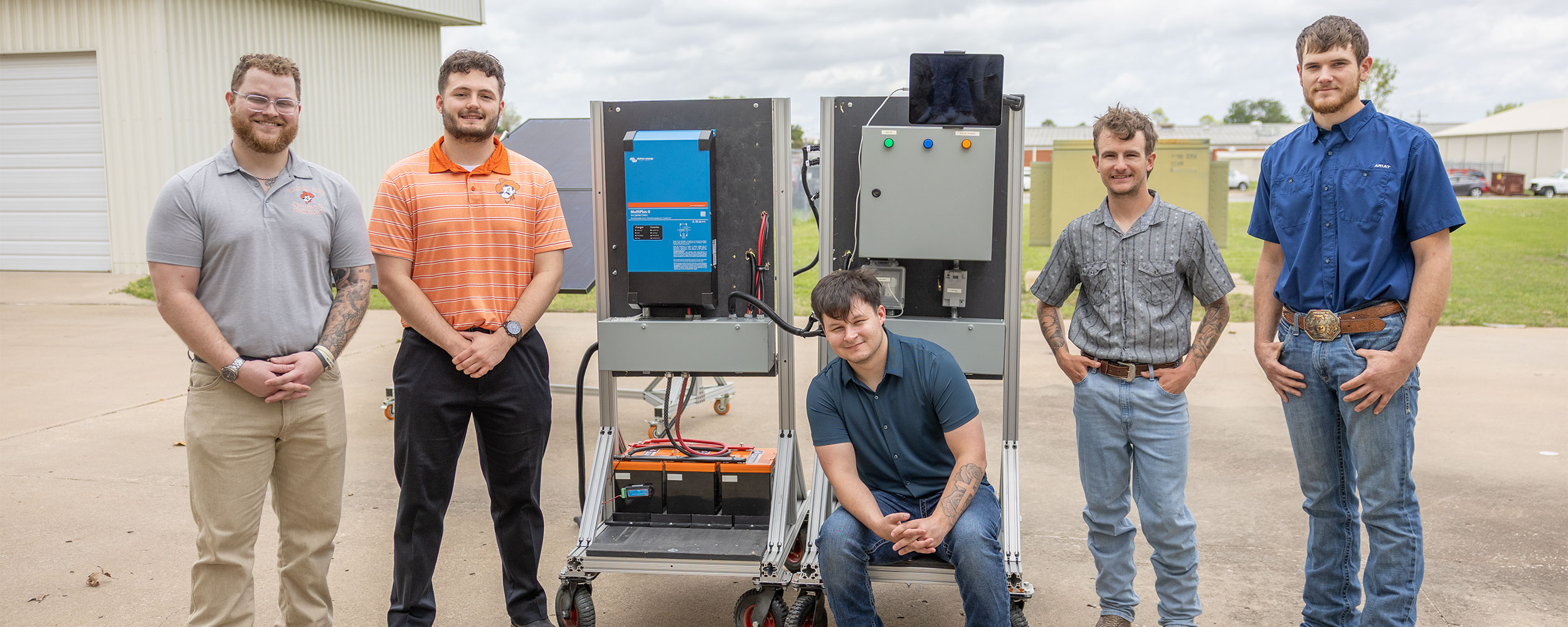
· Wyatt Long, Brock Owensby, Robert Hutchins, Jaxon Hannon and Chandler Long presented a user-friendly solar panel for OSUIT faculty and a simple, yet effective way to count the number of people entering and exiting OSUIT’s GO Lab.
· Cooper Graham, Ruben Lopez, Joshua Ogunseye and Grayson Ramsey presented a controller-operated, eight-barreled T-shirt cannon.
A thoughtful consideration from Kash inspired the concept of the wagon.
“I was thinking about my mom. She has a garden wagon, and she uses it to carry fertilizer and soil, and she'll wheel that around all over the place. And I thought it'd be nice if I could design something that would carry that for her and take the burden off her,” Kash said.
The wagon would be useful to both students and professionals, such as aircraft mechanics.
“Many mechanics, they have to carry different parts, different tools, maybe even logs of what they've done on different aircraft. They could use this cart to go in between buildings, in between hangars or even in between shops carrying everything that they need to work on whatever project they may be working on at that time,” Morrison said.
The wagon team began brainstorming the concept during the fall trimester. They started acquiring parts and actually building the wagon at the start of the spring trimester, according to Cope.
They made efficient use of their time, following a work breakdown structure they had developed.
“Even though we were waiting on parts quite a bit, we still found time to be productive somewhere else, whether it was programming with Matthew, or working on the project portfolio or the PowerPoint,” Cope said. “From Jan. 5 to April 13, we were busy every single one of those days.”
“Every single week there was something either being added to the list or crossed off,” Morrison said.
The cost of creating the wagon came in well below the initial $3,000 budget at $975.
The wagon will remain within the instrumentation program.
“We are about to leave out on internship. So, this is going to be left here for future OSUIT students to pick up and use, learn from, figure out how to do it, how to fabricate things and also figure out that this is for everybody,” Morrison said. “I mean, if you put in the time and the work, you can figure out how to do this, and it's a lot of fun.”
The T-shirt cannon, an eight-barrel, gatling gun design, was the final capstone presentation. It was initially created by a previous capstone team. The team of Graham, Lopez, Ogunseye and Ramsey were tasked with evolving the cannon, which was not functioning as originally intended.
“We finished putting the wiring and the programming in, actually getting the rotation to work for the barrel and for the actual cannon to move side to side and up and down,” Lopez said.
The new team also made other improvements. The cannon’s original barrels were made of exhaust pipe.
“That was a little bit too heavy for us. So, we decided to change it to PVC pipes, and that just kind of reduced the weight of it. And with the motor that we have in there, it just works better like that,” Lopez said.
The new team completed the improvements in about two and a half months. The current design allows for eight T-shirts to be loaded into the barrels and fired at a maximum of 90 PSI, launching the shirts a maximum of 50 to 60 feet.
Lopez said there is potential to evolve the T-shirt cannon further.
“Maybe later on, another capstone group can come in, change it a little bit, make improvements on it. I mean, there's so many things that you can improve on,” he said.