


New energy, new students fuel OSU-Tulsa student organization boom
Monday, August 10, 2026
Media Contact: Aaron Campbell | Communications Coordinator | 918-899-4960 | aaron.ross.campbell@okstate.edu
Student organizations at Oklahoma State University-Tulsa have become increasingly active in recent years, creating and participating in university events and adding members at steady rates on a campus that is redefining itself as a four-year university with new traditions.
OSU-Tulsa is known for a lot of things — top-ranking academic programs, world-renowned research, hands-on workforce initiatives and bringing OSU’s land-grant mission to downtown Tulsa, to name a few. Until the campus began admitting freshmen in 2026, it was also known for serving a non-traditional student base, with many balancing school with full-time jobs and other responsibilities. Those students often had limited availability for things like student-led clubs and organizations.
But Dr. Khaled Sallam, an associate professor of mechanical and aerospace engineering at OSU-Tulsa in the Helmerich Research Center and the faculty advisor for the American Society of Mechanical Engineers’ (ASME) student section at OSU-Tulsa since 2014, knows personally the impact these organizations can have.
“When I came [to work at OSU-Tulsa], my department head stood up and said, ‘Here is Dr. Sallam, he’s joining us from the University of Michigan.’ And he had my resume in front of him,” Sallam said. “My resume was filled with awards I got from the University of Michigan, academic achievements and stuff. But he scanned all this, and the only thing he said was that I was the president of one student organization and the founder of another. So I tell students that out of all my resume, my awards, my achievements, the thing that grabbed their eye was my student activity.”
Student organizations have grown and changed with each wave of students, catering to a wide scope of community and professional interests. Organizations such as the African American Student Association, the Hispanic Student Association (HSA), and International Student Ministries have created events and opportunities for students to engage with and network with communities on campus and beyond. Other groups, such as Tulsa Accounting Scholars, Psychology Club, the Society of the Advancement of Material and Process Engineering, and the now officially chartered American Society of Heating, Refrigerating and Air-Conditioning Engineers, help students develop into professionals and scholars in their field of study.
The passage of Senate Bill 701 in 2025 opened OSU-Tulsa to first-time freshmen and sophomores, adding a new group of students to a campus in transition and new growth in student-led communities. According to Sallam, being a part of a student organization is a major part of the college experience.
“There are a lot of benefits to getting a university degree,” Sallam said. “You are building your career, and you are trying to equip yourself for your future. But one of the reasons why people go to a university is to build a network, a professional network that will support you for the rest of your life.”
"If you do an hour a week, that’s plenty of time,” he said. “It will give you leadership experience. It will shine in your resume. And you will feel good about yourself, too.”
Sallam and the OSU-Tulsa ASME have earned widespread recognition for their impact and efforts in recent years.
The American Society of Mechanical Engineers recently recognized OSU-Tulsa’s student section with its prestigious Student Section Achievement Award for the third consecutive year, placing it among an elite group of student chapters nationwide to achieve such a feat.
"Earning this recognition once is remarkable,” said Steven Wilson, president of the OSU–Tulsa ASME Student Section. “Earning it three years in a row speaks to the dedication of our members, officers and faculty advisor and to a culture of excellence that is handed down each year to the next generation of leaders."
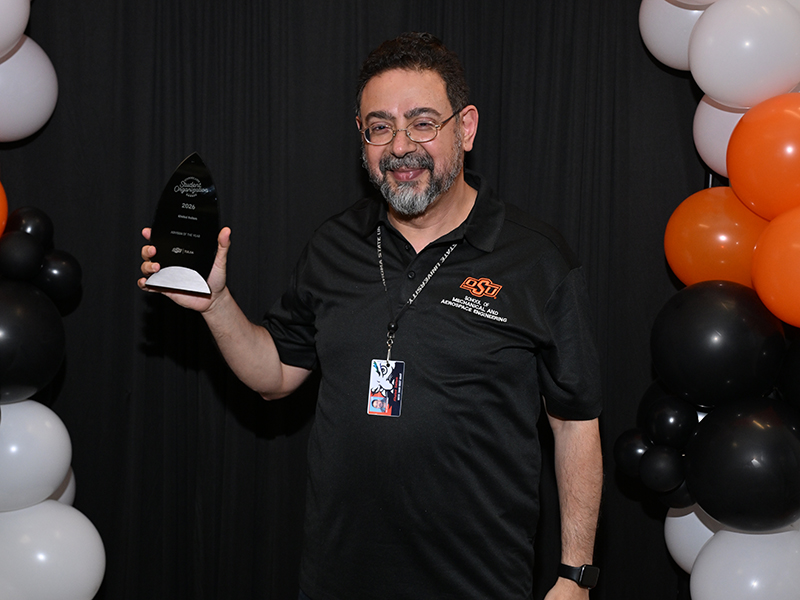
Sallam was recently named Faculty Advisor of the Year at the 2026 OSU-Tulsa Student Organization Awards, the third year of the ceremony and the largest in the award’s history. OSU-Tulsa ASME won the Outstanding Community Engagement Award this year after taking home the Student Organization of the Year in 2025 and the year prior.
“This year, we had several newly active organizations participate in the awards ceremony alongside many of our established organizations, which made for a fantastic turnout,” said OSU-Tulsa Student Life Coordinator Michelle Nguyen. “The atmosphere felt incredibly celebratory. The room was filled with excitement as we recognized all of their hard work and accomplishments.”
Nguyen has been in her position for only a little over a year. Still, she has already noticed a big jump in student energy and engagement at this year’s ceremony compared to last year's.
“What stood out to me most was what happened after the ceremony ended. Instead of everyone immediately leaving, students stayed to mingle, take photos and celebrate with one another,” she said. “Seeing students from different organizations talking, laughing and making new connections was really special.”
Another big winner of this year’s Student Organization Awards was the new Formula SAE Warp Speed Racing student club, which earned the New Student Organization of the Year and People’s Choice awards. The organization is centered around designing, building, testing and racing a formula-style car.
“I came up with this idea hoping to bring different majors together,” said Ethan Stimac, a mechanical and aerospace engineering major and president of the club. “Creating a community is so important because it will introduce you to opportunities that you wouldn't have otherwise.”
The club breaks down into focused groups to tackle each aspect of funding and building a racecar — from vehicle design to business operations to manufacturing — but they also make sure to have fun, creating social media videos together and hosting movie nights.
Stimac, who is also a member of HSA and ASME, stresses the importance of creating and maintaining student organizations — not just for students to add more to their resume, but to connect with others and have fun.
“Meeting people and making long-term bonds is a huge benefit of joining an organization,” he said. “I go [to HSA meetings] because they have good laughs. They talk. They have fun activities. I enjoy being in a group with a lot of people to have fun. It’s pretty simple, really.”
Currently, Stimac is focused on securing funding for the Warp Speed Racing club to purchase parts for their first car. But the momentum they’ve gained on the project in their first year continues to propel them forward, even through the summer semester — because when it comes to Warp Speed Racing, you don’t want to take your foot off the gas.
“A part of getting things done at the pace we’ve seen is just not making any excuses — just do it,” he said. “If you make a mistake, that’s OK, we can learn something from every mistake. As long as you’re putting in that action, that’s the most important thing for us.”
As a traditional student, Stimac said he saw how student clubs interacted on campus in Stillwater and wanted to bring more of that to the Tulsa campus. Now that he has his own club, he’s found that having non-traditional student perspectives in student organizations is a huge bonus, too.
“One of the strengths I think we have is that a lot of us actually have experience working in an actual professional environment,” Stimac said. “As a group with different levels of experience, we’re able to achieve things a more traditional student organization might not be able to.”