

From classroom to clinic: Preparing tomorrow’s veterinarians
Monday, April 20, 2026
Media Contact: Bailey Horn | Marketing Specialist | 405-744-6728 | bailey.horn@okstate.edu
Preparing the next generation of veterinary professionals takes more than textbooks — it takes experience.
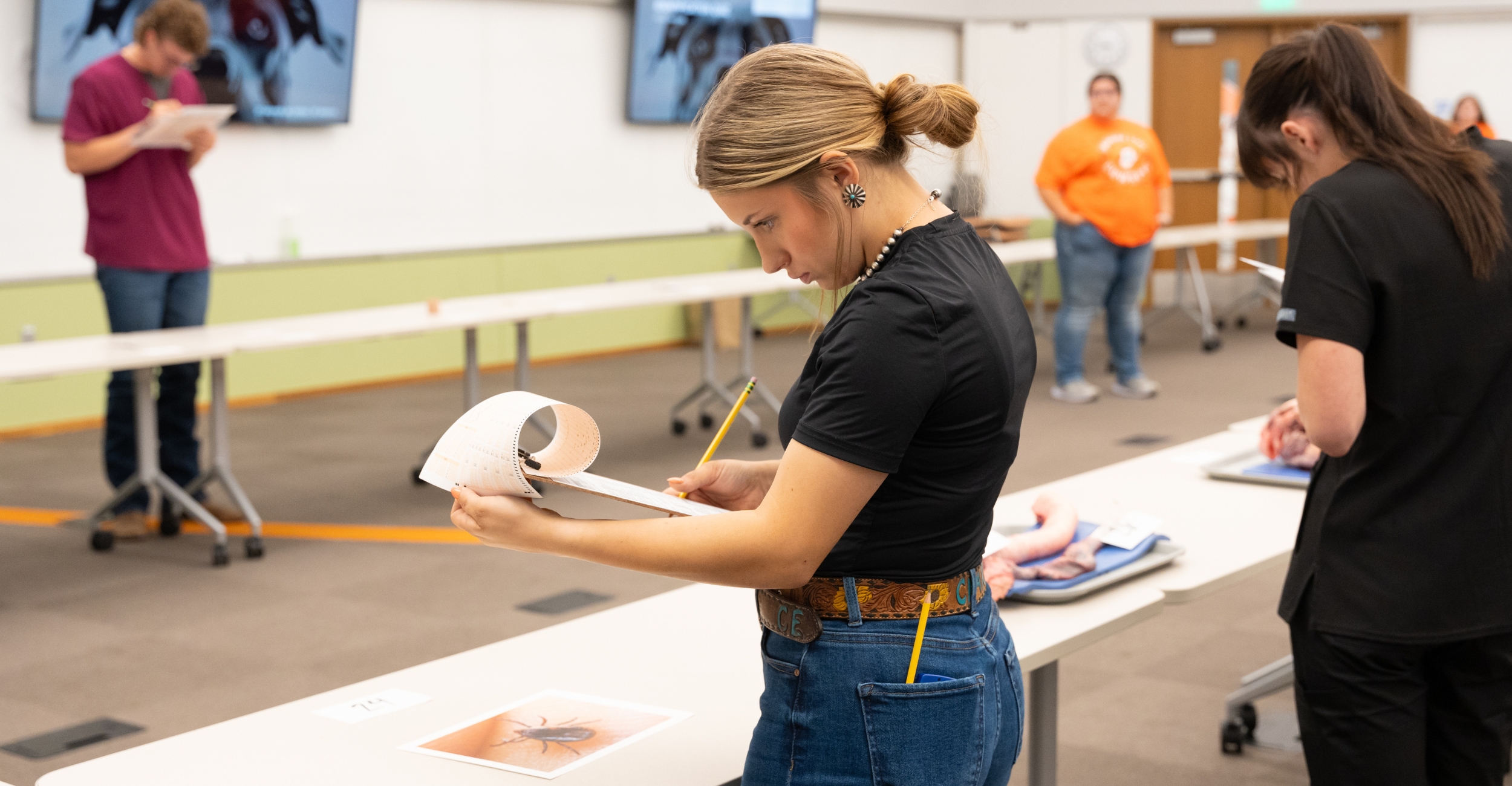
At Oklahoma State University, that experience comes to life as students move from station to station, identifying instruments, and making quick, informed decisions in a fast-paced environment.
Over the past few years, the Veterinary Science Career Development Event for FFA students has evolved into a dynamic, hands-on competition that reflects the OSU College of Veterinary Medicine’s commitment to advancing veterinary medicine.
Pulling off a contest of this caliber is no small task — it requires a dedicated team working together to bring it all to life. Contest superintendents, Dr. Jennifer Rudd, OSU CVM interim associate dean for academic and student affairs, and Dr. Riley Messman, assistant professor in animal and food sciences, have collaborated to enhance the contestant experience.
“I was not in FFA or 4-H growing up, as I am a first-generation American,” Rudd said. “So much of what I have learned about these programs has been since stepping into this role of helping oversee the educational process, and it has been amazing to see what all these programs teach students.”
Since taking on this responsibility, Rudd and Messman have sought out eager undergraduate pre-veterinary students to assist in contest preparation. Luke Sanders, an animal science junior, has made an incredible contribution to the team, bolstering new and bright ideas, Rudd said.
“We knew progress was going to create some discomfort,” Rudd said. “Thankfully, we have a really good team. Luke knows his stuff, and Dr. Messman is always one step ahead of the game.”
Before the official revamp of the contest kick-started, Rudd, Messman and Sanders evaluated the national contest rubrics to understand what students were expected to perform at the national level. It was the team’s priority to set students up for success, while also making the contest a fun learning opportunity.
“We wanted to create something that had enough rigor, but also enough creativity, fun and camaraderie to encourage students to pursue these types of areas down the road,” Rudd said. “So we reworked it all.”
The contest has a series of different components students must complete: a written exam, a math application exam, identification, and hands-on practicums. Rudd and Messman analyzed and adjusted each section of the contest, providing agricultural instructors and extension agents with resources to help students prepare for the updates.
“One of our goals when reconstructing the contest was to communicate with educators to share the different resources students can study to be successful,” Messman said. “Specifically, we wanted the practicums to reflect real hands-on veterinary procedures students could encounter in a clinic, while also aligning with National FFA standards.”
Students and educators can access a full list of practicum options on the OSU Ferguson College of Agriculture webpage. Last year, the practicums ranged from proper restraint of a piglet to performing an intramuscular injection.
“We have to get creative with our practicums,” Messman said. “We try to pick skills that are directly applicable from a livestock perspective and then also from a veterinary perspective.”
In the practicums, students deliver an oral presentation while demonstrating the steps for properly performing the different procedures.
Sanders competed in the Veterinary Science CDE throughout his FFA journey, and when he came to OSU, he knew he wanted to find a way to stay involved in the contest during college.
“I always like to joke that when I competed, my mom would compete and probably do just as good as I could in the practicums because she heard me and held me accountable for doing the right steps,” Sanders said. “So that is what I want to do for students and agricultural instructors: make sure they have the rubric and materials to be able to understand what is needed to be successful.”
In the future, Sanders plans to become a veterinarian, and being able to give back while also helping prepare himself for veterinary school has been a great opportunity, he said.
“To me, assisting with this contest sets the tone of what a veterinarian should be,” Sanders said. “You should be there to serve a community and serve the people you are around.”
Sanders enjoys seeing students get excited and passionate about identifying different instruments and anatomical structures — moments that mirror his own experience in the Veterinary Science CDE and reinforce the impact the contest can have on future veterinary professionals. For the team, those moments are a reminder of why the work matters.
As the contest continues to grow, so does the need for dedicated individuals willing to invest their time and expertise. Faculty, staff and students within OSU CVM play a critical role in bringing this event to life — from setting up stations and evaluating practicums to mentoring and encouraging participants throughout the day.
Those interested in supporting the next generation of veterinary professionals are encouraged to find ways to get involved, as Sanders did. Whether assisting behind the scenes or working directly with contestants, volunteers help create an experience that is both educational and inspiring — one that leaves a lasting impression on students considering a future in veterinary medicine.
Story By: Presley Pullen | ppullen@okstate.edu