

OSU lab studies the role of brainstem in blood pressure regulation in obesity and aging
Monday, May 4, 2026
Media Contact: Bailey Horn | Marketing Specialist | 405-744-6728 | bailey.horn@okstate.edu
At the Oklahoma State University College of Veterinary Medicine, researchers are exploring new ways to understand and treat one of the most common health challenges affecting both people and animals: high blood pressure.
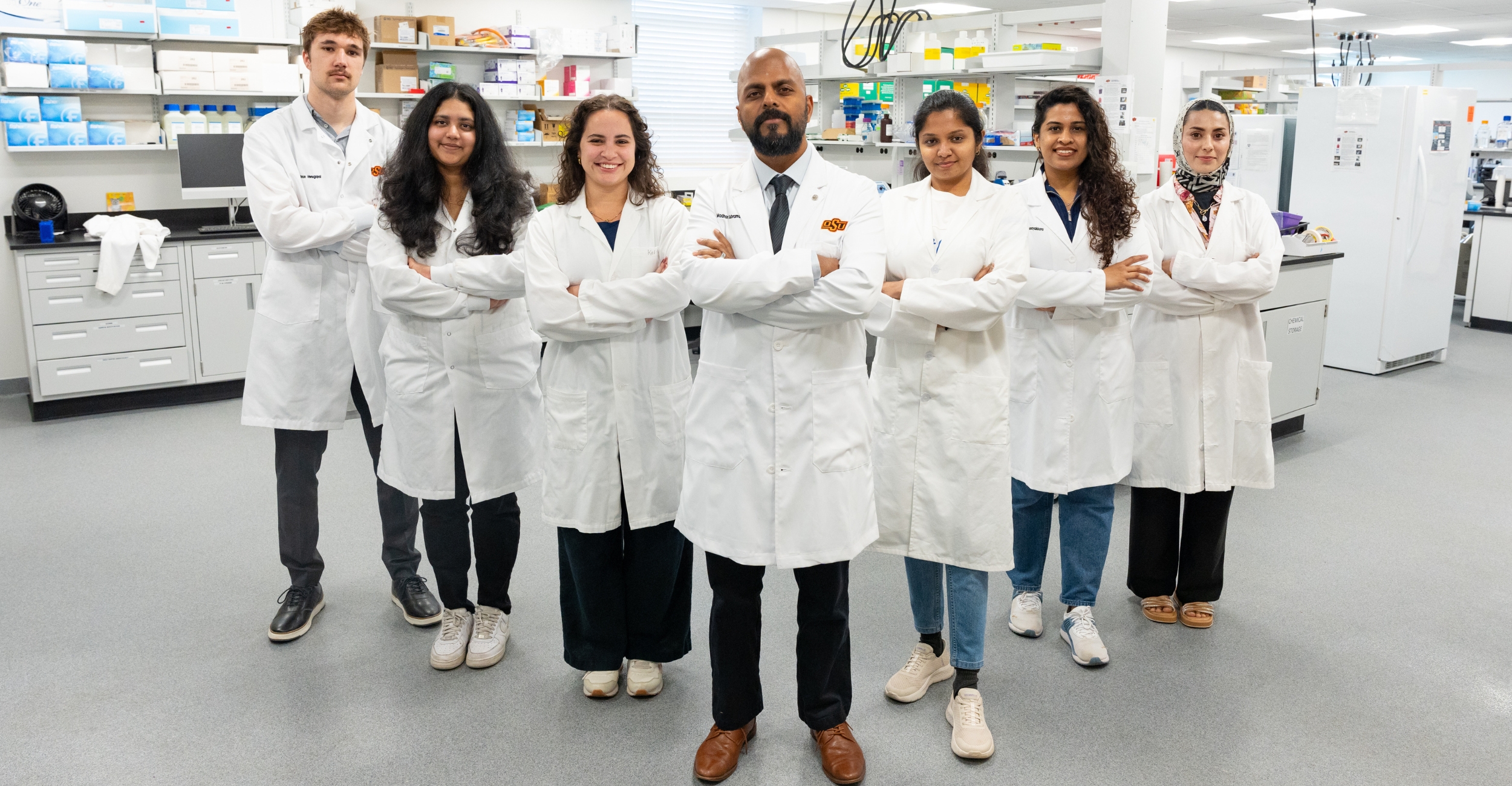
Dr. Madhan Subramanian, an associate professor, leads a research team examining the role of the nervous system in blood pressure regulation, with an emphasis on obesity and aging.
“While much of traditional research has focused on the heart, blood vessels and kidneys, we study how the brainstem, especially glial cells such as astrocytes, microglia and oligodendrocytes, modulate blood pressure changes,” Subramanian said.
The team is also investigating the effects of GLP-1 receptor agonists, a class of drugs widely used to treat diabetes and support weight loss. Although these therapies have shown clear metabolic benefits, their long-term impact on blood pressure and nervous system activity remains unclear. By combining animal models with human clinical studies, the researchers aim to better understand how these treatments may improve cardiovascular health.
Subramanian said his interest in this field is driven by the close relationship between obesity and hypertension, two conditions that continue to rise worldwide. Despite their prevalence, the biological mechanisms connecting them are not fully understood.
The lab has already produced promising findings. In studies involving obese mice, researchers reduced high blood pressure and overactive sympathetic nerve activity by targeting a specific glutamate transporter in the brainstem. In separate studies on aging, time-restricted feeding lowered blood pressure and improved nerve activity, even without reducing overall calorie intake.
“These findings are groundbreaking and would provide new therapeutic approaches for hypertension,” Subramanian said.
The research program also extends to human clinical studies in collaboration with Stillwater Medical Center, where the team is analyzing blood samples from patients using GLP-1 therapies to identify biomarkers for earlier detection and improved treatment outcomes.
OSU graduate students Bhuvana Plakkot, Uday Kiran Venugopal, Diani Nanayakkara, and Syeda Komal Shoaib, along with Summer Research Training Program student Claudia Pantoja Negron, undergraduate student Colin Adams and research scholar Miruthula Tamil Selvan, play an integral role in the lab, participating in both animal and human research. From developing hypotheses to presenting findings, they gain hands-on experience and build skills essential for careers in research and health care.
Through a combination of innovative research and student involvement, the lab is working to better understand the complex relationship between metabolism, the nervous system, and cardiovascular health. Subramanian’s lab is funded by an NIH R01 grant and the President’s Fellows Faculty Research Award.