


AI Forward: Spears Business rebuilding curriculum around industry demand
Thursday, October 22, 2026
Media Contact: Stephen Howard | Director, Marketing & Communications | 405-744-4363 | stephen.howard@okstate.edu
Fast Facts
- A Spears Business AI task force gathered input from industry partners, faculty and students across all eight academic departments, and is now weaving AI into core classes so every graduate leaves ready to use it confidently and ethically.
- Steven West, professor of professional practice in the OSU School of Hospitality and Tourism Management, uses AI to create study materials, and his students’ average score on a global hotel analytics certification exam has climbed from 78 to 90.
- Dr. Felipe Affonso, assistant professor in the School of Marketing and International Business, built AffonsoGPT, a custom chatbot that helps market research students troubleshoot surveys and data analysis in real time.
Steven West loves telling students why he builds AI into his coursework, because it has nothing to do with buzzwords or keeping up with the latest trend.
“My real job is to make sure you get a job that pays you a lot of money, so you live a good life,” said West, a professor of professional practice at the School of Hospitality and Tourism Management.
West spent decades running hotels and resorts all over the planet before he started teaching students about them at Oklahoma State University. He has kept close tabs on the industry since making the switch, and employers regularly tell him the same thing — they want graduates who can put artificial intelligence to work for their company in a meaningful way.
Faculty and administrators across every discipline at the Spears School of Business are hearing the same message from industry partners. For a land-grant institution built to meet the practical needs of the state, that message is hard to ignore.
That is where the Spears Business AI task force comes in.
“Success isn’t just that students have tried a few AI tools,” said Dr. Marlys Mason, Spears Business associate dean of undergraduate programs. “By the time they graduate or head into internships, we want them to have real digital fluency and digital agility. They should understand what AI is, how to use it ethically and strategically, and be ready to walk into a company and help move its use of AI forward.”
A little over a year ago, Mason brought together representatives from all eight Spears Business academic departments to ask industry partners, faculty and students about how they’re using AI and what they need next. Members ranged from early AI adopters to more hesitant faculty, giving the college a realistic picture of where people are starting from.
The task force found real opportunities to build on the momentum already happening in some classrooms, as many faculty members use AI to prepare materials or manage their own workflows. Students, meanwhile, asked for more AI-rich projects and experiences to help them prepare for their careers.
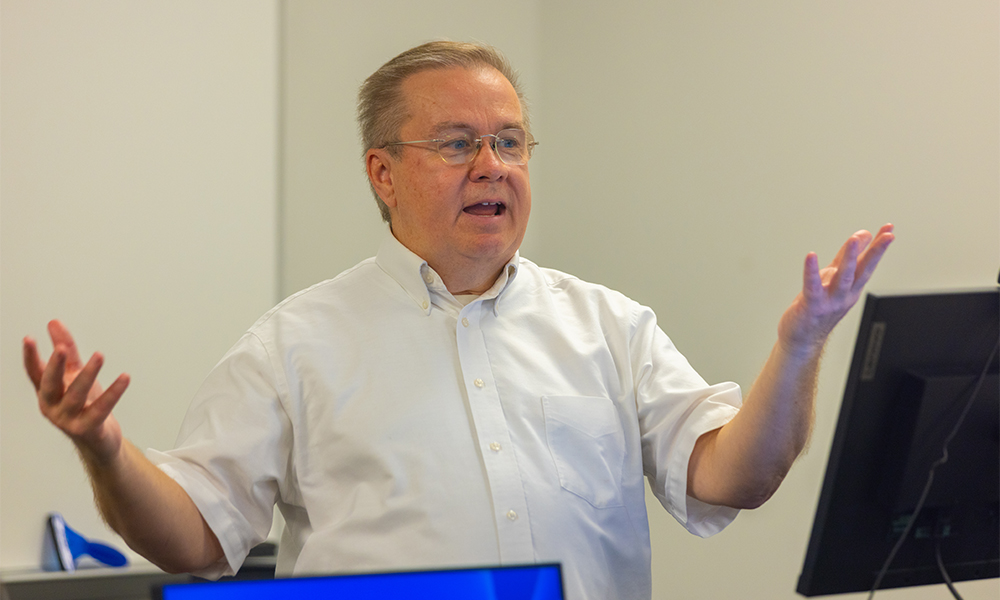
The task force concluded that Spears Business should move to a more intentional model that prepares every graduate to use AI confidently, critically and in line with employer expectations in their field.
“The student who knows how to use AI strategically is the one who gets hired,” Mason said. “That’s what we’re hearing from our corporate partners and alumni, from Phillips 66, Halliburton, BOK, Love’s Travel Stops, InterWorks, you name it. They’re telling us that the fundamentals are still important, but that having AI fluency will be key moving forward.”
West is one of the Spears Business faculty members already closing that gap in his classroom. He uses AI as both a content engine for teaching materials and a critical thinking tool for students. He loads lesson plans, test questions, textbook chapters and his own notes into AI tools to produce 5-minute recap videos, custom slide decks, infographics and even podcasts that help students prepare for an exam in the way that best works for them.
In his resort development course, West’s students complete a multi-phase project where they design properties using AI. With each build, students answer targeted questions, document their prompts, critique the responses and refine their approaches. This helps students learn to write precise, contextual prompts instead of outsourcing their work.
The results have earned the attention of other faculty across the college. West teaches a graduate-level course that prepares students for the Certificate of Hotel Industry Analytics exam, a globally recognized certification that tests students’ ability to interpret hotel performance data and revenue metrics. At the end of the semester, students must score a 70 or better on the exam to earn the certificate.
Since West began using AI to generate training materials, his students’ average scores have climbed from 78 to 90, with several now earning perfect scores each term.
“I think AI breaks things down for students,” West said. “I think that’s where the difference is happening. It’s not too much at once, and it’s bite-sized pieces that they can digest when they feel like it.”
West is hardly the only Spears Business faculty member to embrace AI as a way to help students. Dr. Felipe Affonso, assistant professor of marketing, uses the technology to help build online infrastructure that makes his courses clearer, more organized and more aligned with how students actually learn.
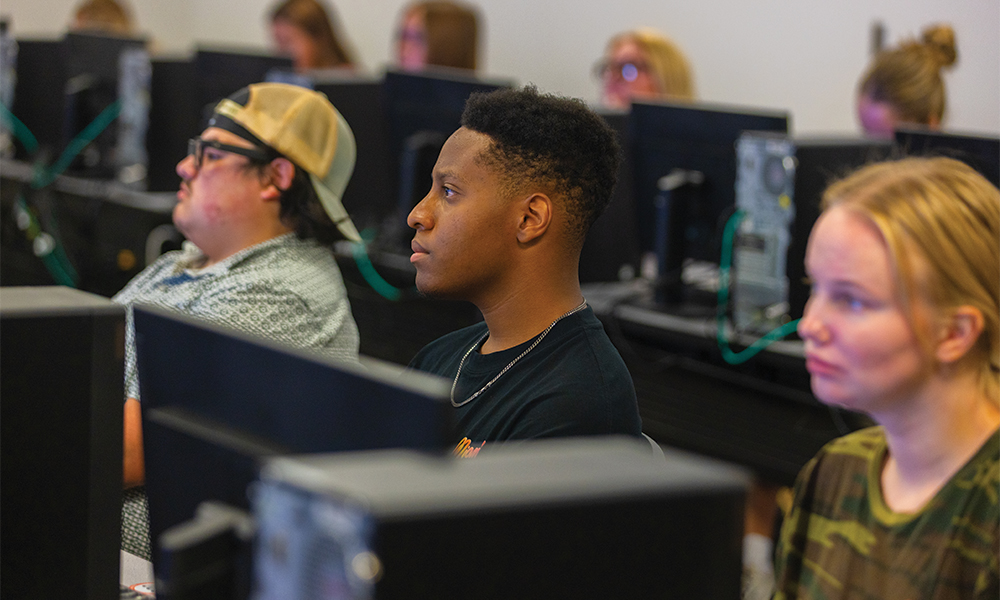
In OSU’s online course-management software, Canvas, Affonso used AI to rebuild the student-facing dashboard to show projects, lesson plans and progress in a visually intuitive way. Students have raved about the dashboard, saying it makes the course feel more structured and easier to navigate.
For students, it’s a smoother course. For Affonso, it’s a concrete example of AI quietly improving instructional design behind the scenes.
One of the nation’s foremost experts on AI in the marketing space, Affonso also takes students under the hood of their favorite AI programs. For this module, he ditches the textbook to show them how large language models process inputs and generate outputs. Then, he illustrates how much the quality of a prompt can shape results.
Affonso spends time distinguishing between different kinds of tools like chatbots, agents and code assistants, so students understand that not all AI interfaces are the same and that each has its own role and capabilities. His goal is for students to learn AI as a system they can reason with, not just a website they can query.
“I try to have them learn AI beyond the login to ChatGPT,” Affonso said. “It’s very difficult to use AI effectively in a way that supports their learning, because the workforce expects them to know and to use AI. At the same time, they cannot use it simply as a cognitive offload.”
Affonso teaches an upper‑level market research course where students design surveys and analyze real data, often running into roadblocks late at night when deadlines are tight. To keep projects moving, he built AffonsoGPT, a custom chatbot trained on his syllabus and course materials that can answer routine questions, point students to the right resources and help them troubleshoot survey and data‑analysis issues in real time.
“It’s one of the most innovative uses of AI in teaching that I’ve seen in our college,” Mason said. “Felipe completely reworked that market research class. It’s the same content but delivered in a way that’s more accessible and responsive to students.”
Mason said the AI task force’s work is far from finished. Spears Business is now weaving AI-forward lesson plans into its core classes, with a goal of helping every graduate leave with a solid understanding of how to use the technology reshaping the workforce.
For West, getting his students hired is just the beginning.
“I want the employers to come back and say, ‘I want 10 of these people,’” he said.
Story by: Stephen Howard | Engage@Spears magazine
Photos by: Cole Weiberg, Phil Shockley
Frequently Asked Questions
-
What is the Spears Business AI task force?
The task force is a group of representatives from all eight Spears Business academic departments, brought together by Dr. Marlys Mason, associate dean of undergraduate programs. It gathered input from industry partners, faculty and students on how they use AI and what they need next.
-
What did the task force find?
Many faculty already use AI to prepare materials and manage their workflows, and students asked for more AI-rich projects to prepare them for their careers. The task force concluded that Spears Business should move to a more intentional model that prepares every graduate to use AI confidently, critically and in line with employer expectations.
-
Why is Spears Business focusing on AI fluency?
Employers are asking for it. Corporate partners and alumni, including Phillips 66, Halliburton, BOK, Love’s Travel Stops and InterWorks, have told the college that fundamentals still matter but AI fluency will be key for new hires.
-
How does this connect to OSU’s land-grant mission?
As a land-grant institution, OSU was built to meet the practical needs of the state. Preparing graduates for the skills Oklahoma employers need is a direct extension of that mission.
-
Does using AI in class mean students are outsourcing their work?
No. Faculty like West and Dr. Felipe Affonso design assignments that require students to document prompts, critique AI responses and refine their approach. The goal is for students to reason with AI rather than use it as a shortcut.
-
What comes next for Spears Business in regard to AI?
Spears Business is now weaving AI-forward lesson plans into its core classes so every graduate leaves with a solid understanding of how to use the technology reshaping the workforce.