


Beyond compare: Dimotakis conducts award-winning research into workplace comparisons
Thursday, October 22, 2026
Media Contact: Stephen Howard | Director of Marketing & Communications | 405-744-4363 | stephen.howard@okstate.edu
Key Facts
- Dr. Nikos Dimotakis received OSU’s 2025 Regents Distinguished Research Award. He was one of seven university-wide winners and the sole recipient from the Spears School of Business.
- Dimotakis, professor and Raymond A. Young Chair, conducts practical research that informs employees and managers while revealing deep insight into human behavior and comparisons.
- With publications in management and psychology journals, Dimotakis is an editorial board member for the Journal of Applied Psychology and Personnel Psychology.
The phrase “comparing apples and oranges” is commonly used to describe two entities too disparate to compare. The problem? It isn’t exactly accurate.
In 2000, surgeon James E. Barone used satire to bust the myth, publishing a playful scientific analysis of the fruits in the British Medical Journal. As it turns out, there are many ways to compare apples and oranges.
In the workplace, we might sometimes assume our experiences are unique. However, the minute we swap stories with coworkers or even with friends at drastically different workplaces, the comparisons begin.
“You can’t really make sense of the world without comparisons,” said Dr. Nikos Dimotakis, professor and Raymond A. Young Chair in the Spears School of Business Department of Management. “We can’t get away from them. It’s one of the fastest brain processes.”
How do these subjective measurements affect our workplace interactions and motivation levels?
"You can't really make sense of the world without comparisons."
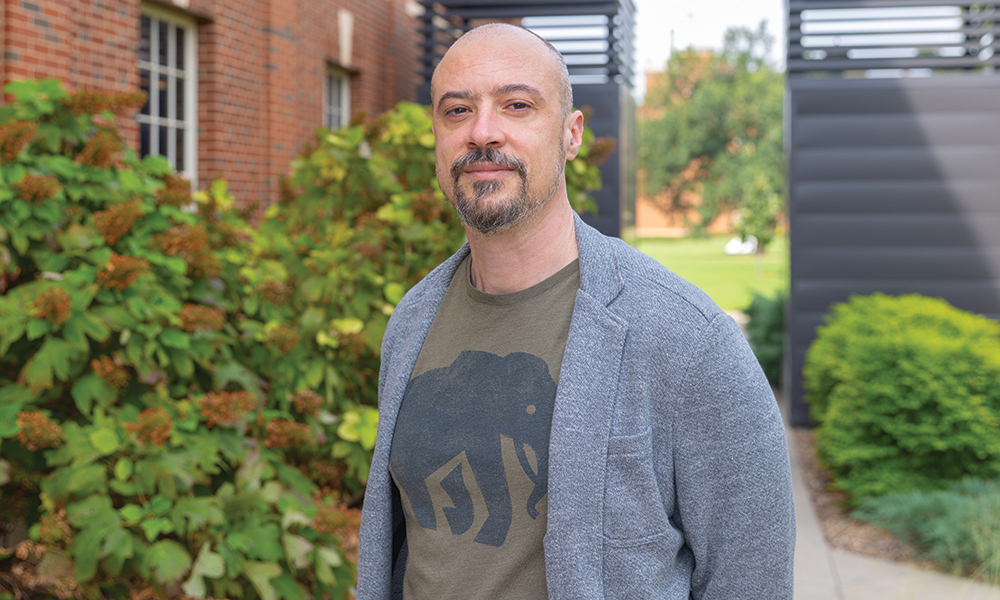
Dimotakis is fascinated with finding out.
Since 2019, he has strengthened Spears Business with practical research that informs employees and managers while revealing deep insight into human behavior.
In December, Oklahoma State University rewarded him for his dedication.
Dimotakis received the 2025 Regents Distinguished Research Award, which recognizes sustained excellence in faculty research and carries a $2,000 permanent increase in annual salary. He was one of seven university-wide winners and the sole recipient from Spears Business.
Dimotakis, who holds an MBA and a Ph.D. in business management and administration from Michigan State University, has teamed up with scholars at OSU and other prominent institutions to produce a prolific library of high-quality research.
Spanning business and psychology, his publications appear in the Academy of Management Journal, Journal of Applied Psychology, Personnel Psychology, Organizational Behavior and Human Decision Processes. Dimotakis serves as an editorial board member for the Journal of Applied Psychology and Personnel Psychology.
Q: What does it mean to you to be recognized with a university-wide award?
Dimotakis: It’s great, and it speaks more highly to the collaborators I’ve had here and in other places because it does take a village. I am humbled by it, of course, and I am also very grateful for all the great people I’ve had the opportunity to work with.
Q: On a broad level, how would you describe your research interests?
A: My first big stream of research had to do with affective processes — the way that people feel in response to circumstances at work and how those feelings lead to general well-being and behaviors.
The second phase is trying to understand how those experiences take place. We know that expectations, change, needs and fit — all of those things are important. All of them represent, essentially, a comparison of the experience that you are having versus some sort of standard: what used to happen before, what other people are getting, etc.
The third phase of my research program is starting to put these comparisons together and seeing which one is most important. For example, when it comes to how much prestige or status people get at work, we found in a paper we’re working on right now that it’s really a social comparison. It’s not about how much your status is increasing or decreasing. It’s mostly what you are getting versus what other people are getting. But, for things such as autonomy, it’s getting the amount of autonomy you need at that particular time, not how much autonomy other people are getting.
Q: How do psychology and sociology fit into management research?
A: That’s where we have emerged from. We are studying people at work. It’s important to deal with people because you can replicate most other resources pretty easily. If you have a shiny new machine that makes things, other people could probably have access to that. But, if you have a work group of particular people configured in particular ways interacting with each other in particular ways, your competitors would be very hard-pressed to copy that.
Q: What is a surprising finding from your work?
A: Good things are not what we would call monotonically good. You can have too much of a good thing. As a matter of fact, that’s more common than we think. So, you would think that having a light workday would be a good thing, but it’s not always. You think people treating you with too much fairness would be impossible, but there can be such a thing. If you expect to be treated poorly and you are treated well, that doesn’t reassure the mind.
I shouldn’t be surprised about this, but workplace history is very important. We were doing a temporal comparison of how poorly a leader treats people, and the only good scenario is if they are never abusive. If they are ever abusive, the anxiety just doesn’t stop, because even if you stop behaving that way, people keep expecting the shoe to drop. The fact that a good thing can be a bad thing if it’s not at the right level, and the fact that a bad thing can remain a bad thing after it stops, were both semi-surprising findings.
Q: How can your research guide managers in the workplace?
A: For managers, the implication is — as they said in the TV show “The Wire” — “All the pieces matter.” You might think that a quick solution to somebody being dissatisfied with work is to give them a salary increase.
Obviously, I’m in favor of salary increases, especially as an employee — but what you will see is that people will compare their salary to their previous salary and be happy, but they might also still compare their salary with other people and still be unhappy. So, addressing part of the problem might not work because people are still making a comparison that is unfavorable.
You will inadvertently create these comparisons that might or might not be salient, and it’s important to look at them. If something is much more of a social comparison as opposed to a temporal comparison or a correct level, then you might be better served by essentially elevating everybody to avoid creating these negative comparisons that people might have.
Q: What would you tell an employee who wants to be more positive at work?
A: Perhaps the most interesting insight I’ve had was very basic. If you’re looking at people’s happiness over time, you find two types of differences. Some people are just generally happier than other people, and some days, people are happier than they are on other days. If you’re a generally happy person but today you were a little less happy, you will probably interpret this as being sad, whereas it might actually not be that notable.
We will bring a lot of our cognitions and happiness into a situation we’re in. Be aware that sometimes, we’re happy or unhappy because of the overall state of affairs, and other times, we are happy or unhappy because of the comparisons we make. It’s about knowing which comparisons we make and being able to unravel those and look at things more objectively with an issue.
Story by: Hallie Hart | Engage@Spears magazine
Photos by: Cole Weiberg
Frequently Asked Questions
-
What is Oklahoma State University's Regents Distinguished Research Award?
The Regents Distinguished Research Award recognizes research excellence at Oklahoma State University. The term “research” includes all scholarly, scientific and creative activities. Recipients are selected based on the evidence of outstanding and meritorious achievements in research.
-
Who is eligible for the Regents Distinguished Research Award?
The annual program includes one award per college at Oklahoma State University, except the College of Arts and Sciences, which has two (one in the sciences and one in the arts and humanities). The award goes to full-time faculty members who have been at OSU for four or more years as of the application deadline.
-
How can I connect with research opportunities in the Spears School of Business?
Visit the website for more information.
-
How can I learn about Spears School of Business faculty research interests?
Browse the Experts Directory to learn about individual faculty members and their areas of expertise.
-
I am a student. Can I get involved with Spears Business research?
Yes. Students can begin research right when they set foot on campus. Through the Freshman Research Scholars Program, incoming freshmen can engage in cutting-edge research under the guidance of Spears Business faculty researchers. After their freshman year, students have many other opportunities through faculty mentorship and events like SAS Analytics Day to compete and present research.