

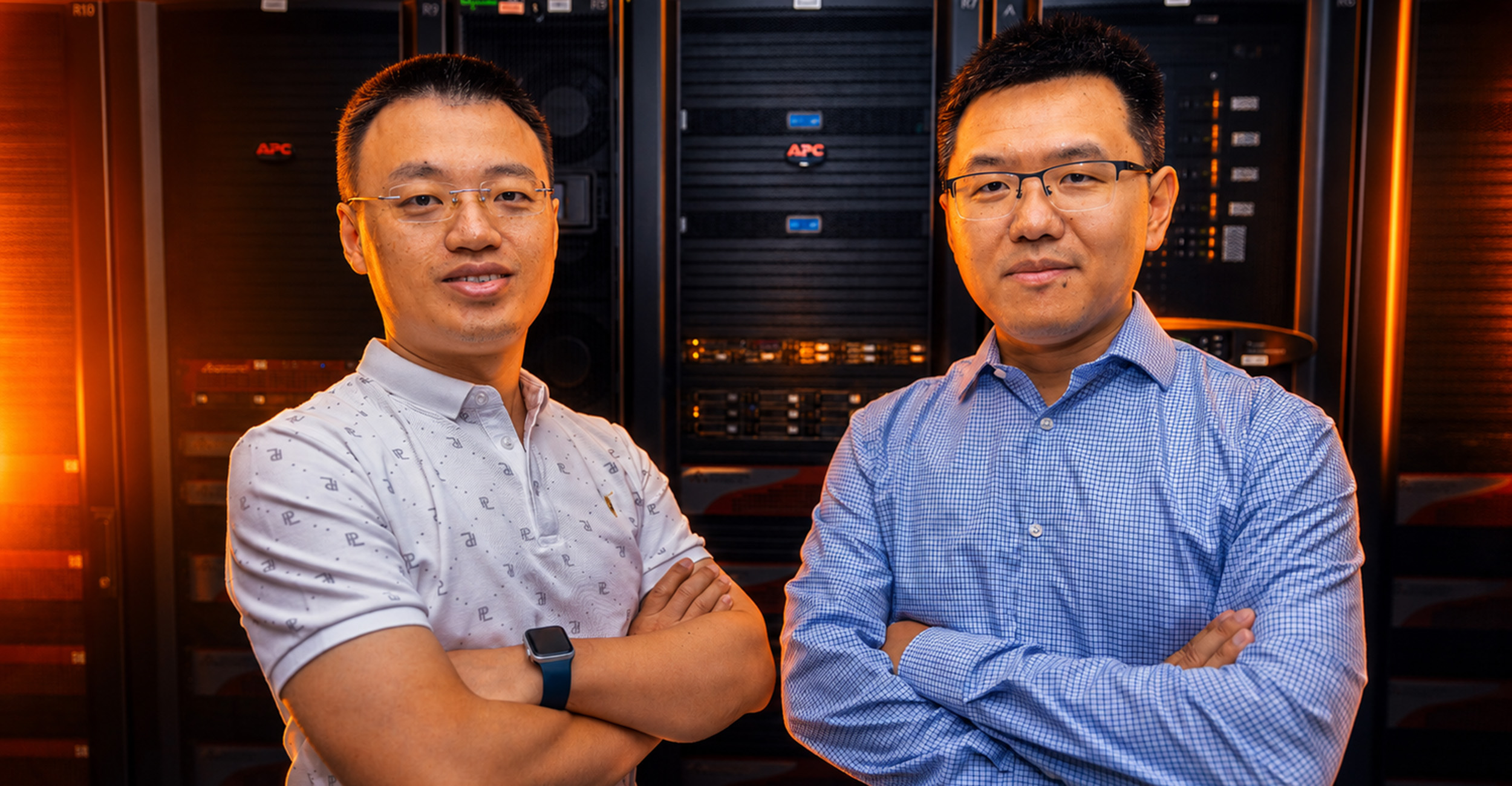
Centers of attention: Spears Business economists analyze 'new wave' of data centers
Thursday, October 22, 2026
Media Contact: Stephen Howard | Director of Marketing & Communications | 405-744-4363 | stephen.howard@okstate.edu
Key Facts
- Dr. Rui Du and Dr. Xiaojin Aaron Sun are collaborating to research data center location choices and the impact on real estate markets.
- According to Pew Research Center, 42% of Americans resided in a 5-mile radius from a functional data center or a chosen data center site as of April 2026.
- Du and Sun worked with Dr. Siqi Zheng to map approximately 32 million grid cells across the United States, gathering information about more than 40 variables relevant to data center construction and operation.
As hyperscale data centers spread across the United States, researchers spanning academic disciplines are racing to answer a deluge of questions.
Dr. Rui Du isn’t surprised.
A couple of summers ago, before data centers demanded attention in daily news headlines and policy debates, Du saw signs of a topic worth researching. The Spears School of Business assistant professor of economics read the growing literature and asked doctoral student Peigen Mao to gather statistics.
“At that time, we didn’t even have really clear questions in mind yet,” Du said. “But, as we know, for empirical researchers, a lot of interesting questions will pop up when you actually see the data.”
Du’s initial research proposal led to an ongoing collaboration with associate professor and real estate expert Dr. Xiaojin Aaron Sun in Oklahoma State University’s Department of Economics. Their work has received seed grant funding from OSU’s Hamm Institute for American Energy, reached industry leaders at prominent conferences and generated insights with widespread relevance to communities that include Stillwater.
In August 2025, Google publicized plans to construct a hyperscale data center in Stillwater and add to the existing data center in Pryor, Oklahoma. According to Pew Research Center, 42% of Americans resided in a 5-mile radius from a functional data center or a chosen data center site as of April 2026.
How will these resource-intensive developments affect local real estate markets? On their way to answering that question, Du and Sun created a deep learning framework to help understand and predict location choices for data centers in all 48 contiguous United States.
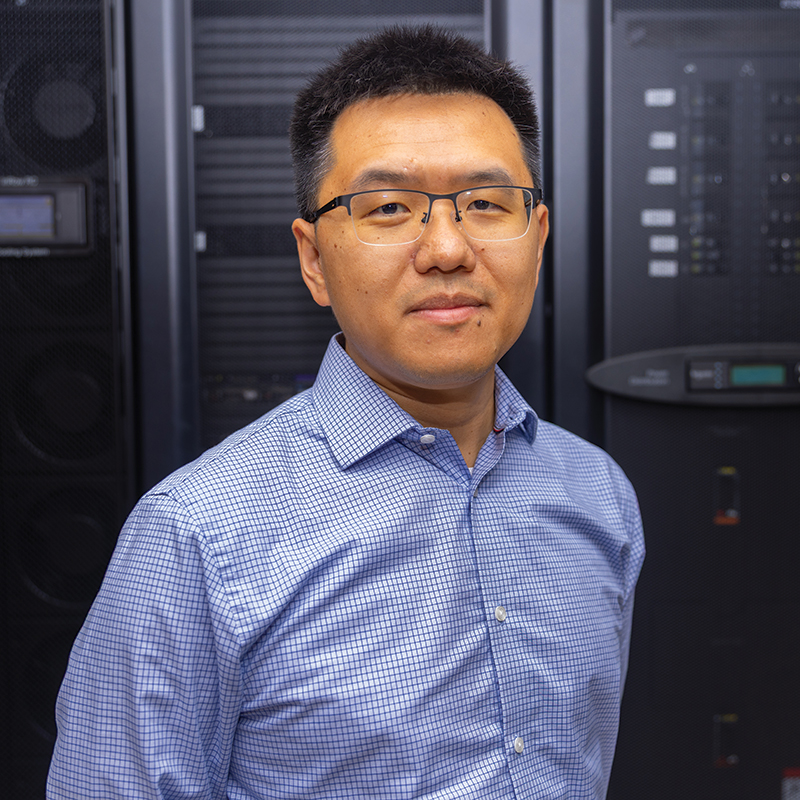
Defining a data center
Imagine a storage unit full of furniture. Now, replace those tables and chairs with computers and data powering our everyday technologies, such as Google Workspace tools.
The concept is not new. Data centers existed in the 1990s, but the big change is the burgeoning scale of operations.
Du categorized most older data centers as third-party data centers.
“These are the data centers that lease server rack space to other companies,” Du said. “They range from small edge sites to facilities approaching hyperscale scale, but on average they're considerably smaller than the campuses the cloud providers build for their own use.”
Although developers continue to build third-party data centers, a larger phenomenon is sweeping the country, intriguing researchers and raising widespread concerns about resource allocation in communities.
“Most importantly, we want to understand the new wave of hyperscale data centers,” Du said. “These data centers are large in terms of the resources they eat. Usually, they are over 100-150 acres of land.”
To cool the servers inside, one hyperscale data center could guzzle as many as 5 million gallons of water each day, according to the Environmental and Energy Study Institute report cited in Du and Sun’s research.
Electricity is another requirement. The state of Virginia, a recent hotspot for data center development, has dealt with skyrocketing electricity prices. Resource constraints, pollution and noise are all factors that could alter real estate markets nationwide.
“There’s going to be more and more concerns about data centers, so the residents may change their housing market behavior,” Sun said.
Will residential pushback create housing vacancies in surrounding neighborhoods? Will new residents move in to build the centers, or will the temporary nature of data center construction jobs leave real estate markets largely unaffected? What is the impact on commercial real estate?
Before digging into these questions, Sun and Du had to gather the facts. Together, the researchers sought to understand how data center locations are determined.
Mapping it out
Du and Sun presented their findings in “Bits and Mortar: The Microspatial Economics of Data Centers,” published as a Massachusetts Institute of Technology Center for Real Estate Research Paper in June 2026.
The Spears Business duo worked with co-author Dr. Siqi Zheng, STL Chair Professor of Urban and Real Estate Sustainability at the MIT Center for Real Estate, to map approximately 32 million grid cells across the 48 mainland states. For each cell, the team gathered information about more than 40 variables relevant to data center construction and operation.
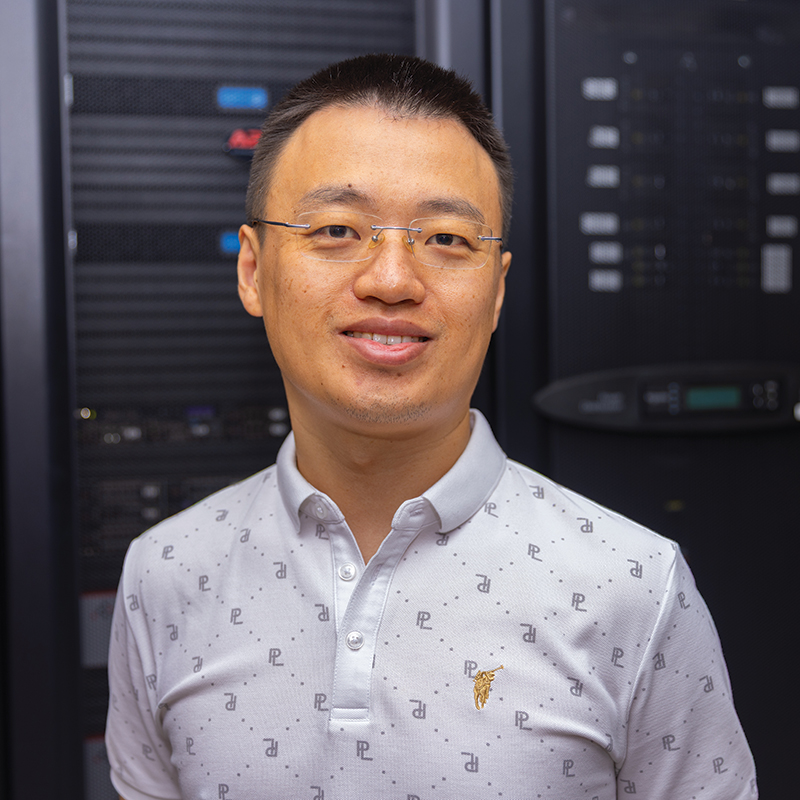
“The entry of data centers is not random,” Sun said. “It’s driven by different kinds of factors. The next set of questions will be, once we observe the location choices of data centers, we’re trying to understand how data center entry affects different outcomes in local markets.”
Sun’s background gives him deep insight into these topics. With publications in leading journals such as Real Estate Economics and Journal of Real Estate Research, he often studies the effects of economic shocks, policy and infrastructure on local outcomes.
When Sun joined the Spears Business Department of Economics in August 2024, it wasn’t long before a colleague asked to collaborate.
Du, who serves as co-editor-in-chief of the Review of Regional Studies, is an accomplished scholar at the intersection of geography and economics. In the early stages of his data center research, Du was thrilled to connect with a real estate expert.
“There’s a natural bridge,” Du said. “This is a perfect topic between urban economics and real estate, so that’s why we teamed up.”
Although many researchers have studied data center location choices from a macro level, or bird’s-eye view, Du and Sun differentiated their work through microspatial analysis.
The team developed an algorithm trained on data from 2010-24 to predict new data center locations through 2030. Testing for accuracy, Du said 7% of realized data centers in the U.S. showed up in the top 1% of their predicted locations, a significant finding that shows their work is on the right path.
"This is a perfect topic between urban economics and real estate, so that's why we teamed up."
The model can adjust its predictions for different scenarios, from climate stresses such as droughts to technological developments such as an AI boom or bust.
“Our message is that, given now the viability of big data across geographic areas, we can actually try to use the deep learning framework to understand how real estate developers think about where to place these data centers,” Du said. “We can use them to make inferences in terms of capital allocation and the policy responses regarding this newly emerging industry.”
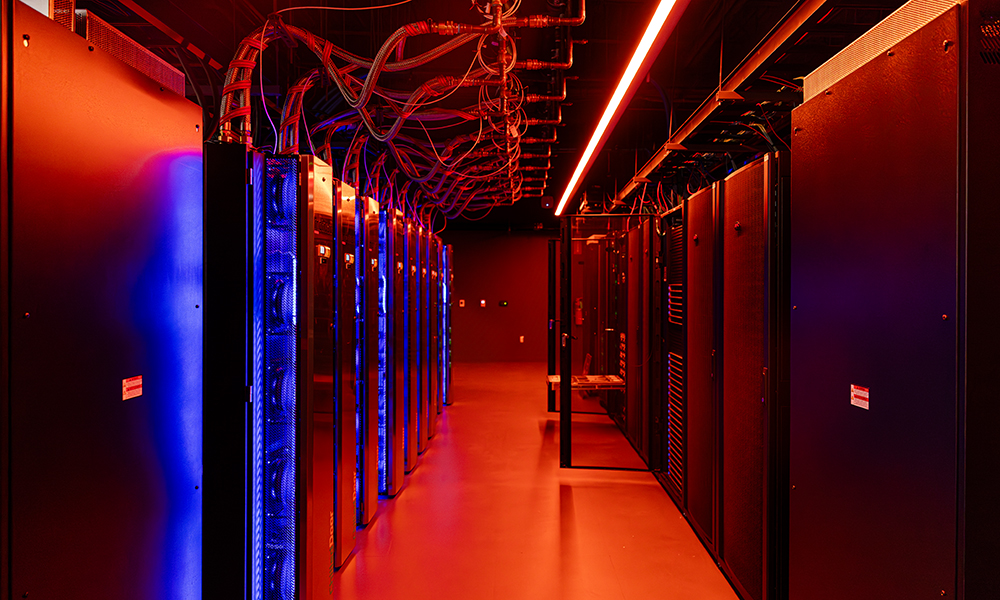
Gaining recognition
In the spring, Du shared these insights with fellow researchers and industry practitioners. He presented “Bits and Mortar” at the Real Estate Research Institute Annual Research Conference on May 19 and at the American Real Estate and Urban Economics Association National Conference on May 29.
Du and Sun’s ongoing project, “AI Data Centers and American Energy Security: An Interdisciplinary Assessment of Grid Resilience and Electricity Markets,” was selected for a $25,000 seed grant from OSU’s Hamm Institute for American Energy in June 2026.
Google is supporting the seed grant program, and Du and Sun’s industry-academia relationships advance their work. To inform their research, they not only met with Google’s data center market intelligence team but also consulted with mentors Brent Ambrose from Pennsylvania State University, Mark Fitzgerald from Affinius Capital and David Kelly from real estate investment firm CBRE.
Now, Du and Sun are using their deep learning framework to study the effects of data centers on real estate and electricity markets, working with economics Ph.D. student Peigen Mao on his doctoral dissertation.
Even with their combined expertise, studying a hot topic in a highly competitive research field can be intense. However, challenging projects bring opportunities to generate insights that inform fellow academics and civic leaders alike.
“Policymakers can be proactive,” Du said. “They can try to design policies before the placement of data centers, rather than respond to the entry of data centers after the construction is complete.”
Story by: Hallie Hart | Engage@Spears magazine
Photos by: Cole Weiberg, Ellie Piper
Frequently Asked Questions
-
What is a data center?
A data center houses server racks for computers and data powering our everyday technologies.
-
Why are data centers so resource-intensive?
Hyperscale data centers typically stretch over 100-150 acres of land. To cool the servers inside, one hyperscale data center might guzzle as many as 5 million gallons of water each day, according to an Environmental and Energy Study Institute report. Electricity is another requirement.
-
Are data centers a new phenomenon?
No. Data centers existed in the 1990s, but the growing number of hyperscale data centers is attracting attention from researchers.
-
How are OSU researchers studying data centers?
Dr. Rui Du and Dr. Xiaojin Aaron Sun are teaming up to analyze data center location choices and the impact on real estate markets across the United States.
-
How can I learn about Spears School of Business research?
Visit the website for more information.