


MRI technology advances neuroscience research at the Hardesty Center
Friday, October 16, 2026
Media Contact: Sydney Trainor | OSU Brand Management | 405-744-9782 | sydney.trainor@okstate.edu
What goes through the minds of parents and their children when they have disagreements, and more importantly, when they find a resolution?
That is exactly what Dr. Kara Kerr, associate professor of psychology at Oklahoma State University, is trying to find out.
Kerr, whose research combines psychology and neuroscience, is using a unique method called hyperscanning that allows researchers to simultaneously scan two participants in MRI machines as they interact.
The OSU Biomedical Imaging Center at the Hardesty Center for Clinical Research and Neuroscience in Tulsa houses two of the most advanced MRI machines in Oklahoma, and it’s where Kerr is conducting her research.
For this pilot study, she is scanning 12 parent-child pairs simultaneously while the two discuss past or ongoing conflicts for two minutes, and then again while they talk through resolutions for those conflicts for two minutes.
“The reason we chose the 11- to 13-year-old age range was so we could potentially predict how brain activity during this conflict and resolution activity might predict how well they transition into working through those things with peers or other adults in later adolescence,” Kerr said.
In a similar study Kerr worked on almost 10 years ago, the team looked at 14- to 16-year-olds.
“We found some interesting things there about predicting their relationship and current mental health, but for prevention or to understand the long-term trajectory, I think you really need to start looking earlier,” she said.
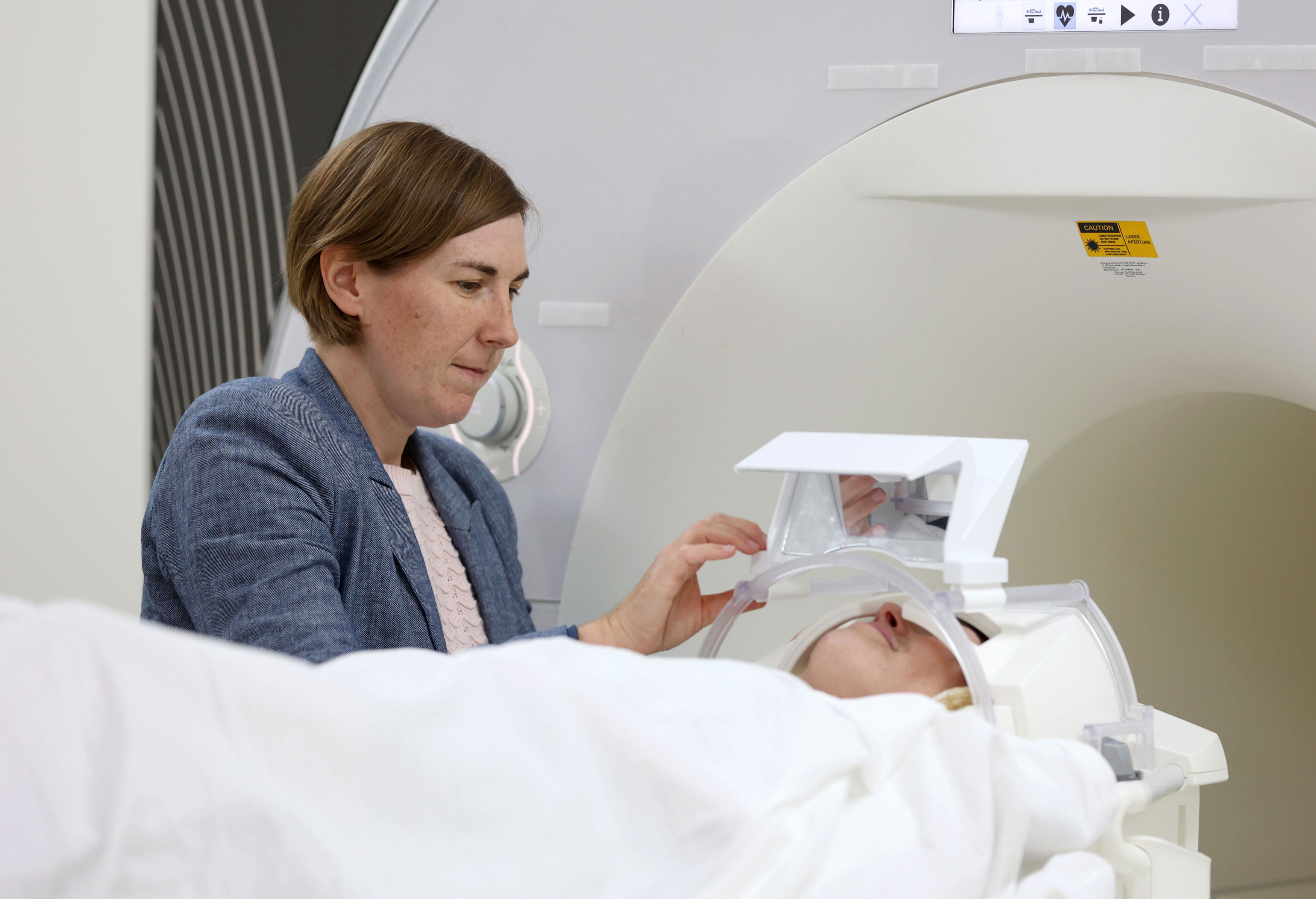
The goal is for the results from this smaller pilot study, which should be published next year, to open the door to a larger, more expansive study in the future.
It’s an opportunity that may not have happened for Kerr if it weren’t for the two MRI scanners at the OSU Biomedical Imaging Center.
“Part of this study was to also develop the hyperscanning technology. Just because you have two scanners doesn’t mean you can do hyperscanning. A lot of the work was synchronizing the two scanners, so they have the same start time, and then connecting the audio system between the two,” Kerr said.
She added that it helps that the Hardesty Center facility was built with this type of research in mind, with the MRI machines only about 20 feet apart.
“During these scans, I’m walking back and forth to make sure everything is OK, and it’s just steps away,” Kerr said. “There are very few, if any, other facilities set up that way.”
“There are very few facilities that have the capabilities to do this, as well as the prioritization of research, so you’re only going to find a handful of studies doing this. Neuroimaging research gets stuck in the constraints we have.”
Dr. Kyle Simmons is a professor of pharmacology and physiology at OSU Center for Health Sciences, director of the OSU Biomedical Imaging Center and the Roger Hardesty Endowed Chair in Clinical Neuroscience. He also worked with Kerr on the previous parent-and-child hyperscanning study.
“Kara was my graduate student and postdoctoral fellow, and since joining OSU, she’s built an independent research program that puts her among the top developmental neuroscientists in the country,” Simmons said. “She’s led the way on hyperscanning at the imaging center, working alongside our technical support team, and I think this work helps to put both her program and OSU Biomedical Imaging Center on the map for what’s possible here.”
The imaging center’s unique capabilities make it a valuable resource for neuroimaging research, Kerr said.
“There are very few facilities that have the capabilities to do this, as well as the prioritization of research, so you’re only going to find a handful of studies doing this,” she said. “Neuroimaging research gets stuck in the constraints we have. Ninety-nine percent of neuroimaging studies are a single person lying by themselves in a scanner, not interacting with anyone.”
But that’s not how people actually go through life, Kerr said, which is why hyperscanning research is so important.
“So much of our lives are interacting with people, and so much of that informs mental health and overall functioning,” she said. “It’s really important to be able to do this work where we can look at two different people’s brains while they’re interacting and see how those relate. We have a lot of important, significant relationships in our lives, and understanding what brain activity might be important in having healthy relationships could be really informative.”
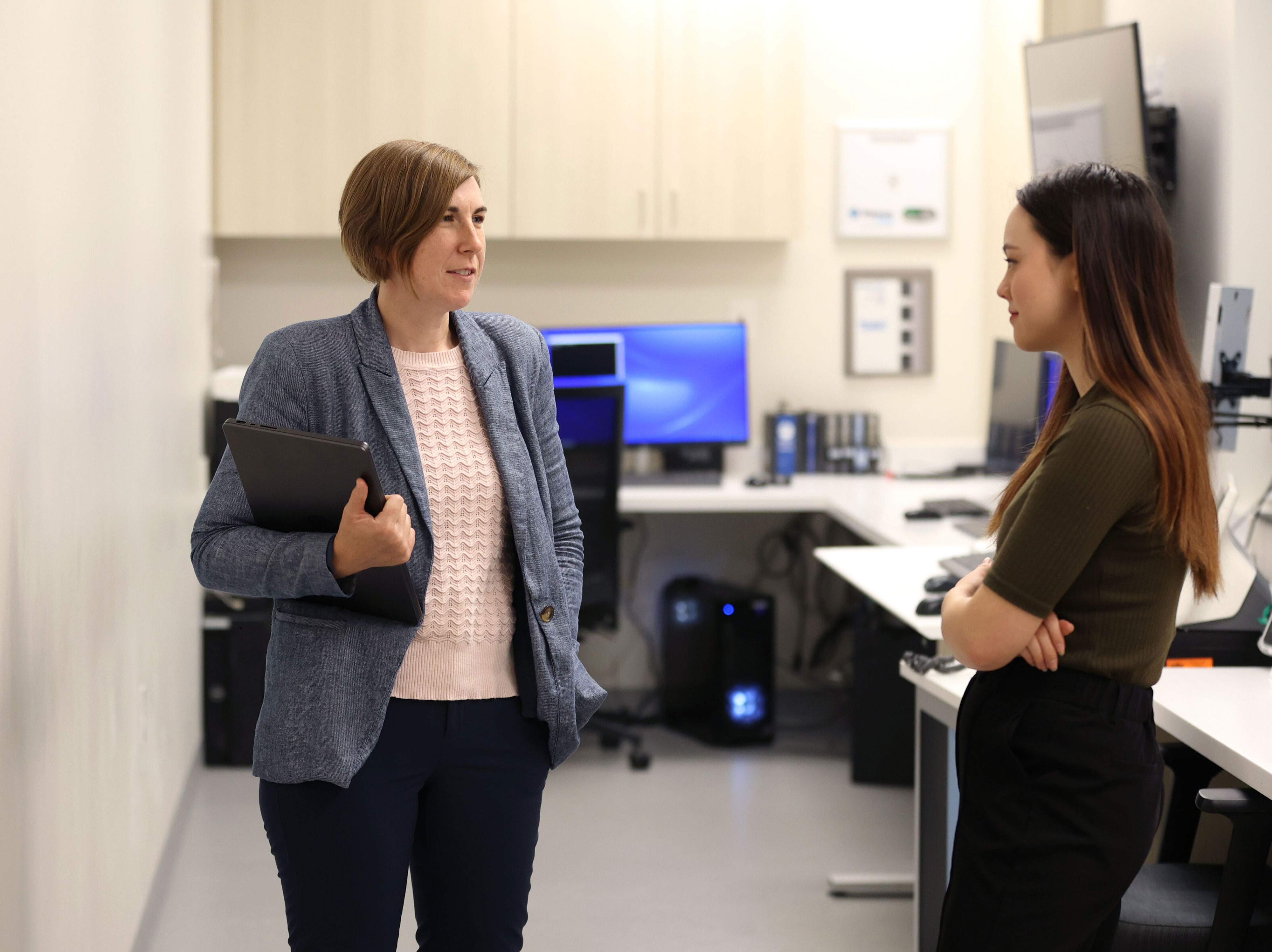
Kerr said she hopes hyperscanning becomes a more in-demand tool for researchers in neuroscience and psychology.
“For better or worse, policymakers and the public are more impacted and willing to make a change when we can show them biological and brain data,” she said. “You can tell them kids are having mental health problems, but when you put a brain image attached to that and show how social media or the pandemic or parenting affects their brains, positively or negatively, suddenly it’s real. They want that visual.”
She and Simmons are already thinking of future hyperscanning research possibilities, including one involving people and their pets; all they need is funding support.
“Kara and I would love to do a study scanning people and their dogs — an adult or child in one scanner and their dog in the scanner next door — interacting with each other. That could tell us a great deal about how humans and dogs build such meaningful relationships, and it could even help us develop pet-based behavioral health interventions,” Simmons said.
“It would need philanthropic support to get off the ground, but it would be a fun project, and I think it fits OSU’s culture. This is the home of Pete’s Pet Posse after all.”
Photos By: Matt Barnard | Research Matters Magazine
Story By: Sara Plummer | sara.plummer@okstate.edu