

OSU microbiome center marks progress midway through first phase of NIH grant
Wednesday, October 14, 2026
Media Contact: Sydney Trainor | OSU Brand Management | 405-744-9782 | sydney.trainor@okstate.edu
In the first two years of Oklahoma State University’s $10.7 million National Institutes of Health grant, the establishment of the Oklahoma Center for Microbiome Research is already accelerating discovery.
This investment supports five research projects that are now halfway through Phase 1, generating new insights while building the research infrastructure needed to advance microbiome science across Oklahoma.
“There is amazing breadth to the five research projects that fall under the umbrella of microbiome science,” said Dr. Tyrell Conway, Oklahoma Center for Microbiome Research director. “These projects are designed to illuminate the human microbiome function in ways that translate into treatments to improve human health. I am exceptionally excited about the research and proud of the scientists who lead it.”
Here’s a closer look at how several of those projects are uncovering new possibilities for human health.
Growing pains
Four of the five projects funded through the grant are led by microbiologists.
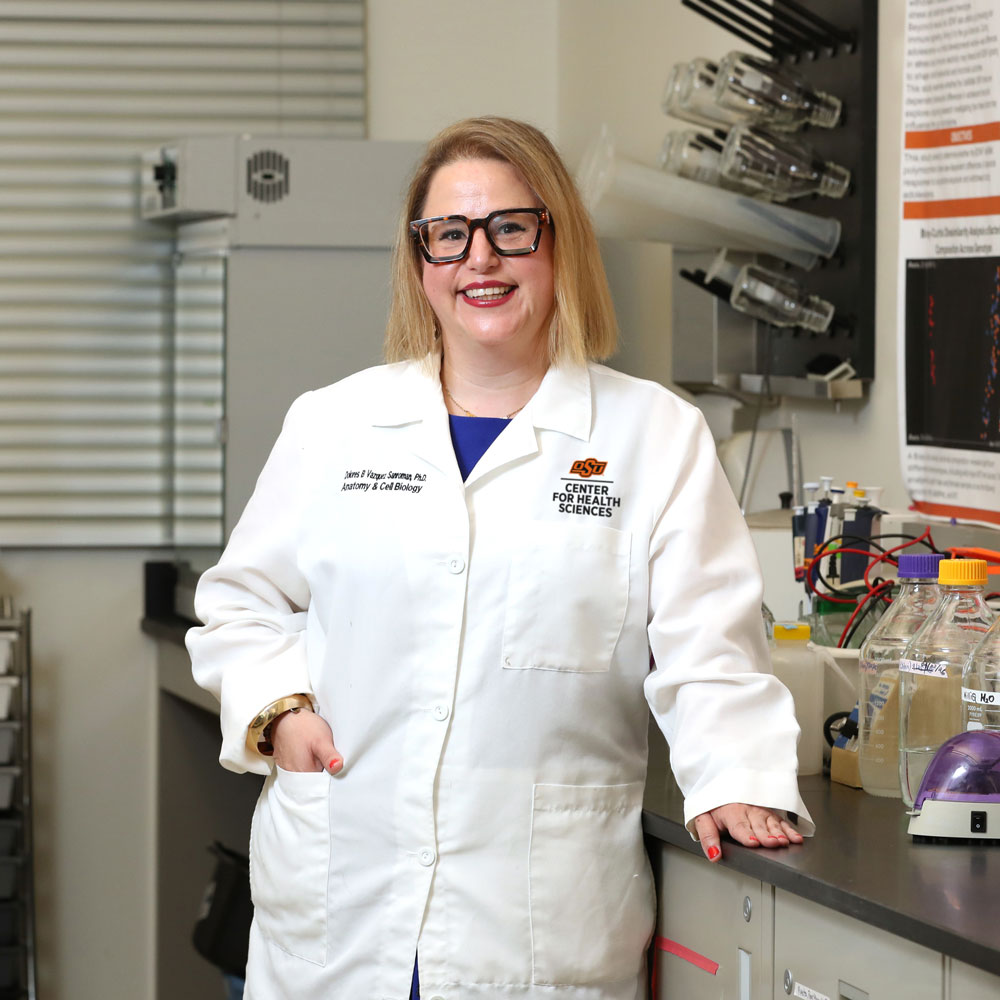
As a trained neuroscientist, Dr. Dolores Vazquez-Sanroman initially found the transition into microbiology somewhat intimidating. However, this project has provided a unique opportunity to expand her expertise and bridge neuroscience with microbiology, allowing her to transition into the emerging field of neuro-microbiology. Her background brings a distinct perspective to the research and strengthens the interdisciplinary nature of the project.
Vazquez-Sanroman, an associate professor of anatomy and cell biology at OSU’s Center for Health Sciences, is leading the project with mentorship from Drs. Gerwald Koehler and Kyle Simmons.
“My project focuses on the brain-gut axis,” Vazquez-Sanroman said. “In layman’s terms, my project is about brain-gut connection, which is the understanding of the effects of oxycodone on the adolescent microbiome, and then later, what is that brain-gut connection in the adolescent?”
Her research examines how opioid exposure during adolescence alters the gut microbiome.
Adolescence is a critical period of growth when the brain is highly adaptable and especially vulnerable to outside influences, which is why substances such as tobacco, alcohol and opioids are restricted to young people.
“What we are finding out on this project is that the adolescent microbiome is very diverse and very different from the adult microbiome,” Vazquez-Sanroman said.
Her team is isolating and identifying bacterial populations that respond rapidly to oxycodone exposure and determining how those changes affect gut motility and communication along the gut-brain axis.
“It’s very important to map out that adolescent microbiome, because their response to those new medications probably could be different,” Vazquez-Sanroman said. “From the gut motility aspect, if you are able to understand what microbiome changes are happening in that small time window, the implications are endless.”
This research is building a foundation of discovery that could lead to a broader effort to map the adolescent microbiome, creating new opportunities for diagnostics, drug discovery and targeted interventions.
“From the gut motility aspect, if you are able to understand what microbiome changes are happening in that small time window, the implications are endless.”

Defense mechanism
Dr. Reed Stubbendieck, an assistant professor of microbiology and molecular genetics, is leading a project, advised by his mentors, Drs. Matthew Traxler and Paul Lawson.
“We’re studying primarily how microbes that live in the respiratory tract interact with each other, and how might they be beneficial to us by providing defense against pathogens or germs that make us sick,” Stubbendieck said.
Many bacteria carry genes capable of producing antibiotic compounds. Stubbendieck’s team is investigating whether beneficial bacteria in the upper respiratory tract naturally produce antibiotics that suppress harmful pathogens before they can establish an infection.
After teaching himself computational biology and genome mining, Stubbendieck began analyzing the genomes of bacteria that inhabit the nose and mouth. What he found surprised him.
“I found that there was this huge potential for these bacteria to make antibiotics, and that hadn’t really been explored before,” he said. “There have been a few examples of people doing that, but what I provide is one of the first systematic surveys of this.”
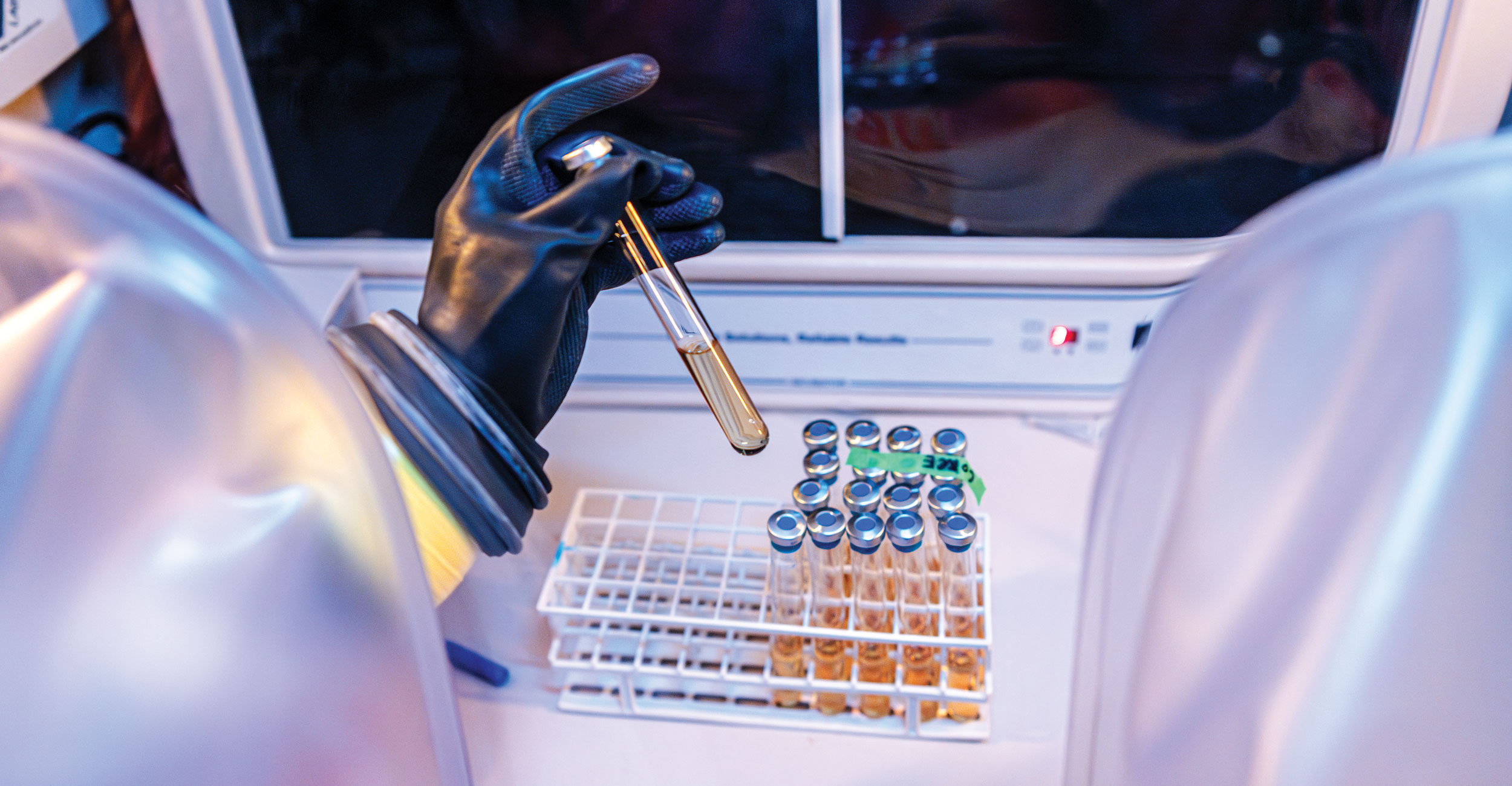
To better understand those microbial communities, the research team collected nasal and oral samples from 100 healthy members of the OSU community. They have since cultured hundreds of bacterial strains and are studying the compounds they produce.
The researchers are also examining what happens when beneficial bacteria and disease-causing pathogens are grown together. They want to know whether the presence of a pathogen triggers beneficial microbes to produce antibiotic compounds as a defense mechanism.
“Can we go and look at the microbiota of people and try to find these new antibiotics?” Stubbendieck said.
“Basically, what we’re trying to do is bridge the gap between all these viruses that only exist on a computer, and real viruses that exist physically.”
Small Wonders
The human body is home to trillions of bacteria, which also means it is home to trillions of viruses. But not all viruses infect humans. Many, known as bacteriophages, infect bacteria instead, playing an important yet largely unexplored role in the human microbiome.
Dr. Paul Kirchberger, an assistant professor in the Department of Microbiology and Molecular Genetics, is studying one of the smallest and most unknown groups of these viruses: microviruses.
“Unlike most other bacteriophages and all cellular lifeforms, microviruses have single-stranded DNA genomes and become increasingly abundant in the human gut as people age. Despite their prevalence, scientists still know little about what they do because most have never been isolated in a lab and exist only as DNA sequences identified through computational analysis of human microbiomes,” Kirchberger said.
“Basically, what we’re trying to do is bridge the gap between all these viruses that only exist on a computer, and real viruses that exist physically.”
To do that, the team synthesizes the tiny viral genomes from their DNA sequences and inserts them into bacteria. The bacterial cells then produce new viruses, allowing researchers to study microviruses that previously existed only as digital genetic data.
“The general idea is, can we manipulate these viruses so they infect different strains of antibiotic-resistant pathogens? The idea is that these viruses infect the bacterial cells, killing them, and produce more of themselves,” Kirchberger said. “These could be very promising viruses to use for phage therapy as an alternative to antibiotics.”
Photos by: Ellie Piper, Matt Barnard and Provided | Research Matters Magazine
Story By: Sydney Trainor | sydney.trainor@okstate.edu