


Smoke Screen: Development of new protective clothing for wildland firefighters brings together interdisciplinary research team
Monday, October 12, 2026
Media Contact: Sydney Trainor | OSU Brand Management | 405-744-9782 | sydney.trainor@okstate.edu
Each time firefighters respond to a fire, they’re risking more than burns — they’re facing exposure to cancer-causing chemicals that can remain on their protective clothing long after the fire is out.
Dr. Sumit Mandal, an associate professor in Oklahoma State University’s Department of Design and Merchandising, leads an interdisciplinary team of OSU researchers and state agency partners working to keep first responders safer on the job.
Firefighter personal protection equipment — specifically clothing —is designed to protect against heat and flames but often fails to prevent the toxic particles produced by soot and smoke from penetrating the fabric and reaching one’s skin.
Mandal’s research addresses this pressing occupational health concern — exposure to carcinogenic particulate matter that penetrates PPE and contributes to elevated rates of occupational cancers, particularly skin cancer.
In the Textiles and Apparel Science Laboratory, Mandal and his doctoral students developed nanofiber fabrics — fibers thousands of times thinner than a strand of human hair — that create an effective barrier against harmful airborne particles while allowing heat and sweat to escape.
Graduate research assistant Ishmam Zahin Chowdhury evaluates the lightweight material’s performance under simulated conditions, such as the hazardous environments firefighters encounter.
The goal is to develop PPE that minimizes on-site injuries and reduces the long-term health risks of repeated exposure.
Moving the nanofiber development from the lab to real-world application and use required a team of human physiology, fire dynamics and particle chemistry experts from OSU and representatives from Oklahoma Forestry Services.
The hidden threat
Wildfire smoke, while primarily consisting of released water vapor, contains many harmful chemicals, said Drew Daily, deputy fire management chief for OFS.
“Due to the rigors of the work, wearing a breathing apparatus is overly cumbersome and oftentimes prohibitive to the work that needs to be accomplished — unlike structural firefighters that generally work in more confined spaces,” Daily said. “This causes exposure to carcinogens that continue to build up over time.”
Traditionally worn PPE provides necessary thermal resistance, but it can also contain PFAS, “forever chemicals” that can be absorbed through the skin and are associated with a slew of health risks in dire need of mitigation.
Experts in human performance, Drs. Doug Smith and Jay Dawes from the School of Kinesiology, Applied Health and Recreation, assess physiologic responses to wearing different types of PPE while fighting fires.
Smith, an exercise physiologist, said it’s important to consider a firefighter’s physical welfare when working at high intensities in suboptimal conditions.
“The goal of trying to provide functional protective garments is vital to the success of firefighters and their ability to do their job — to stop fires and prevent serious injury or death to individuals stuck in or surrounded by fire,” Smith said.
Wildland firefighting PPE needs to be lightweight and flexible to facilitate strenuous work over long periods of time.
“Nanofiber technology has shown promise of mitigating many of these performance concerns by maintaining breathability and facilitating movement while filtering the harmful chemicals readily found on the fireground,” Daily said.
Modern turnout gear consists of multiple layers — often three primary protective layers: outer shell, moisture barrier and thermal liner — that work together to provide thermal insulation, moisture protection and mechanical durability.
Protective clothing is one of the only things keeping firefighters from an extremely hazardous environment. The challenge is balancing multiple competing needs.
Dr. Haejun Park, associate professor of fire, construction and emergency management in the College of Engineering, Architecture and Technology, said the layered construction provides excellent protection against direct flame and radiant heat, but it’s not designed to be completely airtight.
“Small openings around the neck, wrists, waist or interfaces between different pieces of equipment can allow hot gases and smoke particles to enter. Repeated movement during firefighting can create a pumping effect that draws contaminated air into the clothing layers,” Park said.
“Even when flames never touch the skin, heat can be transferred through the materials, resulting in smoke contaminants accumulating within the clothing.”
“The goal of trying to provide functional protective garments is vital to the success of firefighters and their ability to do their job.”
Going smaller to protect bigger
After understanding the functional needs of firefighters and how traditional PPE behaves, the TASL team began developing and testing the material that would solve the shortfalls of existing turnout gear.
The result: nanofibers, which are produced by electrospinning, a technique that uses an electric field to create an ultra fine network of fibers.
“By selecting the right materials and controlling the processing conditions, we can tailor the fiber structure for specific performance characteristics, such as thermal protection, breathability and filtration,” Chowdhury said.
The aim is to use these materials to develop fabrics that neutralize smoke particles, so that even if carcinogens are present, they are no longer harmful.
The manufacturing approach has been established, but material design and optimization remain active areas of research.
Putting it to the test
Dr. Elijah Schnitzler, an associate professor, uses his expertise in particle chemistry to focus on the chemical and physical properties of smoke from wildfires.
“We first began to collaborate with Dr. Mandal when a student in his group needed to generate realistic smoke from controlled combustion for depositing onto fabric swatches used in PPE,” Schnitzler said. “Since then, we have gone on to measure the size and filtration of smoke particles.”
Schnitzler’s group generates representative smoke particles from controlled combustion of biomass in the laboratory, measures the size distributions of the smoke particles, and measures the efficiency of particle filtration for new textiles.
Schnitzler depicted how nanoparticles behave in the atmosphere, comparing them to how a skydiver experiences resistance when falling.
“This slow settling is what allows smoke to remain suspended in the atmosphere, elevating risks of inhalation and long-range travel. Optimizing the interception of particles before they reach the skin of firefighters could help reduce this risk,” Schnitzler said.
Design and merchandising doctoral student Sayak Nandi leads the team’s carcinogenic exposure testing for invisible hazards.
When vegetation burns, carcinogens are produced and remain present in smoke and soot, including benzo[a]pyrene — a Class 1 carcinogen — along with many other Class 2A and 2B carcinogens.
“These don’t just get inhaled, they deposit on the gear and penetrate it, reaching the firefighter’s skin,” Nandi said.
“In the immediate, it may lead to redness, itching and irritation. Long-term effects can be severe, leading to DNA modifications, dysfunctional immune systems, and various other health implications, including terminal cancer.”
Since wildfire itself is uncontrolled, having a controlled lab test with similar smoke conditions is tricky, but that’s where Nandi comes in.
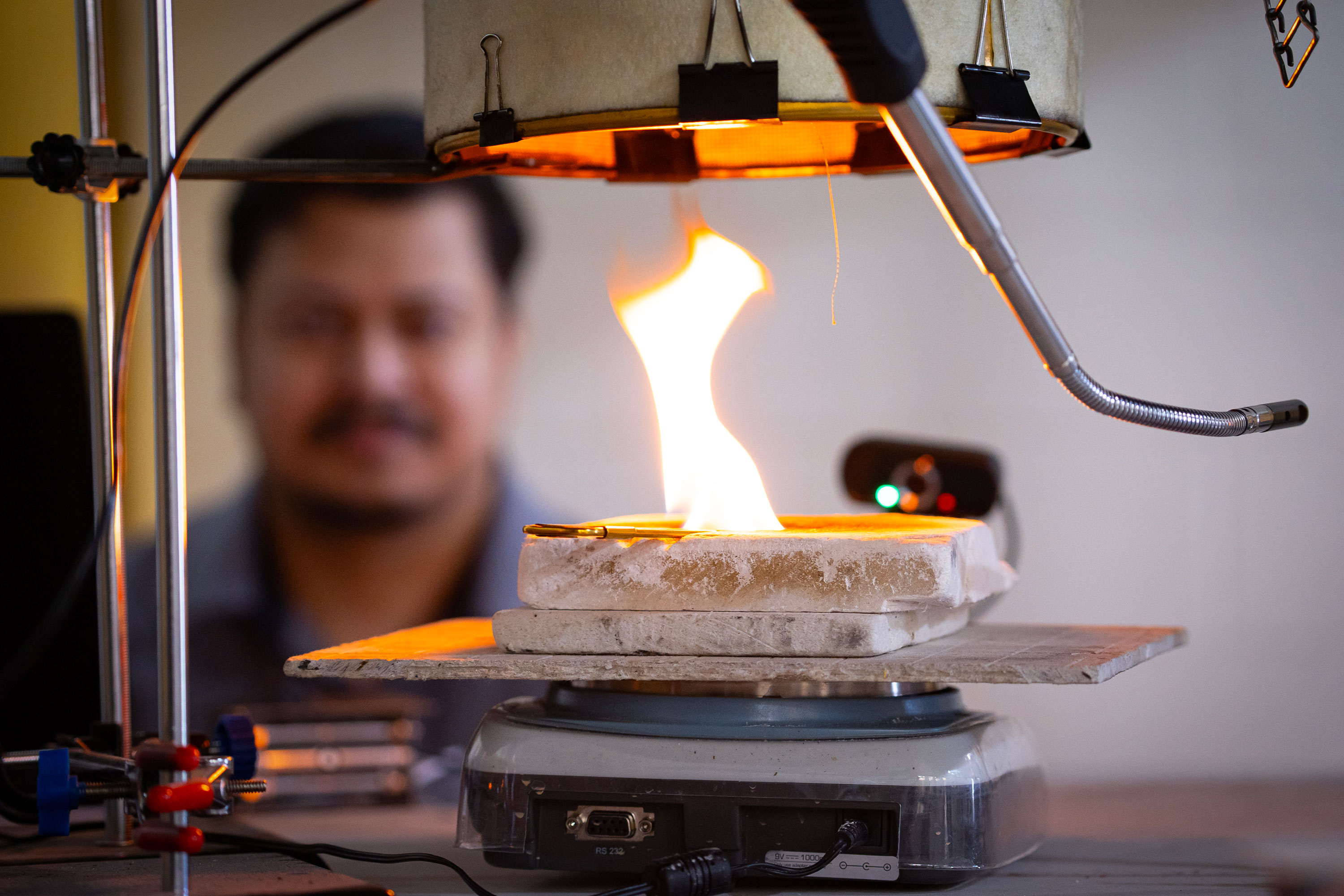
“I’ve helped design a lab-scale open burn set-up that simulates smoke exposure from wildland fire onto fabrics,” Nandi said.
He is developing a standardized testing protocol that measures smoke exposure of fabrics under realistic lab conditions, with the hope that it can serve as a benchmark to evaluate and optimize nanofabrics for use in firefighting PPE.
Durability of the nanofabrics remains one of the key investigations.
“We are evaluating how these layers hold up after heat exposure and mechanical wear,” Chowdhury said.
“Initial results are encouraging, but longer-term testing is needed before we can state an expected service life.”
Designing for the real world
The project highlights OSU’s nationally recognized expertise in functional apparel and protective clothing and demonstrates the College of Education and Human Sciences’ commitment to research that bridges fundamental science with practical application.
By combining advanced nanomaterials, textile science and human-centered design with close collaboration with the firefighting community, the research has the potential to transform firefighter PPE and reduce occupational risks for thousands of first responders.
“If we can design protective clothing that blocks invisible cancer-causing contaminants while keeping firefighters cool enough to do their jobs safely and effectively, we can make a real difference in protecting the people who protect all of us,” Mandal said.
Photos by: Eric Priddy and Kelly Kerr | Research Matters Magazine
Story By: Kirsi McDowell | kirsi@okstate.edu