


Cowboy Chronicles: A history of the Friday Afternoon Tea and Glee Society
Monday, September 7, 2026
Media Contact: Mack Burke | Associate Director of Media Relations | 405-744-5540 | editor@okstate.edu
It was the start of a new era, and an enterprising group of students decided an off-campus newspaper would facilitate communications within the university and Stillwater communities.
They would call their paper The Drummer, and its mission was to provide a platform for free expression and civil discourse, unrestricted by institutional interference.
The following represents only a small part of their story, showing how a few students found a way to share their viewpoint during the tumultuous 1960s.
College-aged “Baby Boomers” arrived in Stillwater during the fall of 1964. This wave of freshmen at the Oklahoma State University of Agriculture and Applied Science had expectations for a college education and experience that differed from those of previous classes. The role of the United States in the world had changed during their youth, and the new enrollees were curious to learn what their individual roles and opportunities would be in the future.
Their generation was so new, the baby boomer label had just appeared in a January 1963 journal article describing the impacts of increased college enrollments across the U.S. Pediatricians and public schools were already well aware of the population tidal wave moving through society. In 1946, a record 3.4 million babies were born in the U.S., a 20% increase over the previous year. Births increased to 4.3 million from 1957 to 1961. Between 1946 and 1964, roughly 78 million baby boomers joined the American population.
When the first boomers arrived for classes in Stillwater, they had different ideas for their future compared to their predecessors. Most had been raised in urban settings, and many from smaller towns and rural counties didn’t anticipate returning home after graduation.
College-aged men were facing new challenges as the U.S. expanded its military involvement in Vietnam. Troop levels in Vietnam expanded from 23,000 in 1964 to a peak of 550,000 in 1968, and annual U.S. military deaths in the conflict increased from 216 in 1964 to 16,900 four years later. The drafting of men into military service became more pronounced in 1965, the same year that OSU discontinued its required Reserve Officer Training for all men on campus.
The university itself was undergoing a difficult metamorphosis. The traditional programs emphasizing agriculture and engineering were still relevant, but increasing numbers of students majored in the arts, social sciences, business and education. By 1967, the College of Arts and Sciences accounted for 58% of the university’s total student credit hours, yet faculty salaries in its academic departments lagged behind departments in other colleges. In addition, university enrollments grew by over 40% from roughly 12,000 students in 1963 to almost 17,000 five years later.
OSU was also experiencing significant administrative changes after almost 40 years of stable leadership under presidents Henry Bennett and Oliver Willham. Dr. Robert Kamm became president on July 1, 1966, after previously serving as dean of CAS and, most recently, as vice-president for academic affairs the year before. His replacement as CAS dean, James Scales, remained at OSU for less than two years before becoming president of Wake Forest University.
One of Scales’ efforts moved the religion and Bible curriculum taught by local pastors from the College of Education to CAS, emphasizing historical context and giving less regard to denominational perspectives. At the same time, campus ministers serving local congregations were arriving from liberal theological seminaries with ideas for reform.
Amid these and other fermenting perspectives, committee members planning the annual Religious Emphasis Week met during the summer of 1966. This designated week, a college tradition for over 30 years, would be held on campus in the spring of 1967. Committee members invited Thomas Altizer to speak. His book, “Radical Theology and the Death of God,” had been published in January 1966, and Altizer had been featured in Time magazine that spring.
Only one week after Kamm’s inaugural celebrations, the new president asked to meet with the committee. Kamm, who had previously advocated for expanded academic freedom, was under growing pressure from Oklahoma religious leaders and higher education boards opposed to Altizer’s visit.
To avoid further public and political criticism already swirling statewide and to ease the burden on himself as the college’s chief representative, Kamm recommended the group withdraw Altizer’s invitation. This decision may have relaxed emotions around conservative Oklahoma, but it stirred the consciences of some faculty and students on campus.
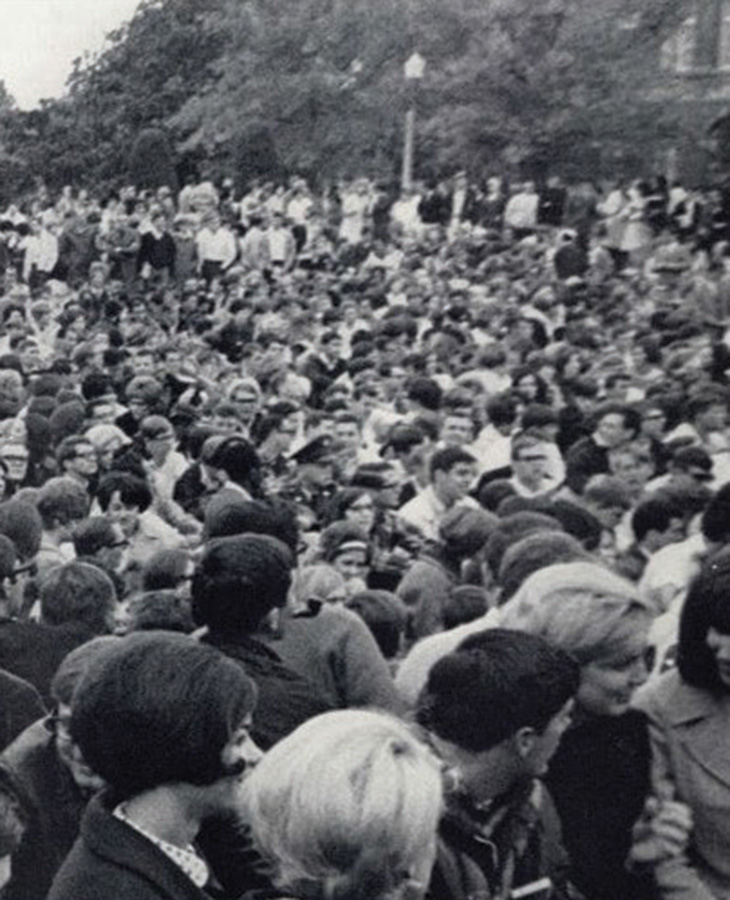
Concerns regarding academic freedom, free speech, freedom of assembly, critical thinking and due process were raised. By the spring of 1967, a series of protest gatherings had occurred on the library lawn. In March 1967, a protest attracted 400 to 500 from the campus community, a month later, roughly 1,200, and at the end of the semester, 2,000. All were non-violent, peaceful assemblies with respectful attention shown to the speakers.
During the May gathering, faculty members from the sociology department announced their resignations in protest. Ultimately, all nine would leave the institution by the summer. Faculty in other departments would transfer elsewhere, some faculty salaries were frozen, the first Honors College director would be pressured to leave, and graduate students withdrew from campus. A Board of Faculty Representatives was formed, and the local chapter of the American Association of University Professors became more involved.
To ease the tension, Kamm created a Great Issues Committee, with faculty and student representatives, to coordinate invitations for outside speakers. This led to mixed results and later to additional conflicts.
While the trials of academia churned around them, a small group of students, many of them with ties to the Methodists’ Wesley Foundation, created an off-campus newspaper named The Drummer. It cost 10 cents. They ran into administrative hurdles when attempting to sell and distribute them on campus. With diligence, perseverance, and an emphasis on working through appropriate channels, they were eventually able to overcome most publishing and distribution obstacles.
After The Drummer staff were initially denied a charter as an official campus organization, they looked to the past. While going through existing approved charters, a few individuals discovered The Friday Afternoon Tea and Glee Society (FATAGS).
It was serendipitous that this group of students chose that charter, as its founding coincided with another act of student protest a half-century earlier. The original FATAGS gatherings occurred circa 1914, consisting of coeds who had a creative solution to their own challenging circumstances.
The Oklahoma State Board of Agriculture, serving as the Board of Regents, banned Greek social organizations between 1908 and 1916. The U.S. War Department then required colleges with the Student Army Training Corps to suspend Greek social organizations during WWI from 1917 through 1918.
Not to be deterred, coeds created social groups with innocent names such as The Owls and Afternoon Tea. The Afternoon Teas met at a “sponsor’s” home near campus on Friday afternoon. They later transitioned into the Alpha Thetas, and eventually, a Greek social organization known as Kappa Alpha Theta was established in 1919 when the ban was lifted.
However, their original charter remained as an approved campus group, but without any new members until 1967, when the baby boomers rediscovered it.
FATAGS was reborn with a new mission to distribute The Drummer.
As an authorized group, they qualified for the use of campus facilities and requested space for meetings and tables in the Student Union. Many of FATAGS’ informal meetings occurred at the Hideaway. Over the next two years, 15 issues of The Drummer were published. Initially, only four pages, the paper quickly grew to eight, then up to 12 and 16 pages.
The paper was produced at a local residence and printed in Edmond when local news printers were unavailable. The student editors pasted articles, photographs and other items onto a board for each page in preparation for printing. A journalism faculty member assisted them in locating the off-site printer.
The first issue stated, “…we hope to make you laugh, maybe cry once in a while, but first of all THINK…hoping to fill this void with a balanced fare of thought-provoking articles and a smattering of humor thrown in.”
The paper covered world and campus affairs, arts, theology, and science with editorials, cartoons, opinions and occasional essays dripping with sarcasm. There were in-depth stories regarding the war, racism, women’s rights and interviews with campus visitors such as Barry Goldwater and Julian Bond. The paper supported critical thinking, civil discourse, and free expression.
Throughout the past 60 years, the core group of students representing FATAGS has continued to meet periodically on campus and gathered again this past summer. They support university programs, provide outlets for critical conversations, endowed the annual Stockton/Brooks Lecture to share perspectives on academic freedom and free speech, and established the Dambach Peacebuilder Endowed Fellowship.
Over 100 years since its founding and through two eras of turmoil, FATAGS remains a remarkable group of OSU alumni who continue to encourage and engage in productive civil discourse while remaining loyal and true.
*A complete collection of The Drummer is housed in the OSU Special Collections and University Archives Department.
Photos by: OSU Archives
Story by: David C. Peters | STATE Magazine